24 Companies Bid for LH-Ordered 3rd New Town Project
Active in Non-Residential Projects Including Railroads
Securing Liquidity and Hiring On-Site Workers Amid Construction Slump
Small and medium-sized construction companies are actively competing to win public construction contracts to overcome the housing market downturn. Although the profits are not as high as private projects, public projects are attractive because they secure liquidity and allow continuous utilization of manpower.
Intense Competition Among Small and Medium Construction Companies for Public Projects
According to the industry on the 26th, on the 19th, two mid-sized construction companies competed in the ‘Daejeon Daedong 2 Residential Environment Improvement Project 1 and 2 Block Apartment Construction and Development’ ordered by Korea Land and Housing Corporation (LH). Kumho Construction and Taeyoung Construction competed, with Kumho Construction gaining the upper hand. Kumho Construction formed a consortium with DL E&C and Gyeryong Construction to build a complex apartment consisting of 19 buildings, ranging from 2 basement floors to a maximum of 35 floors above ground, totaling 1,420 households in the area of 33 Daedong, Dong-gu, Daejeon and 447 Yongun-dong. The total contract amount is 270.3 billion KRW, with Kumho Construction securing about 50% (135.1 billion KRW) of the construction share.
Dongbu Construction and Gyeryong Construction Industry formed a consortium with Daewoo Construction and were selected on the 21st as the preferred negotiation candidates for private participation projects in four complexes: Hanam Gyosan A2 Block and Namyangju Wangsuk B1, B2, A3 Blocks of the 3rd New Town. Dongbu Construction and Gyeryong Construction Industry will each handle 19.5% (144.6 billion KRW) of the total contract amount (approximately 741.4 billion KRW). The proportion of these amounts in their sales is about 7.61% and 4.86%, respectively. Private participation projects are projects where public implementers such as LH and private construction companies jointly supply public housing. According to the Ministry of Land, Infrastructure and Transport’s ‘Construction Market Recovery Support Plan’ announced in March, LH is expanding the proportion of private participation projects to start construction of the 3rd New Town within the year and to recover the construction market. By 2027, LH plans to release 30% of its total approved volume through this method.
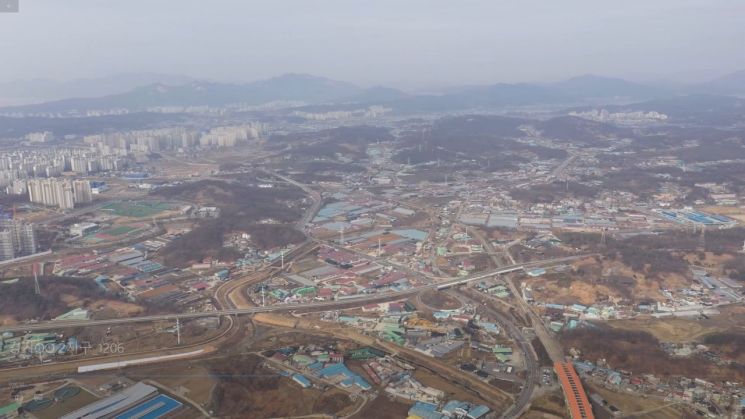
In the bid for the ‘Incheon Gyeyang Technovalley Public Housing District Development Project Section 2 (LH)’ held in April, a total of 24 companies including Geukdong Construction, Daebo Construction, Gyeryong Construction Industry, Ssangyong Construction, Hanshin Engineering & Construction, and Hoban Construction participated. More than 20 construction companies also challenged the bid for the ‘Bucheon Daejang Public Housing District Development Project Section 2’ held a month earlier.
They are also actively winning non-residential projects. Dongbu Construction succeeded in winning the ‘Chuncheon~Sokcho Railway Construction Section 2 Roadbed Construction (contract amount 204.8 billion KRW)’ ordered by the Korea Rail Network Authority on the 19th. Hanshin Engineering & Construction also won the ‘Chuncheon~Sokcho Railway Construction Section 5 Roadbed Construction (183.3 billion KRW).’ Kolon Global won contracts for the ‘Chuncheon~Sokcho Railway Construction Section 8’ and the ‘Gangneung~Jejin Section 6 Roadbed Construction,’ with a total contract amount of 175 billion KRW.
Public Projects as a Breakthrough for Economic Downturn
As the housing market shrinks due to the sluggish construction market, mid-sized construction companies are using public projects as a breakthrough. A representative from a mid-sized construction company explained, “Sales are only happening in some parts of the metropolitan area including Seoul, and even then, it is mostly dominated by large companies, so they are trying to secure cash liquidity through public projects.” He added, “When the market was good, the proportion of private projects was high, but when the real estate market declines like now, they try to balance private and public volumes.”
Unlike private projects, where the frequency of winning contracts varies depending on the market conditions, public projects have the advantage of a steady supply of volume. According to the Korea Construction Industry Research Institute’s real estate market trend data, domestic public orders in April amounted to 4 trillion KRW, an increase of 9.6% compared to a year ago and 100 billion KRW higher than usual. This contrasts with private orders (11.1 trillion KRW), which decreased by 1.4 trillion KRW compared to previous years.
From a manpower management perspective, winning public construction contracts is necessary. To continue employing the site workers hired during the real estate boom, it is necessary to maintain construction sites at a certain level. An industry official said, “If site workers are not rotated, they have to be retired, so public construction orders are increasing to secure work.”
© The Asia Business Daily(www.asiae.co.kr). All rights reserved.

















