Over the past decade, South Korea has led patent applications for ‘Intelligent Internet of Things (AIoT)’ technology aimed at preventing natural disasters. Intelligent Internet of Things refers to technology that combines the Internet of Things (IoT) and Artificial Intelligence (AI).
According to the Korean Intellectual Property Office (KIPO) on the 24th, AIoT-based disaster prevention patents filed with major patent offices (Korea, US, China, Europe, Japan, hereafter IP5) from 2012 to 2021 increased by an average of 19.5% annually.
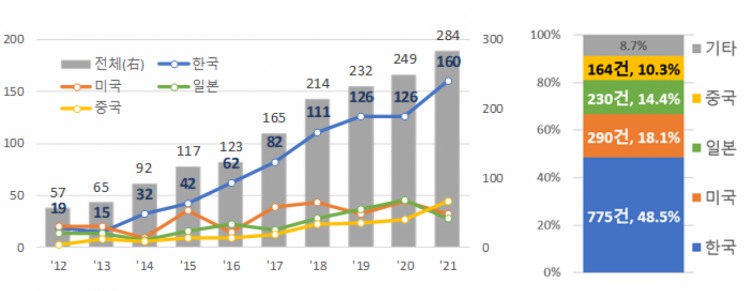 Trends in AIoT-based Disaster Prevention Technology Patent Applications by Nationality from 2012 to 2021. Provided by the Korean Intellectual Property Office
From 2012 to 2021, a total of 1,598 AIoT-based disaster prevention patents were filed with major patent offices. Among these, 775 applications were from South Korea, accounting for 48.5% of the total, ranking first. During the same period, the United States filed 290 patents (18.1%), Japan 230 patents (14.4%), and China 164 patents (10.3%).
It is noteworthy that the number of AIoT-based disaster prevention patent applications filed in South Korea is 2.7 times higher than that of the second-largest filer, the United States. The Korean Intellectual Property Office expects South Korea’s dominance in AIoT-based disaster prevention technology to continue for the time being.
In terms of top applicants, Samsung Electronics ranked first with 36 applications, followed closely by LG Electronics with 35 applications. Sky Motion (32 applications), Qualcomm (29 applications), and InterDigital (26 applications) rounded out the top five.
AIoT-based natural disaster prevention technology collects big data such as satellite data, weather data, and IoT sensor data, then uses artificial intelligence learning to predict damage situations and provide evacuation routes based on location information.
Regarding the types of disasters covered by AIoT-based natural disaster prevention patents, geological disasters accounted for the largest share at 51.4%, followed by wind and flood disasters (23.9%), meteorological disasters (17.0%), and marine disasters (7.7%).
The patent application growth rate was most prominent in the wind and flood disaster sector, recording an average annual increase of 28.9%. This is believed to be due to the recent global surge in wind and flood disasters, increasing demand for related prevention technologies.
According to the United Nations Office for Disaster Risk Reduction, floods increased 2.3 times from 2000 to 2020 compared to the previous 20 years (1980?2000). Additionally, the World Meteorological Organization pointed out that “the warming trend in the Asia region is progressing much faster than the global average, making urgent national support and information provision necessary to respond to rapidly changing weather conditions.”
The international community’s focus on AIoT-based natural disaster prevention technology is closely related to the increase in natural disasters caused by climate change.
Furthermore, Market and Markets Research predicts that the global intelligent Internet of Things market for natural disaster monitoring will grow from $6.68 billion in 2023 to $37.32 billion by 2030. This represents an average annual growth rate of 27.9%, indicating that competition to secure AIoT-based disaster prevention patents is likely to intensify in the future.
Hwang Yoon-gu, Director of the IoT Examination Division at the Korean Intellectual Property Office, said, “As abnormal weather increases natural disasters, global interest in AIoT-based natural disaster prevention technology is also rising. The development of this technology is expected to contribute to reducing damage caused by natural disasters.”
He added, “The Korean Intellectual Property Office will enhance the value of technologies that protect the lives and property of the public and ensure that high-quality examinations and timely provision of related statistical data enable widespread utilization.”
© The Asia Business Daily(www.asiae.co.kr). All rights reserved.
![Clutching a Stolen Dior Bag, Saying "I Hate Being Poor but Real"... The Grotesque Con of a "Human Knockoff" [Slate]](https://cwcontent.asiae.co.kr/asiaresize/183/2026021902243444107_1771435474.jpg)
















