Daishin Securities Leads 150 Billion KRW Liquidity Securing
Fuel Cell Power Plant Construction Receivables Secured in 6 Sites Including Hwaseong Songsan
Seeking Financing Amid Subsidiary Merger and Sale Uncertainties
Financial Deterioration Due to Large-Scale Environmental and Energy Investments
As the restructuring clock of SK Group accelerates, SK Ecoplant has raised funds by utilizing construction costs (accounts receivable) from six fuel cell projects it undertook as a contractor. This move to secure liquidity involved transferring construction accounts receivable to capital market investors. It is interpreted that the company sought alternative financing amid speculation that it could become a sale target during the group’s restructuring process and due to deteriorating financial conditions.
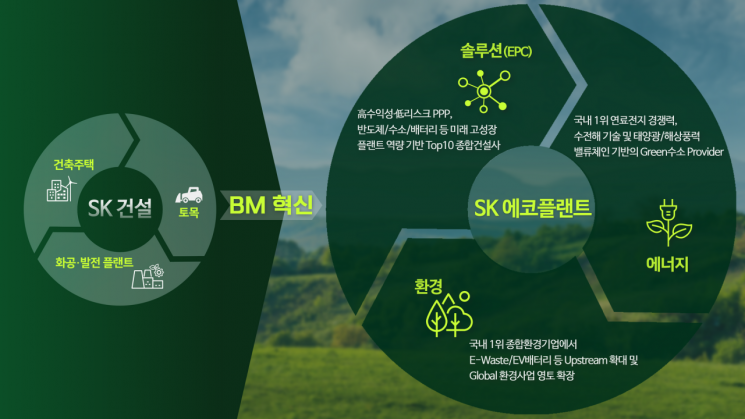
According to the investment banking (IB) industry on the 24th, SK Ecoplant raised 150 billion KRW in funds with Daishin Securities as the lead manager. The method involves transferring the construction costs to investors after winning the contract work. When the construction costs are received from the client, the company uses that money to pay principal and interest to investors, effectively receiving the investment funds in advance.
SK Ecoplant provided construction costs as collateral for six comprehensive design and construction (EPC) fuel cell power plants. These include the Hwaseong Songsan Fuel Cell Power Plant and Yanggam Fuel Cell Power Plant in Gyeonggi Province, the Ham-an Sannae Industrial Complex Fuel Cell Power Plant and Changwon Distributed Fuel Cell Power Plant in Gyeongsangnam-do, the Boeun Fuel Cell Power Plant in Chungbuk, and the Chilgok Yakmok Fuel Cell Power Project in Gyeongbuk. For some of these power plants, SK Ecoplant jointly undertakes EPC construction with its affiliate SK D&D.
SK Ecoplant also participates as an investor alongside other power producers in special purpose companies leading these fuel cell power projects. It holds stakes in Songsan Green Energy (10%), Chorok Energy (26%), Ham-an Green Energy (10%), and Changwon Nuri Energy (10%). It is also known to have invested with its affiliate SK D&D in Kumyang Eco Park and Yakmok Eco Park.
The reason SK Ecoplant raised funds using future construction costs is due to the worsening financing environment for construction companies, including rising borrowing rates. SK Ecoplant’s credit ratings are A- (corporate and corporate bonds) and A2- (short-term credit rating). Recently, demand for construction bonds has shrunk, making it difficult to secure bond investment demand, and even when demand is secured, interest rates are set at very high levels.
As the company expanded investments from construction into environment and energy sectors, its financial situation also deteriorated. SK Ecoplant’s borrowings surged from around 1 trillion KRW in 2019 to over 6 trillion KRW by the end of the first quarter this year. Net borrowings, calculated by subtracting cash equivalents from total borrowings, also rose from about 200 billion KRW to nearly 5 trillion KRW during the same period. Annual operating profit shrank from the 400 billion KRW range to 175 billion KRW last year.
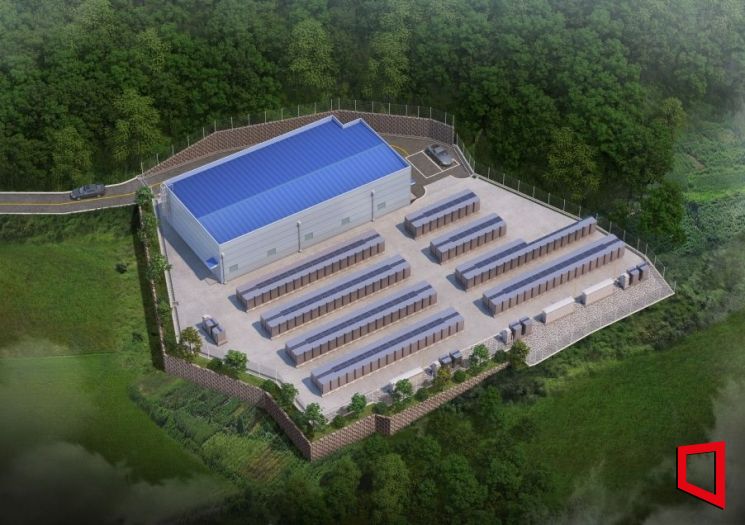 SK Ecoplant has received an EPC order for Yakmok Ecopark as a consortium with SK D&D, aerial perspective rendering.
Recently, as SK Group undertakes restructuring across the entire group, there is speculation that SK Ecoplant could be subject to divestment. A source in the capital market said, "SK Ecoplant has mainly borrowed funds to execute large-scale capital expenditures (CAPEX) in the environment and energy sectors," adding, "The overall financial condition worsened as the pace of visible returns on investments lagged."
Due to various uncertainties, it is understood that the company raised funds through indirect channels beyond corporate bonds or general bank loans. SK Ecoplant previously received a 30 billion KRW loan underwritten by Hanyang Securities. It is reported that Hanyang Securities lent funds to SK Ecoplant through a special purpose company (SPC) and then sold (sell-down) the short-term securities to institutional investors.
An IB industry official said, "SK Ecoplant secures many contracts for affiliate projects requiring confidentiality, such as semiconductor and battery factories, so it is unlikely to be a target for management rights sale during the group restructuring," but added, "However, due to various uncertainties, it is not easy to raise funds through conventional means like corporate bonds, so the company will need to explore diverse financing methods such as accounts receivable securitization."
© The Asia Business Daily(www.asiae.co.kr). All rights reserved.


















