Population Peak at 51.75 Million in 2024 → 46.27 Million in 2052
Decline Accelerates from 2037, Decreasing by 200,000 Annually from 2041
Regional Population Declines Since 2019, Capital Area Population Grows Until 2033
Long-term Population Decline Increases Housing Demand Volatility
Urgent Need for Housing Policies and Industrial Changes Addressing Demographic Structure
Starting from 2025, the national population is expected to enter a declining trend, which is anticipated to intensify in the long term, highlighting the need for fundamental changes in housing policies.
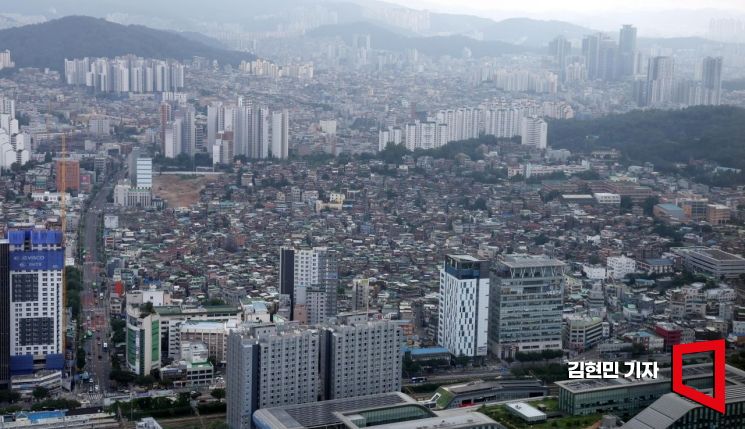 View of the Noryangjin redevelopment site in Seoul from the 63 Building observatory. Photo by Hyunmin Kim kimhyun81@
On the 23rd, the Korea Research Institute for Construction Industry (KRICI) stated in its Construction Trend Briefing, "Until now, South Korea's construction and housing markets have operated based on policies and industrial systems responding to population growth and excess demand. However, from next year, as the country enters a population decline phase, this decline signifies a structural change in demand different from the past, necessitating appropriate responses."
According to the future population projections announced by Statistics Korea in April and May, the national population is expected to peak at 51.75 million this year, then shift to a declining trend from 2025, decreasing to 46.27 million by 2052. The annual decline rate is projected to be around 0.2% until 2036, after which the decline will accelerate from 2037, with an expected annual population decrease of over 200,000 starting in 2041. The proportion of the working-age population (ages 15?64) is estimated to fall from 71.1% in 2022 to 51.4% in 2052.
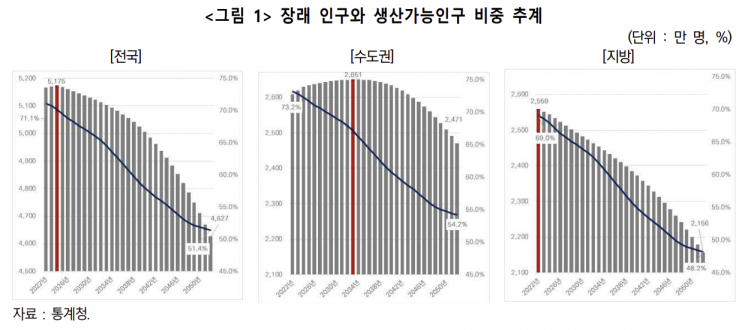 Future Population, Working-Age Population Proportion Projections (Data=KISDI, Source=Statistics Korea)
The population in provincial areas began to decline from 2019, while the population in the Seoul metropolitan area is expected to continue increasing until 2033. The metropolitan population is projected to grow by more than 30,000 annually until 2027, then slow to less than 20,000 annual increases from 2030, reaching a peak of 26.51 million in 2033.
The provincial population peaked in 2018 and has been declining through 2022. This decline is expected to continue until 2052, with a projected decrease of 4.03 million from 2022 levels, falling to 21.56 million. The annual population decrease is estimated to be around 100,000 between 2025 and 2035, and is expected to exceed 100,000 annually thereafter.
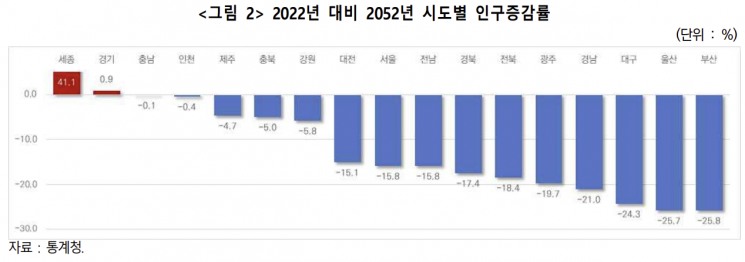 Population Growth Rate by City and Province in 2052 Compared to 2022 (Data=Konsanyeon, Source=Statistics Korea)
Notably, after 2052, population decline is expected in all provinces except Sejong and Gyeonggi. The Yeongnam region is projected to decrease by more than 20%, while the Honam region, Gyeongbuk, and Daejeon are expected to decline by over 15%.
Looking at the population change rates by region 30 years from now, Busan (-25.8%), Ulsan (-25.7%), Daegu (-24.3%), and Gyeongnam (-21.0%) show significant decreases, followed by Gwangju (-19.7%), Jeonbuk (-18.4%), Gyeongbuk (-17.4%), Jeonnam (-15.8%), and Daejeon (-15.1%). Seoul is also expected to decrease by 15.8%, but Gyeonggi (0.9%) is projected to increase, and Incheon (-0.4%) is expected to remain stable. Sejong (41.1%) is the only region forecasted to experience population growth.
Researcher Heo Yoon-kyung of KRICI explained, "The 2022 baseline projections by Statistics Korea revised the 2020 baseline projections, showing a steeper population decline after 10 years. Although an increase in migration-related population has somewhat slowed the decline over the next decade, the sharp drop in birth rates is estimated to have a negative impact on long-term population growth."
As of 2022, the number of deaths exceeds births, resulting in natural population decline. The number of births is expected to increase from 246,000 in 2022 to 280,000 in 2036, but deaths are projected to rise from 360,000 in 2022 to 480,000 in 2036, a larger increase. Natural population decline nationwide is estimated to reach 512,000 by 2052. The population projections also indicate increased volatility in housing and construction market demand due to the long-term intensifying decline.
KRICI emphasized the urgent need to introduce housing policies that respond to low birth rates and changing population structures. Until now, housing supply and financial support have been mainly operated by the public sector, including special supply for newlyweds and families with multiple children, and special newborn housing loans. However, there have been consistent criticisms that existing policies have not produced substantial effects. In response, the government announced on the 19th a 'Plan to Reverse the Low Birthrate Trend,' which includes significantly expanding special supply quotas for newlyweds and temporarily relaxing loan income requirements up to 250 million KRW.
Researcher Heo stated, "For various policies to have real effects, support must be provided not only at the individual household level but also through organic linkage with related policies such as expanding residential infrastructure and housing services. There are numerous housing policy challenges, including expanding housing support programs for the elderly, housing area redevelopment linked with employment and transportation in provinces experiencing rapid population decline, addressing the increase in vacant houses, and providing housing support for migration-background populations."
Heo also emphasized, "The industrial environment will change rapidly, and improvements in industrial structure must follow, including responding to increased consumer demands for quality and safety, and shifting business models and portfolios from sales-centered to ownership and operation."
© The Asia Business Daily(www.asiae.co.kr). All rights reserved.



















