The Supreme Court has ruled that if a former employee belatedly claims compensation for a job-related invention, the payment eligibility must be reviewed based on the regulations in effect during their employment.
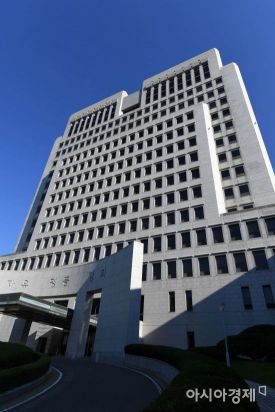 Supreme Court. [Image source=Asia Economy DB]
According to the legal community on the 23rd, the Supreme Court's Second Division (Presiding Justice Kwon Young-jun) overturned the lower court's ruling against Mr. A in a lawsuit he filed against Samsung Electronics for compensation related to a job-related invention on the 30th of last month, and remanded the case to the Patent Court.
Mr. A joined Samsung Electronics in 1989 and worked as a senior researcher, inventing 10 technologies related to washing machine filters and transferring the patent rights to the company in August 1997. After filing the patent application, the company sold washing machines equipped with the filters developed by Mr. A starting in 1999. Mr. A resigned in 1998.
About 17 years after his resignation, in November 2015, Mr. A requested compensation from the company for six of the technologies. According to the Invention Promotion Act, when an employee invents something at the company and transfers the patent rights to the company, the company must provide fair compensation to the inventor.
Samsung Electronics rated five of Mr. A’s inventions as 'Grade B' and decided to compensate a total of 58 million KRW considering the period of technology application, but Mr. A raised objections, leading to a lawsuit.
The key issue in the trial was the statute of limitations for the compensation claim. The statute of limitations for claims related to job-related invention compensation is 10 years, similar to general claims, meaning that if the right is not exercised within 10 years, the claim is generally forfeited.
The question was when the 10-year period starts. Generally, it is considered to start from the time the employer succeeded the patent rights, but if the work regulations specify the payment timing, the 10 years are counted from when the payment is due.
Samsung Electronics’ 'Job-Related Invention Compensation Guidelines,' revised in 1995, stipulated the payment timing as "when the patent is recognized to have significantly contributed to company management by being applied to company products, and after review by related departments and committees and approval by the CEO." In other words, the company's decision to pay compensation marks the start of the statute of limitations calculation.
On the other hand, the new compensation guidelines implemented on January 1, 2001, did not specify a separate payment timing. Accordingly, the Patent Court, which reviewed the second trial, ruled that the statute of limitations should start from January 1, 2001, and based on this standard, Mr. A’s claim had expired.
However, the Supreme Court’s judgment differed. The Supreme Court held that since Mr. A had already resigned, the 2001 compensation guidelines could not be applied. The 1995 guidelines should apply to Mr. A, so the statute of limitations had not elapsed, and his right to claim compensation was still valid, thus overturning and remanding the lower court’s decision.
However, the Supreme Court did not rule on whether the company’s decision to pay Mr. A 58 million KRW was appropriate. The Patent Court, which received the case back, will re-examine this part.
© The Asia Business Daily(www.asiae.co.kr). All rights reserved.
















