China and Germany discussed issues including the EU's high tariffs on Chinese electric vehicles recently sold in the European Union (EU) during a high-level meeting on the 22nd, but failed to narrow their differences.
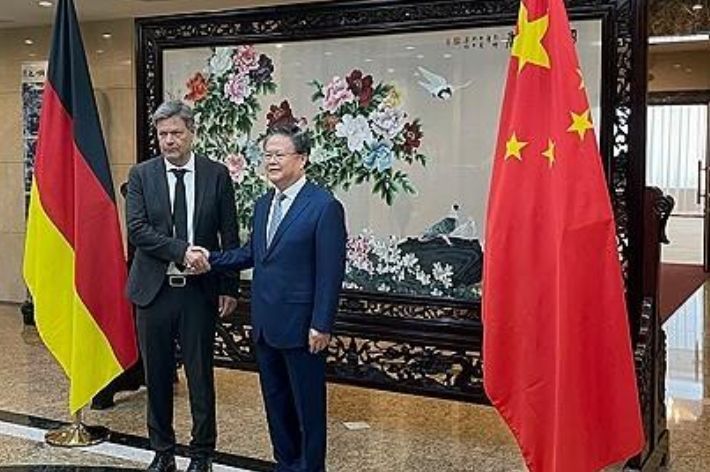 During his visit to China, Robert Habeck, Vice Chancellor of Germany, co-chaired the 1st High-Level Dialogue on Climate Change and Green Transition between China and Germany with He Lifeng, Director of the National Development and Reform Commission (NDRC) of China, on the 22nd.
 [Image source=Yonhap News]
On the morning of the same day in Beijing, Robert Habeck, Germany's Vice Chancellor, co-chaired the first high-level dialogue on climate change and green transition between China and Germany with Zheng Shanjie, Chairman of China's National Development and Reform Commission (NDRC).
Vice Chancellor Habeck is the first senior European official to visit China since the EU announced plans to raise tariffs on Chinese electric vehicles by up to 48%.
During the meeting, China pointed out the unfairness of the EU's tariff imposition and warned that the Chinese government would take resolute countermeasures.
According to Xinhua News Agency, Chairman Zheng stated, "The EU's tariff increase on Chinese electric vehicles only harms others and does not benefit itself," adding, "China will take all necessary measures to protect the legitimate rights and interests of Chinese companies."
He further claimed, "The development of China's new energy industry is the result of comprehensive advantages in technology, market, and industrial systems," and argued, "Foreign brands are increasing their investments in China not because of 'subsidies' but due to China's excellent systems and skilled labor market."
On the other hand, Vice Chancellor Habeck pointed out China's support for Russia in the Ukraine war while expressing willingness to engage in dialogue with China.
Germany, as Europe's largest automobile producer, has maintained a relatively critical stance toward the EU's decision to impose tariffs on Chinese electric vehicles. However, this meeting is also analyzed as focusing on minimizing the damage to domestic companies caused by the EU's tariff measures.
According to Bloomberg News, Vice Chancellor Habeck stated in his opening speech at the high-level dialogue, "China's support for Russia in the Ukraine war is a major cause of the deterioration in economic relations between Berlin and Beijing."
He also emphasized the inevitability of the EU's tariff imposition on Chinese electric vehicles, saying, "Unlike the comprehensive and punitive tariffs imposed by the United States, T?rkiye, and Brazil, these are differentiated tariffs carefully reviewed over nine months," and stressed that the EU is willing to engage in dialogue with China.
The EU's tariff measures on Chinese electric vehicles will take effect from the 4th of next month, but to be fully confirmed, they must be approved by a qualified majority vote of the 27 member states by November.
Regarding this, Vice Chancellor Habeck said in a statement, "There is time for the EU and China to discuss until November," adding, "If a phase where negotiations are possible opens, discussion and dialogue are important."
© The Asia Business Daily(www.asiae.co.kr). All rights reserved.

















