US Joint Research Team Discovers Evidence of "More Than One Species of Leech Jumping" During Madagascar Expedition
"Evidence of Leech Jumping by More Than One Species"
The jumping behavior of terrestrial leeches, which has been a subject of debate for over 100 years in Madagascar, Africa, was captured on camera for the first time.
On the 21st (local time), a joint research team from the American Museum of Natural History, Fordham University, and the City University of New York (CUNY) announced in the biological journal Biotropica that "during an expedition in Madagascar, the terrestrial leech Chtonobdella was observed twice jumping by bending like a spring on a leaf."
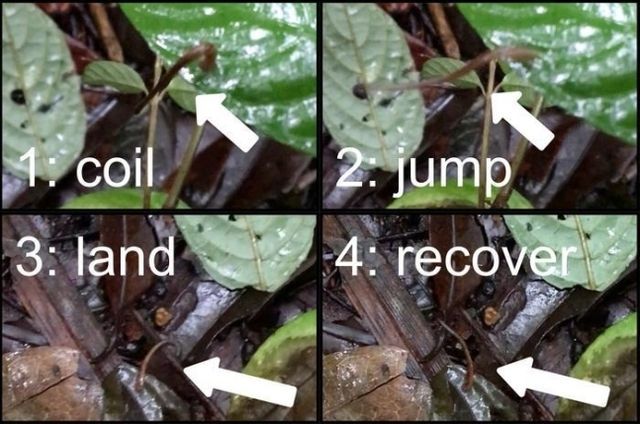
Dr. Mai Pami of the American Museum of Natural History stated that this provides definitive evidence that at least one species of terrestrial leech can jump, settling a debate that has lasted for more than a century.
Dr. Pami explained, "There have been reports of leeches jumping around, but these were often explained as them hitting branches or falling and attaching to passersby. This discovery dispels such claims."
Among insect larvae, many individuals have been found to bend their bodies like a ring and then leap into the air. However, except for some travelers' eyewitness accounts, there has been little concrete evidence regarding leeches, making it a long-standing topic of debate.
The photos posted by the research team show the Chtonobdella leech bending its long body backward like a cobra or pulling its body back like a spring before stretching out and leaping into the air.
Dr. Pami said, "It is unknown how often leeches perform this action or whether they use this ability to find hosts to feed on blood. However, since multiple jumps were captured in two short recordings, it seems this behavior is common." She added, "If we can understand how leeches find and attach to hosts, it will help us interpret the results of analyses of the contents of their intestines."
© The Asia Business Daily(www.asiae.co.kr). All rights reserved.
![Clutching a Stolen Dior Bag, Saying "I Hate Being Poor but Real"... The Grotesque Con of a "Human Knockoff" [Slate]](https://cwcontent.asiae.co.kr/asiaresize/183/2026021902243444107_1771435474.jpg)
















