46.2% Increase Compared to 6,945,507 Passengers in the Same Period Last Year
Number of Flights Also Increased by 37.5% Compared to Last Year
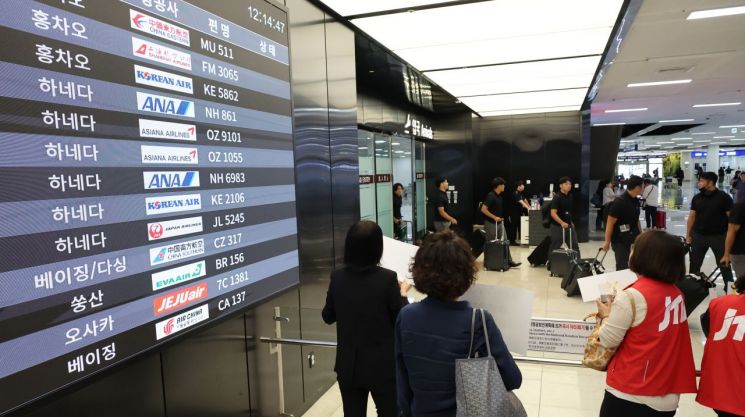
The number of air passengers traveling between Korea and Japan from January to May this year exceeded 10 million, marking a record high. This appears to be a result of the explosive increase in tourists visiting Japan due to the weak yen. In response, domestic airlines are also focusing on increasing the number of flights to attract more passengers. On the other hand, domestic flights such as those to Jeju have significantly decreased, causing a shortage.
According to aviation statistics from the Ministry of Land, Infrastructure and Transport on the 21st, the number of air passengers on Korea-Japan routes from January to May this year was 10,156,796 (combined departures and arrivals). This is a 46.2% increase compared to 6,945,507 during the same period last year.
This is the highest figure for the January-May period since the Ministry began providing aviation statistics in 2009. Even the passenger count from January to May 2019, just before COVID-19, was lower at 9,386,078. Compared to the 5,072,554 air passengers on short-haul routes to China, which is similar to Japan, this number is about twice as high.
The aviation industry attributes this to the increase in tourists visiting Japan due to the weak yen that has continued since last year. Additionally, domestic airlines have significantly increased the number of flights on Japan routes to meet the explosive travel demand, accelerating the growth.
The number of flights on Japan routes was 39,980 from January to May last year, but increased by 37.5% to 54,973 this year.
During the same period, the most used Japan routes were Incheon?Narita (1,940,818 passengers), Incheon?Kansai (1,872,442 passengers), and Incheon?Fukuoka (1,381,387 passengers), in that order.
While demand for flights to Japan is increasing, the shortage of domestic flights such as those to Jeju continues. According to an analysis of Jeju Airport air transport performance by Jeju Special Self-Governing Province on the 21st, from January to May this year, domestic flights originating from Jeju numbered about 64,000, and available seats were about 12.37 million. These represent decreases of 4.0% and 2.9%, respectively, compared to the previous year. The number of passengers was 11.16 million, down 4.2% from 11.65 million the previous year. The load factor was 90.2%, a 1.2% decrease from 91.4% the previous year.
© The Asia Business Daily(www.asiae.co.kr). All rights reserved.
![Clutching a Stolen Dior Bag, Saying "I Hate Being Poor but Real"... The Grotesque Con of a "Human Knockoff" [Slate]](https://cwcontent.asiae.co.kr/asiaresize/183/2026021902243444107_1771435474.jpg)
















