Seoul Tourism Foundation Conducts On-site Survey of 1,600 People
Last Year's Stay and Spending Increased Compared to Pre-COVID-19
Need to Strengthen Overall Inbound Market
Increase in Visitors to Korea, Decrease in Stay and Spending
As K-food and K-content gain global popularity, the length of stay and travel expenses of foreign tourists visiting Seoul, a representative tourist destination in South Korea, have increased compared to the pre-COVID-19 period. However, despite the rise in the number of foreign tourists in the overall domestic inbound (foreign visitors to Korea) market, per capita spending has decreased, highlighting the need to strengthen the market's substance.
Captivated by Chicken, Bibimbap, and Samgyeopsal
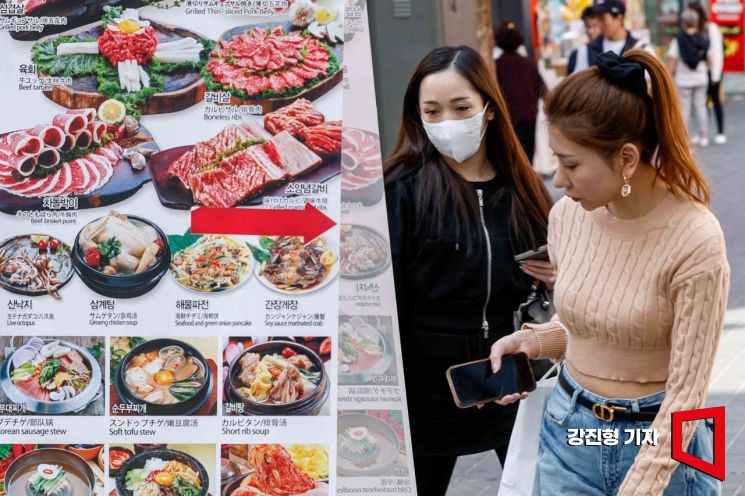 Foreign tourists visiting Myeongdong, Jung-gu, Seoul, are looking at a promotional board displaying restaurant menus. Photo by Jinhyung Kang aymsdream@
According to the Seoul Tourism Foundation on the 22nd, foreign tourists who visited Seoul last year stayed in the city for about six days and spent an average of over 2.8 million KRW on travel expenses. This figure was obtained from an on-site survey conducted by the foundation from March to November last year, targeting 1,600 foreign tourists visiting Seoul.
Specifically, the average length of stay for foreign tourists in Seoul was 6.05 days, and the average spending was 2.84 million KRW (including airfare). This exceeds the pre-COVID-19 figures from 2019, which were an average stay of 5.11 days and average spending of 1.89 million KRW.
The significant increase in spending is analyzed as a result of a decrease in the proportion of tourists from nearby Asian countries and an increase in long-distance tourists from Europe, the Americas, and other regions among all inbound tourists.
The most preferred itinerary for foreign tourists visiting Seoul was food tourism (97.4%). Among the types of food they experienced, Korean cuisine (66.9%) ranked first, followed by street food including bunsik (38.2%) and cafes/coffee shops (34.4%).
Among Korean dishes, chicken (54.9%) was the most experienced, followed by bibimbap (48.1%) and samgyeopsal (42.7%). The tastiest Korean foods were also identified as chicken (29.5%), samgyeopsal (25.7%), and bibimbap (24.3%).
An industry insider stated, "With K-pop and K-content gaining huge popularity overseas, and K-food being widely introduced through YouTube and social networking services (SNS), foreign tourists have developed a strong interest in Korean cuisine. There is a growing trend of preferring travel itineraries that include visiting 'must-visit' restaurants and cafes favored by locals, as well as trendy hot spots."
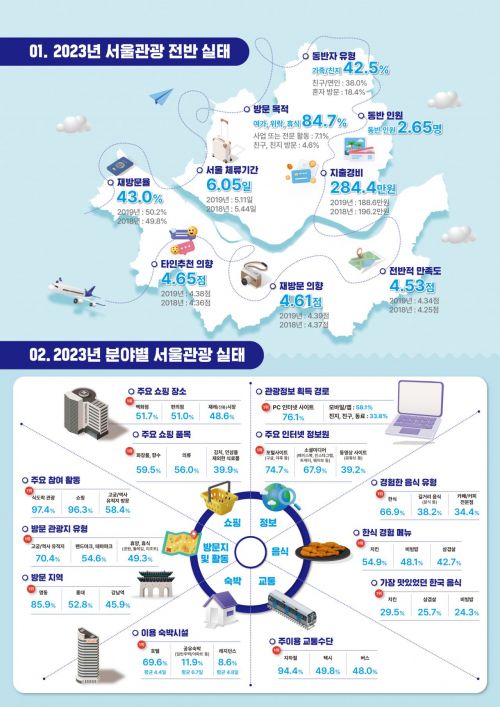
The area most visited by foreign tourists in Seoul was Myeongdong, followed by Hongdae (52.8%) and Gangnam (45.9%). Among tourist attractions, a high proportion visited palaces and historical sites (70.4%), with landmarks/theme parks (54.6%) and parks/trails/resorts (49.3%) also favored.
Foreign tourists' satisfaction with their visit to Seoul steadily increased from 4.25 points in 2018 (out of 5) to 4.34 points in 2019, and 4.53 points last year. The intention to revisit score also slightly rose to 4.61 points last year from 4.39 points in 2019.
Although foreign tourists' preference for Seoul has increased, the overall domestic inbound market is still struggling compared to the pre-COVID-19 period.
The Bright and Dark Sides of the Overall Inbound Market from January to April This Year
According to a report analyzing the inbound tourism market from January to April this year by Yanolja Research, the number of foreign tourists visiting South Korea during this period was 4,865,670, an 87% increase compared to the previous year. This recovers about 89% of the level during the same period in 2019.
By continent, the number of tourists from Asian countries more than doubled compared to the same period last year but was still 15% below the 2019 level. The number of tourists from the Americas, Europe, Oceania, and Africa increased by 5% to 35% compared to 2019.
Foreign tourists entering by ship rather than by air accounted for 12% (about 600,000) of the total, an increase of about 7% (approximately 40,000) compared to 2019. This is attributed to the resumption of cruise travel from China since August last year, leading to an increase in Chinese tourists entering by ship.
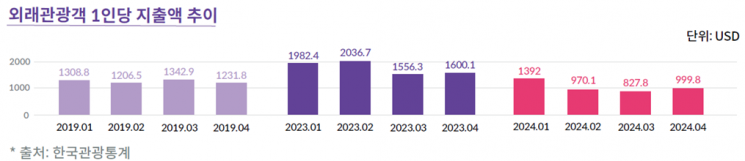
Despite the increase in the number of foreign tourists this year, per capita spending has significantly decreased. The average spending per inbound tourist during this period was 1,063 USD, down from 1,286 USD in 2019 and 1,858 USD in 2023. The report estimates that the main cause is the shortened stay of foreign tourists from countries with high travel expenses such as China, the United States, Germany, and France.
Additionally, the average length of stay for foreign tourists in the first quarter of this year was 6.5 days, 1.9 days shorter than the same period last year. In particular, Chinese tourists stayed 13.7 days in the first quarter last year but only 6.5 days this year, a decrease of 7.2 days. The report also analyzes that the decrease in the proportion of business tourists, who tend to spend more than leisure tourists, by 3.6 percentage points likely contributed to the decline in per capita spending.
A Yanolja Research official noted, "While the increase in the number of foreign tourists is important, it is now necessary to devise practical measures to increase the length of stay and per capita spending."
© The Asia Business Daily(www.asiae.co.kr). All rights reserved.



















