Construction method capable of handling yards with pillar spacing over 11m
Securing competitive edge in winning orders for PC method construction throughout logistics center
Hanwha Construction Division is developing a PC method for logistics centers that can be constructed even in loading docks where the distance between columns is over 11 meters.
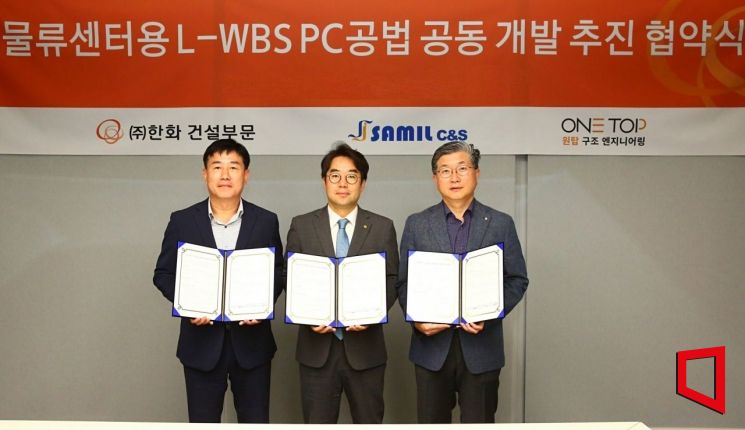 Hanwha Construction Division announced on the 21st that it has signed a "Joint Development Agreement for L-WBS PC Method for Logistics Centers" with Samil C&S and OneTop Structural Engineering. From the left: Park Se-young, Head of Architecture Business Division at Hanwha Construction Division; Ha Chang-yong, Head of PC Business Division at Samil C&S; Lee Kang-chul, CEO of OneTop Structural Engineering.
On the 21st, Hanwha Construction Division announced that it signed a 'Joint Development Agreement for L-WBS Method (Longspan-Wide Beam System PC Method) for Logistics Centers' with Samil C&S and OneTop Structural Engineering at the Hanwha Building in Janggyo-dong, Seoul.
The L-WBS method is a PC (Precast Concrete) method applicable to logistics center loading docks where the distance between columns exceeds 11 meters. The PC method refers to a construction technique where concrete building materials are produced in advance at a factory and then assembled on-site.
The previously developed WBS-I and II methods were only applicable inside logistics centers where the distance between columns did not exceed 11 meters. With the L-WBS method developed through this agreement, construction using the PC method will be possible throughout the entire logistics center.
Hanwha Construction Division successfully applied the WBS-I method, developed in 2021, to Coupang’s Namdaejeon and Yeoju Jeombong-dong logistics centers. The WBS-I method differs from general PC methods in that the structure is lighter and easier to construct, while having a wider beam width to support heavier loads. In particular, this method allows for reducing the thickness of floor slabs while maintaining the same strength, making it more economical.
The WBS-II method, developed earlier this year, enables continuous column construction over two floors, unlike the previous process which required sequential construction one floor at a time, thereby shortening the construction period. Hanwha Construction Division plans to apply the WBS method to various building constructions beyond logistics centers through further development and review.
Domestic PC methods are being applied beyond underground parking lots in apartment complexes to logistics centers, knowledge industry centers, and semiconductor factories. Major construction companies are focusing on developing methods and technologies to expand the scope of PC application. Hanwha Construction Division aims to enhance technology specialized in PC methods as a stepping stone to secure competitiveness amid changes in the domestic construction environment through this agreement.
Park Se-young, Head of the Architecture Business Department at Hanwha Construction Division, said, "The development of PC method technology can improve cost, construction, and quality in all areas. This agreement will be an opportunity to expand the application scope of the PC method."
© The Asia Business Daily(www.asiae.co.kr). All rights reserved.

















