Local Governments Conduct Food Waste Processor Subsidy Program
Companies Compete by Continuously Launching New Products
The ‘food waste disposer’ that efficiently processes food waste without odor is gaining attention. Some local governments are focusing on its eco-friendliness and are also running subsidy programs to support the purchase of food waste disposers, so the market is expected to grow further. As a result, small and medium-sized enterprises (SMEs) and mid-sized companies are entering this market one after another and launching new products.
According to Smart Cara on the 23rd, sales of 5ℓ food waste disposers from January to May this year increased by 770% compared to the same period last year. The industry expects the domestic food waste disposer market, which was worth 600 billion KRW last year, to exceed 1 trillion KRW this year. An industry insider said, “Food waste disposers are popular because they reduce the hassle of having to take out the trash and create a comfortable home environment,” adding, “Since there are still many more potential consumers than households owning food waste disposers, the market potential is considered large.”
Some local governments are accelerating market expansion by implementing support programs for household food waste disposers with the aim of reducing food waste. In various regions nationwide, including Yongsan-gu and Dobong-gu in Seoul, Jung-gu and Bupyeong-gu in Incheon, Yuseong-gu in Daejeon, Dongnae-gu in Busan, and Hwasun-gun in Jeollanam-do, 30-80% of the purchase cost of food waste disposers is being subsidized.
As the market grows, SMEs and mid-sized companies are entering and continuously launching new products. The market has been formed mainly by SMEs and mid-sized companies from the beginning, and large corporations have not yet entered. Smart Cara, which has focused solely on food waste disposers since 2009, introduced two new products last month. The 5ℓ product ‘BladeX’ features a drying drum coated with G7 ceramic to enhance durability and is designed to handle chicken bones and crab shells when using the strong mode. The eco-filter’s performance has improved by 125% compared to previous models. The maximum daily processing capacity is 30ℓ, making it suitable for multi-person households.
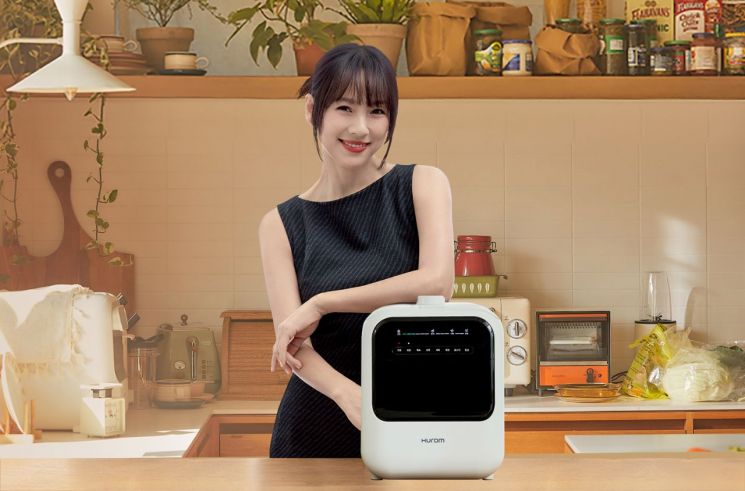
Hurom, famous for its ‘juicers,’ launched its first food waste disposer in 2022 and released the second-generation product last month. It uses an improved composite activated carbon filter to reduce odors, and an analysis comparing ammonia levels with the first generation showed that fishy smells decreased to one-fifth. Additional input during operation is now possible, so users do not have to wait until food waste accumulates. The ‘cleaning mode’ has also been upgraded to automatically clean the drying drum with 100-degree water within 30 minutes.
Cuckoo Electronics expanded its product lineup in April by releasing a drying and grinding type food waste disposer. Leveraging heating technology developed through kitchen appliances such as rice cookers, it boasts removing 99% of moisture from food waste. Once completely dried, it grinds the waste using a millstone method, reducing volume by up to 95%, thereby lessening the burden of waste disposal. It can process up to 1.3 kg of food waste per day and is equipped with a 2.6ℓ drying drum to collect and process waste at an appropriate level in one go.
AtHome launched the compact food waste disposer ‘Minix The Blender’ in October last year. With a size of 19.5 cm, roughly the span of an adult’s hand, it maximizes space efficiency. It targets 1-2 person households with trendy design, ZeroStr technology for processing peels and other waste, and a high-temperature hygiene care system. Since its launch, cumulative sales have reached 45,000 units, and sales in the second quarter increased by 67% compared to the first quarter this year. On the 20th of last month, it recorded sales of 2.34 billion KRW in one hour on Gmarket Live.

© The Asia Business Daily(www.asiae.co.kr). All rights reserved.


















