The U.S. government has stated that it views the treaty signed between North Korea and Russia, which is equivalent to restoring a military alliance, as a threat to security in the Indo-Pacific region and will respond by strengthening alliances.
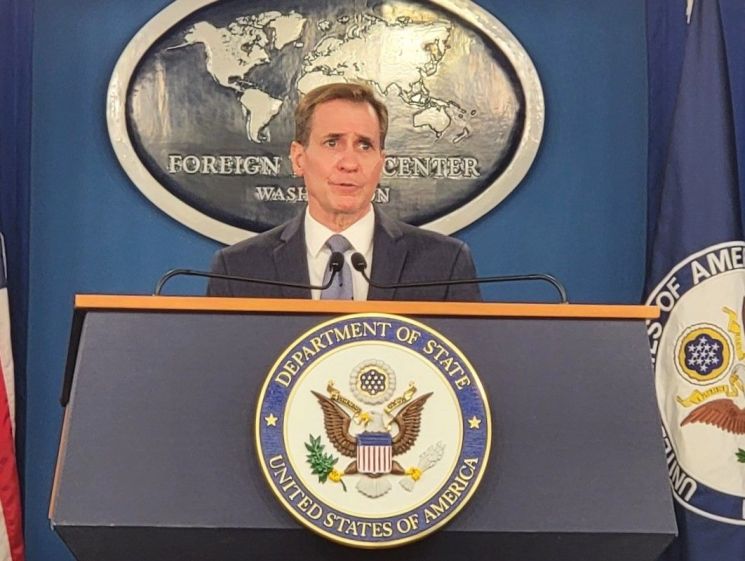
John Kirby, White House National Security Communications Coordinator, said in an online briefing on the 20th (local time), "This agreement (North Korea-Russia treaty) is a concern for all countries that value peace and security on the Korean Peninsula and in the Indo-Pacific, all countries that believe United Nations Security Council (UNSC) resolutions must be respected, and all people who think supporting the Ukrainian people is important."
He also suggested that if threats from North Korea and Russia escalate, military deployment in the Indo-Pacific region could be increased. Kirby emphasized, "We will assess our (defense) posture across the Indo-Pacific as needed" and secure the best position to respond to threats and challenges, including on the Korean Peninsula.
Kirby further stated, "This agreement shows Russia's desperation," adding, "We will certainly continue to seek opportunities to strengthen our strong and vast alliance and partner network."
Pat Ryder, spokesperson for the U.S. Department of Defense, said in a briefing, "We will continue to watch and monitor (future moves between North Korea and Russia)," and "Our focus remains on peace, security, and stability, and we will continue to strengthen our alliances with that understanding."
When asked about the difference between the South Korea-U.S. alliance and North Korea-Russia relations, Ryder explained, "The alliances with South Korea and Japan are defensive alliances," adding, "We are there for defense, and our focus is on cooperating with partners who share our position in the region." Ryder also emphasized, "We have clearly expressed support for our ally South Korea," and "Our support for our ally South Korea is ironclad."
On the 19th, North Korea and Russia signed the "Treaty on Comprehensive Strategic Partnership" in Pyongyang, in which they agreed that if either side is subjected to armed invasion and enters a state of war, they will provide military assistance to the other without delay according to Article 51 of the UN Charter on collective self-defense and their respective domestic laws.
Regarding the South Korean government's position on reviewing arms support to Ukraine, the U.S. government expressed that any support to Ukraine is welcomed. Matthew Miller, spokesperson for the U.S. Department of State, responded to related questions at the briefing, saying, "We welcome any support for Ukraine in its fight against Russia's aggression, but ultimately, that is a decision for South Korea to make."
© The Asia Business Daily(www.asiae.co.kr). All rights reserved.

















