Financial Authorities' Exemption from Governance Evaluation Criteria TF Meeting Concludes
Temperature Gap Between Business and Accounting Sectors Over Detailed Criteria
HanGongHoe Next President Election Ends... Debate Expected to Intensify
As a result of discussions between financial authorities, the business community, and the accounting industry regarding a plan to exempt governance-excellent companies with well-established external auditor appointment and supervision systems from the 'Periodic Auditor Designation System (Periodic Designation System),' a consensus on the necessity of such an exemption has been reached. However, due to significant differences in opinions between companies and the accounting industry over detailed evaluation criteria, it is expected to take a long time to finalize the plan as originally intended by the government. With the selection of the next president of the Korea Institute of Certified Public Accountants (KICPA), which represents the accounting industry, the debate between both sides is also expected to intensify.
Task Force Meeting on Establishing Governance Evaluation Criteria for Designation Exemption Concludes
According to the government and the financial investment industry on the 21st, the third meeting of the 'Task Force (TF) for Establishing Governance Evaluation Criteria for Designation Exemption' was held on the 18th, marking the conclusion of the TF. Participants included the Financial Services Commission, Financial Supervisory Service, Korea ESG Standards Institute, Accounting Standards Board, KICPA, Korea Listed Companies Association, KOSDAQ Association, and Capital Market Research Institute. At the meeting, a consensus was reportedly formed on the broad direction that "governance-excellent companies with well-established external auditor appointment and supervision systems can be granted exemption benefits from the periodic designation system." Discussions were mainly centered on private sector experts from the business community, accounting industry, and capital markets.
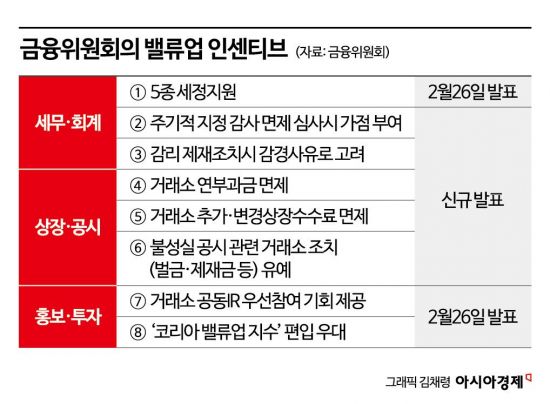
The goal of this TF was to select criteria for identifying companies eligible for exemption from the periodic designation system. Although specific criteria have not yet been disclosed, the financial authorities announced in April that the core evaluation criteria would include whether the external auditor appointment and supervision system is properly established and operated. Based on this, the authorities plan to form a 'Governance Evaluation Committee' composed of external organizations and experts to evaluate and select governance-excellent companies. Companies selected as governance-excellent will be exempted from periodic designation for a certain period following approval by the Securities and Futures Commission. Additionally, if a company receives a 'Corporate Value-Up Award' in the future, this will be reflected as a bonus factor to be actively considered during governance evaluations for designation exemption. The authorities are reportedly considering a system where listed companies that believe they meet the exemption requirements can apply to avoid periodic designation, rather than granting exemption benefits through a blanket survey of all listed companies. Upon application, the financial authorities will assess the exemption eligibility based on evaluation criteria.
However, negotiations over detailed evaluation criteria remain at an impasse. The accounting industry, which seeks to preserve the original periodic designation system, has consistently opposed expanding exemption requirements and has applied stringent standards in detailed criteria. The Financial Services Commission had announced plans to finalize specific evaluation criteria, methods, and exemption procedures within the second quarter and to amend the Enforcement Decree of the Act on External Audit of Stock Companies (External Audit Act), which underpins the designation exemption. Nonetheless, it is unlikely that policy directions will be settled within the first half of the year. According to the Enforcement Decree, exceptions to the periodic designation system currently apply only to companies that voluntarily requested and underwent inspections by the Securities and Exchange Surveillance Commission under the Financial Services Commission within the past six years without any violations detected.
'Hot Potato' Periodic Designation System... An Old Debate
The periodic designation system is a 'hot potato' where the interests of companies and the accounting industry sharply conflict. Introduced in 2019, the system mandates that if a company autonomously appoints an auditor for six consecutive years, the financial authorities will designate the auditor for the next three years. This system was introduced following the revised External Audit Act (New External Audit Act) enacted in November 2018 after the Daewoo Shipbuilding & Marine Engineering accounting scandal. While the system has been credited with improving accounting transparency, the industry has voiced complaints about excessive audit time and cost burdens, especially amid the COVID-19 pandemic.
The financial authorities have also sought solutions, recognizing that companies with excellent internal audit organizations capable of independently appointing auditors and effectively monitoring management face undue burdens. In June last year, the Financial Services Commission decided to maintain the current system while reviewing follow-up measures, considering the accounting transparency and independence effects of the periodic designation system. A senior official at the Financial Services Commission stated, "Previously, the proportion of designated audits exceeded half, which was excessive, so efforts were made to reduce this. Attempts were made to rationalize the reasons for auditor designation." Since the implementation of the periodic designation system in 2020, the proportion of listed companies with designated auditors has increased, with more than half (54%) of listed companies receiving designated auditors in 2021.
The accounting industry has openly criticized the exemption plan announced by the financial authorities in April as part of the value-up program. Ahead of the KICPA presidential election on the 19th, all three candidates expressed opposition to the exemption policy for the periodic auditor designation system, which is part of the value-up program. Newly elected President Choi Un-yeol, who led the periodic designation system as a member of the National Assembly, emphasized at a press conference immediately after his election, "Exempting the periodic designation system is not value-up but value-down," adding, "I believe the issue can be resolved through dialogue with policy authorities."
KOSDAQ-listed companies have welcomed the government's push for exemption from the periodic auditor designation system. As the periodic designation system, initially introduced as a temporary measure, has become customary, KOSDAQ-listed companies, which generally have smaller personnel and capital compared to KOSPI-listed companies, have complained about the cost and audit workload burdens. At value-up related corporate meetings, many KOSDAQ-listed companies requested relaxation of the auditor designation system. A senior official at a KOSDAQ-listed company A stated, "Forcing companies to accept government-designated auditors for three years imposes a significant burden in terms of time and cost," adding, "If the exemption plan is realized, it is expected to reduce fee burdens and significantly alleviate the workload caused by the designated audit system."
Experts participating in the TF also emphasized that the intention is not to grant exemption benefits to all listed companies that faithfully implement value-up. Rather, exemption incentives will be given only when a listed company meets conditions such as transparently operating the audit system by thoroughly reviewing auditor appointment procedures and the qualifications of designated auditors, and is judged to have excellent corporate governance. Companies with accounting issues requiring urgent delisting or with poor governance systems, as feared by the market, will not even qualify as exemption candidates. A financial investment industry official said, "It is appropriate to relax the system to allow free appointment of auditors, but from the perspective of investor protection, if external monitoring functions can sufficiently oversee the company's finance and accounting, then listed companies with excellent auditor appointment procedures and overall governance systems should be given the opportunity to appoint auditors independently."
© The Asia Business Daily(www.asiae.co.kr). All rights reserved.
![User Who Sold Erroneously Deposited Bitcoins to Repay Debt and Fund Entertainment... What Did the Supreme Court Decide in 2021? [Legal Issue Check]](https://cwcontent.asiae.co.kr/asiaresize/183/2026020910431234020_1770601391.png)
















