Kim Jong-un Advocated 'Alliance'... Putin Takes a Step Back
Difference Lies in 'UN Charter and Russian Domestic Law' Preconditions
Russian Foreign Minister: "North Korea-Russia Treaty Is Defensive in Nature"
The contents of the newly signed 'Comprehensive Strategic Partnership' agreement between North Korea and Russia have been revealed. Although the agreement includes provisions that were considered 'automatic military intervention clauses' during the Soviet era, it now includes caveats referencing the UN Charter and Russian domestic law. While the Russian side maintains that this is on a 'defensive level,' North Korean State Affairs Commission Chairman Kim Jong-un alone has asserted it as an 'alliance,' highlighting a clear difference in stance between the two sides.
Article 4 of the new North Korea-Russia treaty, disclosed by North Korea on the 20th, states, "If either party is subjected to armed invasion by an individual state or multiple states and enters a state of war, the other party shall, without delay, provide military and other assistance by all means at its disposal in accordance with Article 51 of the UN Charter and the laws of the Democratic People's Republic of Korea and the Russian Federation." The latter part of this clause specifying military assistance aligns with the 'automatic military intervention' clause of the 1961 North Korea-Soviet Union friendship treaty.
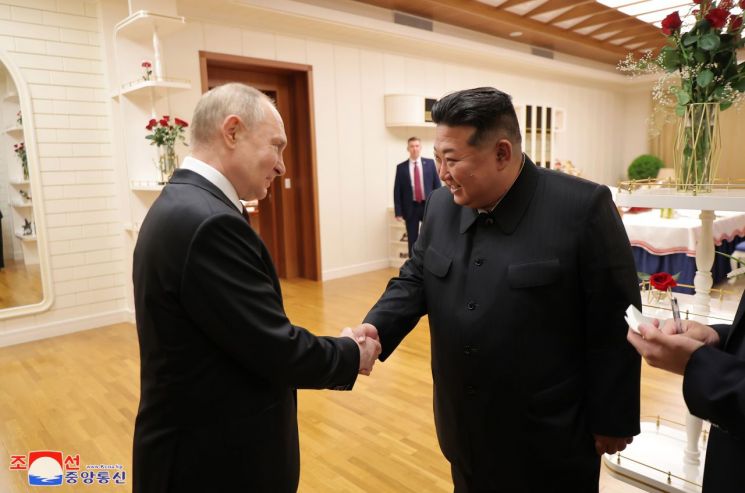 Russian President Vladimir Putin and North Korean State Affairs Commission Chairman Kim Jong-un. [Image source=Yonhap News]
The difference lies in the precondition of the UN Charter and Russian domestic law. Russian Foreign Minister Sergey Lavrov, in an interview with local media on the same day, referred to Article 51 of the UN Charter regarding the new North Korea-Russia treaty and stated that it is "purely a defensive stance." Article 51 stipulates that member states have the right to individual or collective self-defense if an armed attack occurs.
President Vladimir Putin, after signing the new agreement in Pyongyang the previous day, stated, "If one party is invaded, mutual support will be provided." Interpretations differed on whether this revived the 'automatic military intervention' clause. Subsequently, the Russian government's position, as further explained by Minister Lavrov, is that this policy is merely 'defensive.' Given Russia's heavy burden from confrontation with the West, it has effectively applied a kind of 'brake.'
As various interpretations arose regarding the difference in tone between the two sides, North Korea released the full text of the treaty on the same day. Chairman Kim claimed immediately after the talks that "the two countries have risen to a new high level of alliance relations." Although the level of closeness between the two sides is increasing, strictly speaking, a comprehensive strategic partnership is a lower level than an alliance. President Putin did not mention the term 'alliance' at all.
A government official pointed out, "The difference from the past is that the domestic laws of Russia and North Korea are explicitly stated as conditions," adding, "More analysis is needed on why Russia included such clauses, but even comparing the positions expressed by Russia and North Korea immediately shows a stark difference in tone."
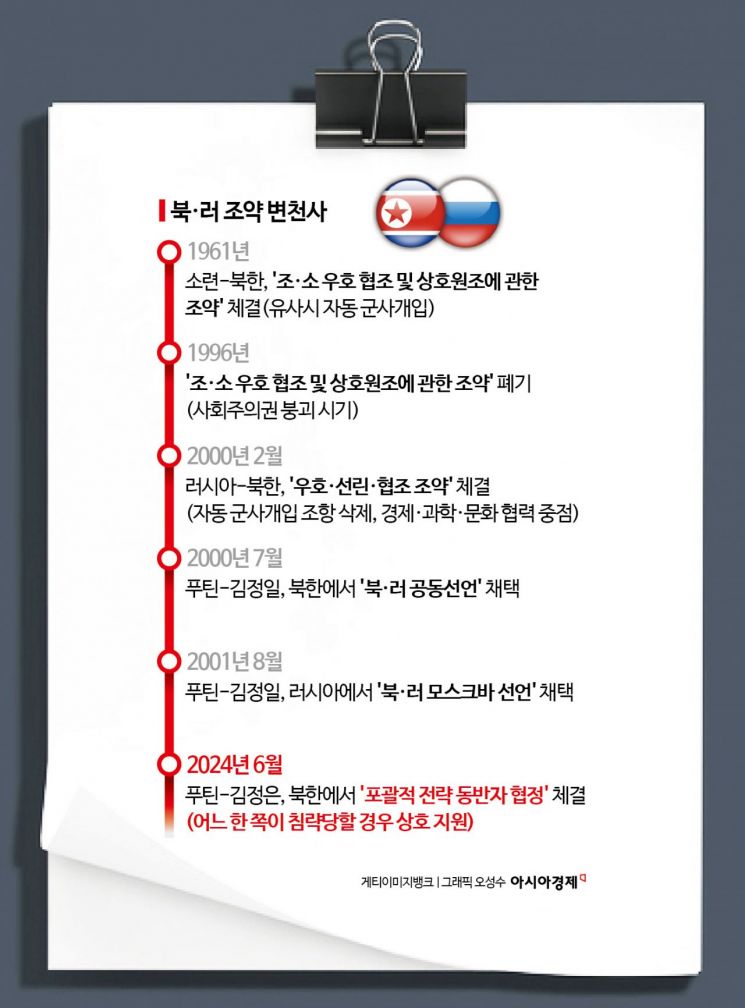
For Russia, it is difficult to easily decide on military intervention in the Korean Peninsula. North Korea has designated the South as a 'belligerent state' this year. If Russia promises military intervention, it would create a scenario of facing South Korea as a hostile country. Compared to the United States, an ally of South Korea, warning of the 'end of the Kim Jong-un regime' over concerns about North Korea's provocations or nuclear use targeting the South, a significant difference in level can be discerned.
The government evaluated the recent North Korea-Russia summit as a 'display of anti-Western solidarity.' A Ministry of Unification official said, "In summary, it can be seen as an elevation of bilateral relations centered on military cooperation and a demonstration of anti-American and anti-Western solidarity both domestically and internationally," adding, "From North Korea's perspective, it secured Russia's support against the South Korea-U.S.-Japan cooperation, and Russia maintained encouragement of North Korea's support regarding the Ukraine war."
© The Asia Business Daily(www.asiae.co.kr). All rights reserved.
![Clutching a Stolen Dior Bag, Saying "I Hate Being Poor but Real"... The Grotesque Con of a "Human Knockoff" [Slate]](https://cwcontent.asiae.co.kr/asiaresize/183/2026021902243444107_1771435474.jpg)

















