A technology that produces electricity using forest and agricultural waste remaining after logging as fuel has been developed domestically.
The research team led by Dr. Min Kyung-sun at the Gwangju Eco-friendly Research Center of the Korea Institute of Energy Research (hereinafter referred to as KIER) announced on the 20th that they have developed a technology that converts branches, kudzu vines, and mushroom substrate (a cultivation medium containing nutrients necessary for mushroom growth, mostly discarded after harvest) into solid biofuel that can be converted and utilized as fuel for thermal power plants.
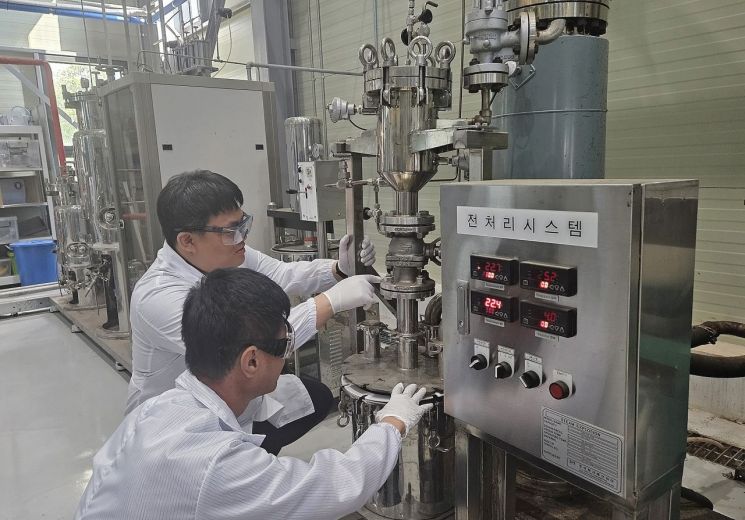 The research team is conducting a study by placing agricultural and forestry waste into a steam explosion-based semi-carbonization reactor. Provided by Korea Institute of Energy Research
Biomass can be crushed and processed from wood and forestry by-products into small cylindrical pellets or chips to be used as raw materials for thermal power plants.
This is attracting attention because it can replace fossil fuels and be used as a raw material that absorbs carbon dioxide to achieve carbon neutrality. The International Energy Agency (IEA) predicts that biomass-based power generation will account for 7% of renewable energy generation by 2050.
Initially, food resources such as corn were used as raw materials for biofuels. However, as food security issues emerged, recent research has focused on developing technologies that use non-food biomass as raw materials.
Currently, most wood pellets made from sawdust are imported and used. The main method of producing biofuel is a heating and drying-based semi-carbonization process, which requires high temperatures above 300 degrees Celsius. During the drying process, heat energy is lost, and minerals such as potassium and sodium are generated, causing equipment corrosion as a side effect.
To overcome these problems, the research team developed a steam-based wet process instead of a drying method, reducing mineral generation while lowering the heat energy loss rate of the raw materials.
In particular, biomass utilization has been enabled for logging by-products, kudzu vines, and mushroom waste substrate, which were previously discarded or left unused because they were difficult to apply to the dry semi-carbonization process, allowing diversification of raw materials.
The process developed by the research team involves inputting raw materials at a lower temperature of 200 degrees Celsius than the existing semi-carbonization process and exposing them to steam for about 15 minutes to reduce chemical bonds and make decomposition easier. Then, by rapidly dropping the pressure, the raw materials break down into smaller particles, making it easier to form pellet shapes.
The biomass, now in small particles, is placed into a device to be compressed into pellet shapes for use in thermal power plants. Finally, by varying the chemical composition, temperature, pressure, diameter, and length to optimize the compression ratio, the research team explained that it is possible to produce uniformly high-quality, high-efficiency pellets.
Analysis of the biofuel produced through this process confirmed that as temperature and time increased, the content of hemicellulose and minerals, which hinder combustion efficiency, decreased.
Furthermore, the high heating value of the biofuel increased up to 22.0 MJ/kg, and the energy recovery rate reached up to 95%, proving that the steam-based wet process is the most effective method for utilizing waste biomass.
Dr. Min Kyung-sun stated, “Biofuel is recognized as an energy source that directly contributes to solving climate crises and resource depletion issues,” adding, “Producing fuel that can be mixed and used in thermal power plants from agricultural and forestry waste will act as a catalyst in establishing a resource circulation system by upcycling waste resources into energy sources and contributing to achieving carbon neutrality.”
Meanwhile, this research was conducted with support from KIER’s basic projects and the Gwangju City government. The research results were published in the prestigious agricultural engineering journal ‘Bioresource Technology.’
© The Asia Business Daily(www.asiae.co.kr). All rights reserved.

















