Governance Restructuring Centered on Population Strategy Planning Division and Low Birthrate Secretariat
Increasing Male Parental Leave Usage Rate to 50%
The government is activating an emergency response system to address the extremely severe low birthrate issue. It will reorganize the government structure by establishing the 'Population Strategy Planning Department' and the 'Low Birthrate Senior Office,' and launch extensive support measures such as significantly increasing parental leave pay to reduce the social burden of childcare and caregiving.
On the afternoon of the 19th, President Yoon Seok-yeol chaired the '2024 Low Fertility and Aging Society Committee Meeting' at the HD Hyundai Global R&D Center Asan Hall in Seongnam, Gyeonggi Province, under the theme of 'Measures to Reverse the Low Birthrate Trend.' This meeting was the second time President Yoon, who is the chairman of the Low Fertility and Aging Society Committee, presided since March last year, focusing on discussing extraordinary measures to reverse the low birthrate trend.
President Yoon stated, "As of today, I officially declare a 'national population emergency' and will activate a nationwide all-out response system until the low birthrate problem is overcome," adding, "We will significantly increase the male parental leave usage rate, which is currently only 6.8%, to around 50% during my term, and introduce a new parental leave system that allows short-term use in two-week increments."
The initially announced dedicated department, tentatively named the Low Birthrate Response Planning Department, will be designated as the 'Population Strategy Planning Department,' and a Low Birthrate Senior Office will be newly established within the Presidential Office. The current high-level committee will be transformed into a 'Population Emergency Measures Meeting' involving ministers from related ministries and senior committee members, with plans to hold monthly meetings. A 'Special Account for Population Crisis Response' will also be established to set revenues and expenditures related to population policies and ensure stable budget use in this sector.
Significant Increase in Parental Leave Monthly Pay... Introduction of '2-Week Short-Term Parental Leave'
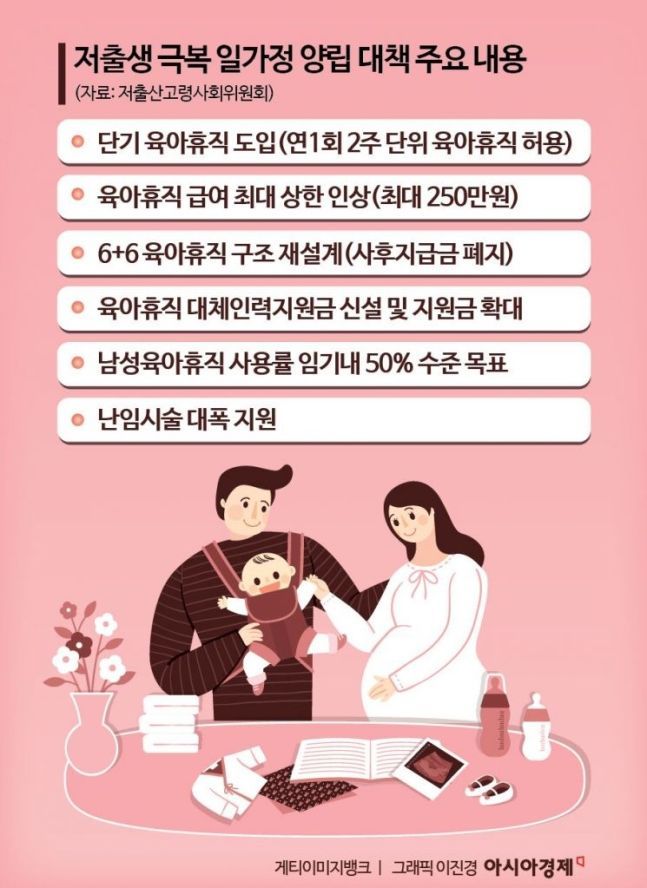
To seek a rebound in the birthrate, the government has introduced support measures focusing on three areas: 'work-family balance, childcare, and housing.' First, parental leave pay will be increased from the current 1.5 million KRW per month to a maximum of 2.5 million KRW per month so that anyone can take parental leave without worrying about income. Currently, 80% of the average wage, equivalent to about 1.5 million KRW per month, is paid evenly for up to one year, allowing a total support of up to 18 million KRW for one year of leave.
Going forward, with parental leave pay rising to a maximum of 2.5 million KRW per month, a total of up to 23.1 million KRW can be received for one year of leave. The aim is to promote the use of parental leave by increasing the income replacement rate. However, the '2.5 million KRW cap' applies only for the first three months. After that, it decreases to 2 million KRW for the next three months and 1.6 million KRW for the following six months.
A 'short-term parental leave system' allowing use for only two weeks will also be introduced to enable flexible use of leave and vacation when needed. This system is designed to flexibly operate parental leave to respond to short-term childcare needs such as temporary daycare closures or school vacations. Use of parental leave in two-week increments will be allowed once a year during periods of high caregiving demand. Parents can use this once per child per year, allowing up to four weeks per child annually.
The government also plans to significantly increase the male parental leave usage rate from the current 6.8% to about 50% during the president’s term. Paternity leave will be extended from 10 days to 20 days, and the claim period (from 90 days to 120 days) and installment frequency (from once to three times) will be expanded. The age limit for reduced working hours during childcare will be extended from 8 to 12 years old, and a new parental leave system allowing short-term use in two-week increments will be introduced. Additionally, employers will receive a monthly subsidy of 1.2 million KRW for replacement workers for employees on parental leave, sharing the burden with colleagues and companies.
Special Tax Credit of 1 Million KRW for Married Couples Who Register Their Marriage
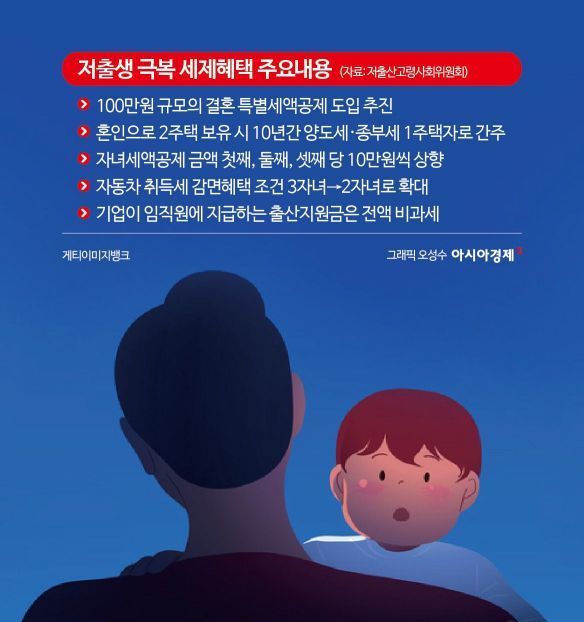
Tax incentives related to childbirth and childcare will also be expanded. A special marriage tax credit will be provided to couples who register their marriage. Joo Hyung-hwan, Vice Chairman of the Low Fertility Committee, said, "There have been no tax incentives related to marriage so far," adding, "We will establish a special marriage tax credit worth 1 million KRW to strengthen support throughout the life cycle." However, specific eligibility and credit amounts will be announced in this year’s tax law amendment prepared by the Ministry of Economy and Finance.
Tax incentives for families with children will also be expanded. Currently, tax credits of 150,000 KRW for the first child, 200,000 KRW for the second child, and 300,000 KRW for the third child are provided. These amounts will be increased by 100,000 KRW each.
Tax benefits related to home ownership will also be expanded. The government currently considers a man and woman with one home each who marry and become two-home owners as one-home owners for five years; this period will be doubled to 10 years. This means they can enjoy a capital gains tax exemption of up to 1.2 billion KRW for a long period. The basic deduction for comprehensive real estate tax will be up to 1.2 billion KRW, and tax credits of up to 80% for elderly and long-term owners will also be applicable.
"Realizing Substantial Free Education up to Ages 3-4"... Expansion of Neulbom School to All Grades
The government also announced plans to realize substantial free education within its term. Starting next year, support will be increased to cover standard kindergarten tuition for 5-year-olds and standard daycare fees and other necessary expenses for daycare centers to achieve free education. The plan is to expand this to ages 3-4 within the term.
In elementary after-school care, the 'Neulbom School' program will be expanded from the current first grade to all grades by 2026. The government will also gradually expand free operation of the program. Gap childcare will be strengthened as well. To allow children to receive care near their homes during times needed by parents and children, such as after school until parents return from work, the number of time-based childcare service providers will be expanded to 3,600 classes by 2027.
To meet in-home caregiving demand, the government will also promote the expansion of foreign domestic workers. A pilot project for foreign domestic workers targeting 1,200 people will be implemented in the first half of next year, and a pilot project allowing caregiving activities by foreign students (D-2) and spouses of foreign workers (F-3) will be conducted.
Effectively Abolishing Income Criteria for Newborn Special Loans... Priority Supply for Newborns Also Implemented
Housing benefits for childbirth households have also been strengthened. The combined income requirement for couples eligible for the newborn special loan will be raised to 250 million KRW annually for households that give birth within three years starting January next year. This effectively abolishes the income limit, allowing high-income dual-income couples to receive low-interest newborn special loans.
The newborn special loan is a system that provides low-interest loans of up to 500 million KRW at annual rates of 1-3% for home purchase funds and jeonse (key money deposit) funds to non-homeowners or one-home owners (for refinancing) who have given birth or adopted within two years from the loan application date. Eligible homes for purchase loans are priced at 900 million KRW or less with exclusive area of 85㎡ or less.
Additionally, a priority supply system for newborns will be introduced, increasing the number of housing units supplied to childbirth households from 70,000 to over 120,000 annually. The government will lift greenbelt restrictions to allocate 14,000 public housing units to newlyweds, childbirth, and multi-child families, and increase the proportion of special supply for newlyweds in private sales from 18% to 23%.
Support for Frozen Egg Preservation and Fertility Testing for All Men and Women of Childbearing Age
Infertility support will be significantly strengthened to help individuals who wish to conceive avoid obstacles caused by aging and other factors. The government will provide essential fertility testing up to three times for men and women aged 25-49 who desire pregnancy, regardless of marriage status or number of children. Previously, fertility testing was supported only once in a lifetime for couples preparing for pregnancy.
Support for frozen egg procedures will also begin. The government will cover the costs of freezing reproductive cells such as eggs and sperm for men and women who expect permanent infertility and need fertility preservation, regardless of marriage status. Frozen egg procedures involve collecting and storing healthy eggs in advance to be used later for actual pregnancy attempts through assisted reproduction. Support for infertility costs will be greatly expanded. The government will promote health insurance coverage for essential non-reimbursed medications such as uterine implantation aids and miscarriage prevention drugs during infertility treatments.
© The Asia Business Daily(www.asiae.co.kr). All rights reserved.
![Clutching a Stolen Dior Bag, Saying "I Hate Being Poor but Real"... The Grotesque Con of a "Human Knockoff" [Slate]](https://cwcontent.asiae.co.kr/asiaresize/183/2026021902243444107_1771435474.jpg)












