Open Source OS... Enhancing App Accessibility for Netflix and More
Equipped with AI Devices like 'Bolly'... 'Core AI Platform'
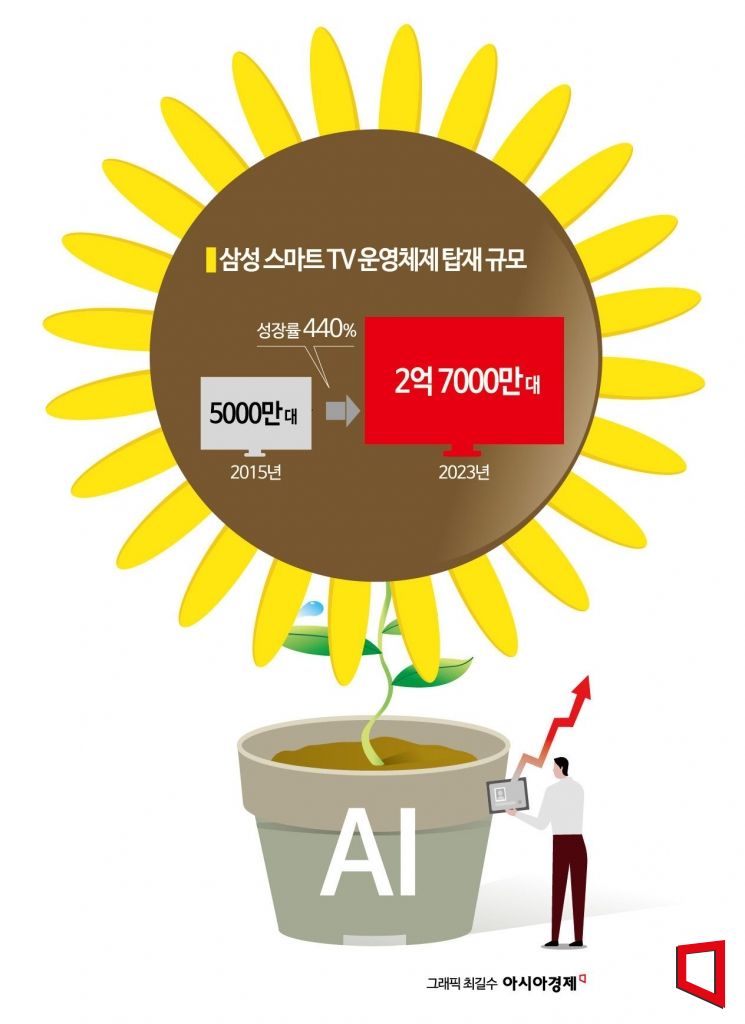
Samsung Electronics announced on the 20th that its TV operating system (OS), 'Tizen,' is being utilized as a core platform for AI smart TVs. Tizen is an open-source OS introduced in 2015.
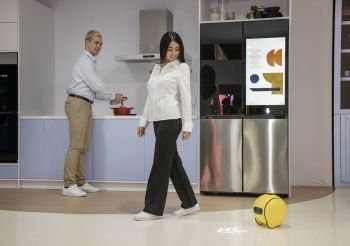 A Samsung Electronics model is introducing the AI companion 'Ballie' at the Samsung Electronics booth at 'CES 2024' held at the Las Vegas Convention Center in the United States.
 [Photo by Yonhap News]
On the same day, Samsung Electronics introduced Tizen’s features and the background of its adoption through its newsroom. Since 2011, Samsung applied the closed platform Orsay OS to its smart TVs. In 2015, it first adopted the open platform Tizen. As of the end of last year, approximately 270 million Samsung smart TVs released in the market were equipped with Tizen. This is the largest scale for a single product in the industry. Considering all products sold so far, the number of Samsung smart TVs equipped with the Tizen OS is expected to approach several hundred million units.
Unlike Orsay, Tizen is an OS that opens its source code. If Orsay is a 'single process' based OS where multiple people ride one bus to different destinations, Tizen is a 'multi-process' based OS where each person drives their own car to their destination. Kwangseop Byun, a professional at Samsung Electronics, explained, "The biggest purpose of adopting Tizen was to expand the ecosystem by attracting various external developers."
The initial Tizen development team focused on standardizing the development interface API, opening it externally, and adopting standard technologies. After applying standard technologies, accessibility for external content providers (CPs) was improved. Various CP applications such as Netflix, Spotify, and Apple TV became available on Samsung smart TVs.
Tizen is expected to serve as a core AI platform. To provide diverse AI services, platform technology that includes server cloud, on-device, and edge computing is necessary. Seyoung Hwang, a professional at Samsung Electronics, said, "The Tizen platform will play a pivotal role as an AI service platform."
Another feature of Tizen is its support for various device form factors. It can simultaneously handle multiple resolutions, ratios, and form factors with a single code base. From its launch, it supported devices such as mobile, wearable, and TV. Currently, it is used not only in smart TVs and monitors but also in beam projectors and B2B signage products like 'The Wall.'
Tizen OS will also be installed in 'Bolly,' an AI companion robot unveiled at the world’s largest IT and home appliance exhibition, CES 2024, held in January. Seonyong Jeong, a professional at Samsung Electronics, said, "By utilizing edge technology and leveraging the high-performance computing resources embedded in the Bolly product, it will be a use case of AI technology through hyper-connectivity," adding, "We expect Tizen to play a central role."
© The Asia Business Daily(www.asiae.co.kr). All rights reserved.
![From Hostess to Organ Seller to High Society... The Grotesque Scam of a "Human Counterfeit" Shaking the Korean Psyche [Slate]](https://cwcontent.asiae.co.kr/asiaresize/183/2026021902243444107_1771435474.jpg)

















