Russia and North Korea Sign Comprehensive Strategic Partnership Agreement
Includes Mutual Support Clause in Case of Invasion
"Elevating Bilateral Relations to a New Level"
Russian President Vladimir Putin, who visited North Korea, expressed resentment toward the West while criticizing international sanctions against Russia and North Korea.
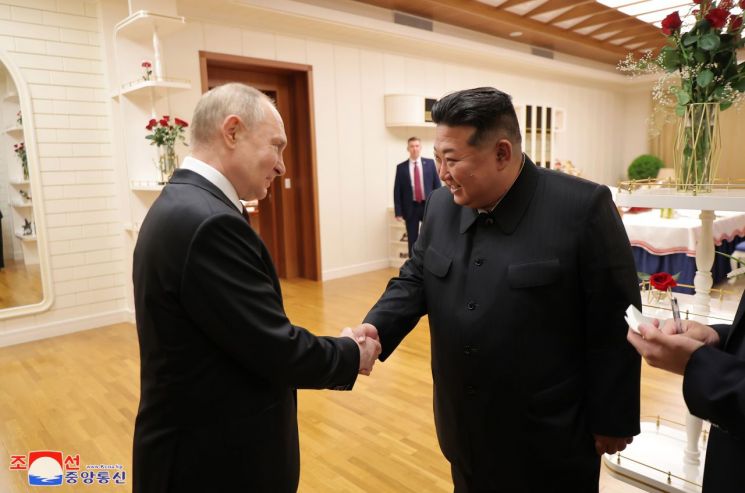 Russian President Vladimir Putin (left) arrived in Pyongyang, North Korea, early on the 19th and is shaking hands with North Korean State Affairs Commission Chairman Kim Jong-un. [Pyongyang, Korean Central News Agency, Image source=Yonhap News]
According to Russian news agencies TASS and Interfax on the 19th (local time), President Putin said in a joint press statement after holding a summit with North Korean State Affairs Commission Chairman Kim Jong-un at the Kumsusan Guesthouse in Pyongyang that "Russia and North Korea have independent foreign policies and do not tolerate threats or coercion," adding, "We will resist sanctions, which the West has increasingly used as a means to maintain political and economic hegemony."
He also stated, "The indefinite sanctions against North Korea led by the United States and its allies at the UN Security Council need to be overhauled." He continued, "It is unacceptable to blame North Korea for the deterioration of the (security) situation," asserting, "North Korea has the right to take reasonable measures to strengthen its self-defense capabilities and protect national security and sovereignty."
President Putin criticized the South Korea-U.S.-Japan military exercises, saying, "These are part of the U.S.' confrontational policy aimed at expanding its military presence in the region by significantly increasing the scale and intensity of various military drills involving hostile forces from South Korea, Japan, and North Korea," adding, "They not only threaten the security of the entire Northeast Asian region but also undermine peace and stability."
However, he said, "Russia is ready to continue political and diplomatic efforts to eliminate the threat of renewed armed conflict on the Korean Peninsula and to build long-term peace." He also emphasized, "This North Korea-Russia summit will further develop friendly and cooperative relations between Russia and North Korea and strengthen security throughout the entire region."
President Putin signed a comprehensive strategic partnership agreement with North Korea following the summit. He revealed that the agreement includes a clause for mutual support in the event one party is attacked.
Regarding the agreement, President Putin described it as "a truly groundbreaking document that elevates bilateral relations to a new qualitative level without resting on past achievements." He added, "Broad goals and guidelines have been established to deepen long-term relations between Russia and North Korea."
He also stated, "Russia does not rule out advancing military and technical cooperation with North Korea," and "We will cooperate in the military field under the new agreement."
Chairman Kim and President Putin concluded the North Korea-Russia summit with a nearly two-hour one-on-one meeting and signed the agreement. Neither North Korea nor Russia has disclosed the full text of the 'Treaty on Comprehensive Strategic Partnership.' The agreement signed on this day is expected to replace the treaties from 1961 and 2000, as well as joint declarations following the North Korea-Russia summits in Pyongyang and Moscow in 2000 and 2001, respectively.
Meanwhile, with the signing of this agreement, North Korea-Russia relations have been elevated from a friendly neighborly relationship to a comprehensive strategic partnership. Going forward, it is expected that North Korea and Russia will strengthen cooperation in a broader range of fields, including the military sector.
President Putin emphasized, "This is a truly groundbreaking document that elevates bilateral relations to a new qualitative level," and "Broad goals and guidelines have been established to deepen long-term relations between Russia and North Korea."
Chairman Kim also evaluated, "The relations between the two countries have entered a better prospective trajectory for progress and the improvement of the people's welfare through mutual cooperation in various fields such as politics, economy, culture, and military."
© The Asia Business Daily(www.asiae.co.kr). All rights reserved.
![User Who Sold Erroneously Deposited Bitcoins to Repay Debt and Fund Entertainment... What Did the Supreme Court Decide in 2021? [Legal Issue Check]](https://cwcontent.asiae.co.kr/asiaresize/183/2026020910431234020_1770601391.png)















