Medical school professors, residents, and medical students filed a request for a suspension of execution against the government, seeking to halt the enforcement of the 'increase and allocation of 2,000 medical school quotas,' but the Supreme Court ultimately rejected the request.
With the Supreme Court's final ruling, the sporadic lawsuits opposing the government's medical school quota increase are expected to end in a near-total defeat for the medical community.
This case involved applicants such as residents filing a lawsuit to cancel the Ministry of Health and Welfare Minister's 'announcement of quota increase' and the Ministry of Education Minister's 'allocation of increased quotas' related to the medical school quota increase, along with a request for suspension of execution. During the trial process, issues such as the applicants' standing to file the cancellation lawsuit, and the grounds for suspension of execution?including the infringement of medical students' right to education and the public welfare of 'medical reform through medical school quota increase'?were considered. Therefore, there is little chance that the conclusion will differ in the main lawsuit.
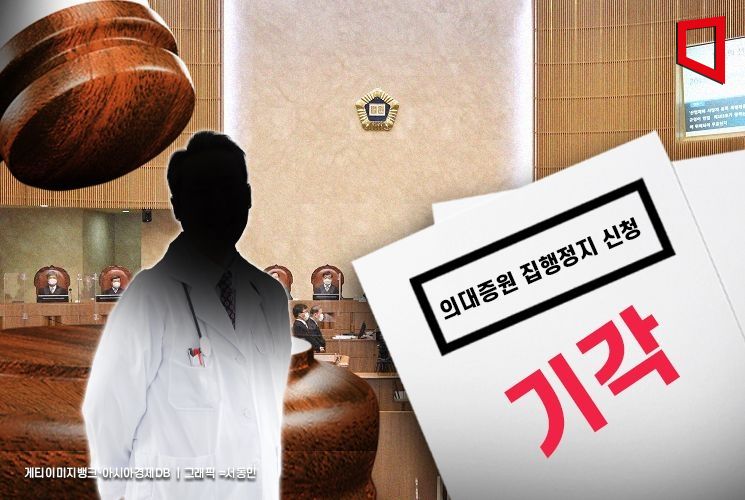
The Supreme Court's Second Division (Presiding Justice Shin Sook-hee) on the 19th dismissed the rehearing request for the suspension of execution filed by a total of 18 people, including four professors from Seoul National University College of Medicine, three residents from Yonsei University Hospital, five students from Pusan National University College of Medicine, and six medical school applicants. They had requested to suspend the enforcement of the Ministry of Health and Welfare Minister's '2025 academic year medical school quota increase announcement' and the Ministry of Education Minister's '2025 academic year medical school quota increase allocation.' The Supreme Court confirmed the Seoul High Court's original decision, which dismissed the other applicants' requests and rejected the requests of the medical students.
Previously, the Seoul High Court, which reviewed the appeal case of this request, judged that the Ministry of Education Minister's disposition to set medical school admission quotas was directed at university presidents, making medical school professors and residents 'third parties' who had no standing to challenge the disposition. While medical students, whose right to learn could be infringed, were recognized as having the right to request suspension of execution, the court dismissed the request, stating that it was necessary to protect the public interest by partially sacrificing their rights for the public welfare of 'medical reform through medical school quota increase.'
The Supreme Court found no problem with the conclusion of the lower court's decision. However, the Supreme Court noted that the lower court's recognition of the disposition nature of the Ministry of Health and Welfare Minister's announcement of the medical school quota increase was problematic, but since the conclusion to reject the request was appropriate, it would not overturn the lower court's decision on this basis.
The court explained, "This quota increase announcement is merely the Ministry of Health and Welfare Minister, a related central administrative agency head, announcing the content of consultations that the Ministry of Education Minister, the respondent, must go through when setting the recruitment quota of medical schools. There is no basis to consider that the Ministry of Education Minister is bound by the consultation content with the Ministry of Health and Welfare Minister, so it cannot be considered to affect the rights and obligations of the people," thereby denying the disposition nature.
It added, "The actual legal effect of the medical school quota increase can be seen as occurring externally only through this quota increase allocation. Therefore, there is no need to separately target this quota increase announcement in the appeal lawsuit apart from the quota increase allocation."
The court stated, "The request to suspend the effect of this quota increase announcement is inappropriate and should be dismissed. Therefore, although the lower court erred in dismissing some applicants' requests to suspend the effect of this quota increase announcement, the conclusion to reject the request is appropriate, so the lower court's decision will not be overturned on this ground."
On the other hand, the Supreme Court recognized the disposition nature of the Ministry of Education Minister's quota increase allocation disposition.
However, like the Seoul High Court, the Supreme Court denied the applicants' standing for medical school professors, residents, and medical school applicants, excluding medical students.
The court stated, "The lower court's judgment that the remaining applicants (excluding medical students) do not have a legal interest to request suspension of execution of this quota increase allocation disposition is appropriate."
The court cited the 'Regulations on University Establishment and Operation' and Article 31, Paragraph 1 of the Constitution, which guarantees the right to education, as grounds for recognizing the standing of medical students related to the quota increase allocation disposition.
The court explained, "According to Article 28 of the Enforcement Decree of the Higher Education Act, each university must comply with the matters determined by the Ministry of Education Minister regarding the quotas for recruitment units related to the training of medical personnel. Accordingly, when the Ministry of Education Minister sets the student quota for medical schools, the number of students is determined considering the classrooms, school grounds, faculty, and basic property for profit as stipulated in the 'Regulations on University Establishment and Operation.'"
It added, "According to the 'Regulations on University Establishment and Operation,' the area of basic educational facilities, support facilities, and research facilities that a medical school must have, as well as the number of faculty members that must be secured, are determined based on the number of students. When increasing the student quota, the medical school must meet these standards for the entire number, including the increase. This is interpreted as realizing the educational ideals set forth in Article 2 of the Framework Act on Education and further realizing the constitutional right to education guaranteed to medical students under Article 31, Paragraph 1 of the Constitution."
Finally, the court assessed the substantive requirements for granting the suspension of execution request filed by medical students.
The court stated, "Even if the quota increase allocation is not immediately suspended, the increased quota in 2025 is only for one academic year, so it is insufficient to conclude that the quality of education received by the medical student applicants will be significantly degraded."
It further added, "Due to the educational characteristics of medical schools, education necessary for training medical personnel often begins after one to two years of admission. Therefore, even if the increased number of new students enroll in the 2025 academic year, it is difficult to conclude that education necessary for training medical personnel will become impossible or that its quality will significantly decline."
The court noted, "In a situation where there is a forecast of a future shortage of doctors, suspending the execution of this quota increase allocation could cause significant disruption to the increase of medical school quotas, which plays a crucial role in public health. It should also be considered that suspending the execution could cause considerable confusion among examinees preparing for university entrance exams and the educational field, assuming the 2025 academic year medical school admission quotas have already been increased."
With the Supreme Court's explicit ruling on this day, the litigation between the government and the medical community over the medical school quota increase is expected to be effectively concluded for the time being. Currently, more than ten suspension of execution requests filed by the medical community against university presidents are pending at the Seoul High Court, and they are expected to be dismissed or rejected sequentially following the Supreme Court's ruling.
© The Asia Business Daily(www.asiae.co.kr). All rights reserved.
![Clutching a Stolen Dior Bag, Saying "I Hate Being Poor but Real"... The Grotesque Con of a "Human Knockoff" [Slate]](https://cwcontent.asiae.co.kr/asiaresize/183/2026021902243444107_1771435474.jpg)
















