Interview with An Hosang, President of Sejong Center for the Performing Arts
Sejong Center for the Performing Arts, Seoul Arts Center, and the National Theater of Korea are the three major public theaters representing South Korea. An Ho-sang, president of Sejong Center for the Performing Arts, has led two of these institutions. Before assuming the presidency of Sejong Center in October 2021, he served as the director of the National Theater for over five years starting in 2012. He also held key positions at Seoul Arts Center, having joined as part of the first public recruitment in 1984 and worked there for 23 years, serving as director of the Performance Business Bureau and the Arts Business Bureau, among others.
The biggest difference among the three institutions lies in whether they have affiliated arts organizations. Seoul Arts Center has no affiliated arts groups. In contrast, the National Theater has three affiliated arts groups (National Changgeuk Company, National Dance Company, National Gugak Orchestra), and Sejong Center has as many as eight, including the Seoul City Theater Company and Seoul City Opera Company.
With such a complex organization, President An has many tasks to handle. In an interview with Asia Economy, he said that despite his busy schedule, he finds time to quietly sit and enjoy performances at the theater. "When my head aches or I can't come up with good ideas, I often find comfort or inspiration by entering the theater alone to watch a performance. While performances are work, they also serve as a channel for new ideas, so I try to watch performances frequently at the National Theater, Seoul Arts Center, and now at Sejong Center. Even if I am overwhelmed with paperwork all day in the office, the theater seats never feel like a workplace but rather like a strange new place, which always excites me."
The organization and work at Sejong Center are expected to become even more complex in the future. This year, it took on the management of the newly founded Seoul City Ballet, and Sejong Center, which will celebrate its 50th anniversary in 2028, is preparing for significant changes.
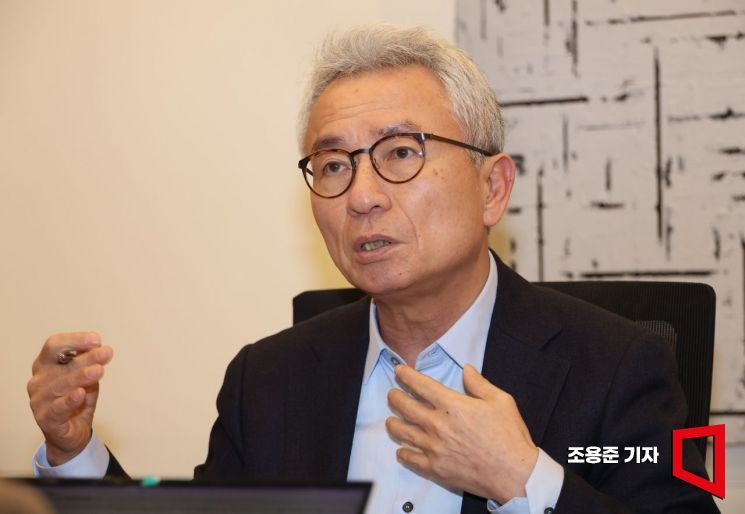 Manbojeongdam Interview - Ahn Ho-sang, President of Sejong Center for the Performing Arts. Photo by Jo Yong-jun jun21@
Targeting 6 to 7 Billion KRW in Revenue from Affiliated Arts Groups’ Performances
President An Ho-sang emphasizes Sejong Center’s identity as a theater that produces its own performances.
"Seoul Arts Center is a theater without affiliated arts groups. Sejong Center and the National Theater have had affiliated arts groups since their establishment. Since we have affiliated arts groups, we need to increase the number of self-produced performances."
Producing works independently inevitably involves significant burdens. Audiences tend to prefer widely known works, which directly affects theater revenue.
President An explained that the reason the proportion of performances by affiliated arts groups had been small was due to concerns about audience turnout and revenue. However, he said, "If Sejong Center excludes its affiliated groups and only invites external or overseas artists for performances, our artists will inevitably become marginalized." After taking office, President An boldly increased the proportion of performances by affiliated arts groups, and fortunately, results have followed.
Last year, paid attendance for affiliated arts groups’ performances increased by about 45%, and revenue rose by 57%. Revenue from affiliated arts groups’ performances grew from 2.1 billion KRW in 2022 to 3.3 billion KRW last year. President An stated that the annual production cost for affiliated arts groups is about 7 billion KRW, and the goal is to generate revenue at least equal to production costs.
"Making a lot of money is not the goal, but since Sejong Center uses public funds, it cannot rely solely on taxes. If there are areas where we can earn revenue, we must maximize it. We have a goal of earning around 6 to 7 billion KRW. Currently, affiliated arts groups spend about 7 billion KRW on production costs, so I think we should at least earn that much."
Performances by affiliated arts groups are risky but offer great rewards if successful. By creating repertoires and performing regularly, continuous revenue can be generated. In contrast, scheduling external performances is challenging due to artists’ availability, making it difficult to establish repertoires.
"Working with external groups can be much easier. However, while production is easier, it is harder to hold repeat performances. If we can produce good works properly, having affiliated arts groups is advantageous."
Dedicated Classical Music Hall in Gwanghwamun
Sejong Center will celebrate its 50th anniversary in 2028. In line with this, the Seoul Metropolitan Government plans to remodel the current Sejong Center in Gwanghwamun and build a second Sejong Center in Yeouido. The Gwanghwamun Sejong Center building is old, and there have been ongoing demands for remodeling. It has lacked proper acoustic facilities for classical performances, leading to dissatisfaction especially among classical music enthusiasts in northern Seoul. When internationally renowned orchestras perform at Sejong Center’s Grand Theater, some lament why the venue is not Seoul Arts Center or Lotte Concert Hall instead.
Regarding the dedicated classical hall, President An said he is currently pushing plans to convert the M Theater space, which mainly hosts plays and musicals, into a concert hall. "We are considering building an 1,800-seat concert hall and a 500-seat chamber hall vertically stacked in the space where M Theater is located. This way, the entire space can be fully utilized as a concert hall."
The Seoul City Ballet, officially founded this August, will be operated and managed by Sejong Center for the time being. Seoul City Ballet is the third public ballet company to be launched after the National Ballet in 1962 and Gwangju City Ballet in 1976, marking a 48-year gap. It successfully held a pre-launch performance, 'Festival of Spring,' in April and plans to stage the inaugural performance 'A Midsummer Night’s Dream' in August and a double bill in October.
Seoul City Ballet positions itself as a contemporary ballet company. Unlike classical ballets such as 'Swan Lake,' 'Giselle,' and 'The Nutcracker,' contemporary ballet has lower recognition and less audience interest.
President An said, "Performing contemporary ballet is a burden. We need to change the tastes and experiences of audiences who prefer classical ballet. We must promote that contemporary ballet offers as much enjoyment as works like 'Swan Lake' or 'Giselle' and work to expand public interest in new performances."
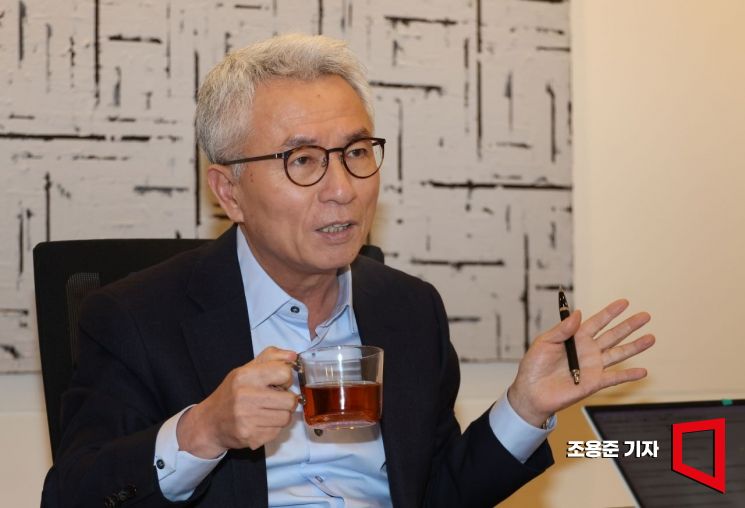 Manbojeongdam Interview - Ahn Ho-sang, President of Sejong Center for the Performing Arts. Photo by Jo Yong-jun jun21@
Theater as a Space for an Experience Detached from the Secular World
Before joining Seoul Arts Center, President An Ho-sang was distant from culture and the arts. His university major was political science and diplomacy. "It’s not that I did it because I loved the arts, but because I worked at Seoul Arts Center and became involved in arts management and theater administration, my lack of bias toward any particular performance genre is my strength."
However, among various performances, President An said he increasingly enjoys classical music concerts and finds them the most comfortable to watch these days. Classical performances have no language and can be enjoyed in a state of no thought or distraction. He explained that this feeling of detachment from the secular world is what theaters should offer audiences.
"Theater is a space that provides comfort and anticipation, and an experience independent from the world, that is, a feeling of separation from the secular. I want audiences to feel that the moment they step inside, they have entered a different world."
President An hopes more citizens can experience these feelings inside theaters. This is also why the Seoul City Opera Company, affiliated with Sejong Center, performed the outdoor opera 'Cavalleria Rusticana' at Gwanghwamun Square on the 11th and 12th. Since taking office, President An has increased cultural activities utilizing Gwanghwamun Square. Performances at Gwanghwamun Square are an extension of Sejong Center’s theater space. He said that outdoor performances at Gwanghwamun Square are an example of expanding the theater experience to customers.
"Watching good works inside the theater is important, but it is also important for audiences to experience the theater space itself. I want citizens to feel a completely new atmosphere just by entering the theater space. However, not everyone can easily access the theater, so sometimes we need to go outside to provide those experiences. When people have new experiences at Gwanghwamun Square, their curiosity will grow, making it more natural for them to come inside the theater."
© The Asia Business Daily(www.asiae.co.kr). All rights reserved.


















