Regular Press Briefing at Government Sejong Complex on the 19th
"Main Cause of Supply Instability is Abnormal Climate"
"Establishment of 'Climate Change Response Agricultural Supply Stabilization Plan' by Year-End"
Song Miryeong, Minister of Agriculture, Food and Rural Affairs, stated on the 19th that "the price situation of agricultural products is clearly improving." On the same day, Minister Song held a press conference at the Government Complex Sejong and said, "Since peaking in March this year, agricultural product prices have been showing a downward trend."
According to the Ministry of Agriculture, Food and Rural Affairs, the consumer price index for agricultural products peaked at 138.4 in March this year, then recorded 133.1 in April and 129.7 in May. Livestock and agricultural products have also been continuously declining since peaking at 128.6 in March.
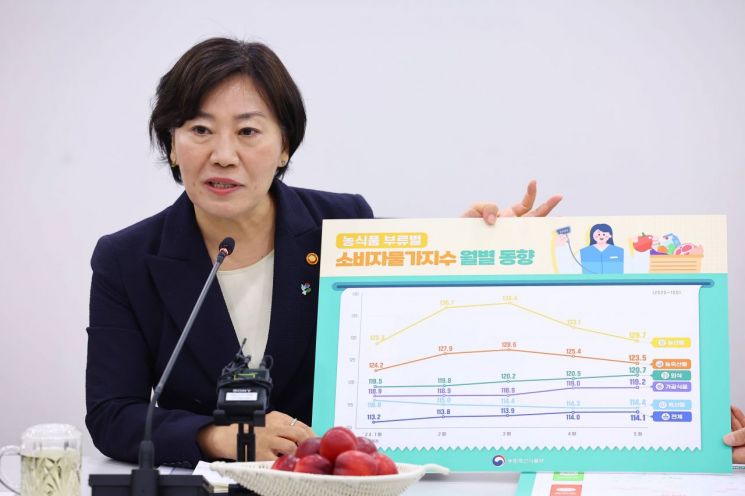 Song Mi-ryeong, Minister of Agriculture, Food and Rural Affairs, is holding a regular press briefing at the Government Complex Sejong on the 19th, explaining the recent price situation of agricultural and livestock products.
Minister Song explained, "I go to the mart every week to check the prices of livestock and agricultural products and do grocery shopping, and I feel the prices are dropping." She added, "Watermelon prices have fallen by 12.9% compared to last year, plums by 20.3%, and melons and Korean melons (chamoe) have dropped by 29.9% and 33.1%, respectively."
Minister Song said that during this summer, when damage from heavy rain, heatwaves, and typhoons is expected, they will strengthen growth management for summer cabbage, watermelon, Korean melon, and peaches. She stated, "The crops most affected in summer are Korean melon, watermelon, peaches, and summer cabbage. We have stockpiled 10,000 tons of spring cabbage with good yields and secured 23,000 tons of government-available quantities through the Nonghyup shipment control facility and contract farming." She added, "For Korean melon, watermelon, and peaches, we will minimize damage by maintaining reservoirs and drainage channels."
The apple production this year is expected to recover to the average level. Minister Song emphasized, "Fortunately, we overcame the cold damage well this year. There are still issues such as fruit drop and anthracnose caused by heavy summer rain, but we will strive to minimize the damage. Since the fire blight disease is not expected to affect supply and demand as much as last year, we expect production to be around the average level."
The Ministry of Agriculture, Food and Rural Affairs views climate change as the fundamental cause of recent price crashes due to unstable supply and demand of agricultural products and plans to establish supply-demand stabilization measures responding to climate change by the end of this year. Minister Song said, "Last year, the damage caused by climate change was so severe that the production volume of apples and others sharply decreased. Despite these changes, we need ways to improve productivity." She added, "We will form and operate a task force (TF) with related agencies such as the Korea Meteorological Administration, Statistics Korea, Rural Development Administration, and experts to create production and supply-demand stabilization measures responding to climate change."
To stabilize prices of dining out and processed foods, efforts will be made to reduce labor cost burdens. From this year, foreign workers with E-9 visas can work in restaurants, but there are restrictions such as Korean restaurant business experience in 100 regions nationwide. Minister Song said, "The price of one serving (200g) of samgyeopsal (pork belly) has exceeded 20,000 won, but pork, the main ingredient, accounts for only 17% of that price." She added, "The rest reflects labor costs and rent, so we are consulting with related ministries on lifting restrictions on the non-professional employment (E-9) visa that allows foreigners to work in restaurants to reduce labor costs."
© The Asia Business Daily(www.asiae.co.kr). All rights reserved.
![Clutching a Stolen Dior Bag, Saying "I Hate Being Poor but Real"... The Grotesque Con of a "Human Knockoff" [Slate]](https://cwcontent.asiae.co.kr/asiaresize/183/2026021902243444107_1771435474.jpg)
















