Preparation of Seoul-style Landlord Housing Management Plan
Accelerate Support for Successful Areas
Encourage Resolution in Slower Areas Before Damage Increases
Seoul City is launching a full-scale evaluation to remove the stigma of regional housing cooperatives, often called 'Jiok Jutaek Johap' (Hell Housing Cooperatives). Successful projects will be expedited, while those with unclear or slow progress will be encouraged to dissolve quickly before members suffer greater losses.
On the 19th, Seoul City announced that it will implement the 'Seoul-type Regional Housing Cooperative Management Plan' in earnest.
Currently, there are 118 regional housing cooperative projects in Seoul, with over 70%, or 87 projects, effectively stalled. These projects have not received district unit plans and remain at the stage of member recruitment notification.
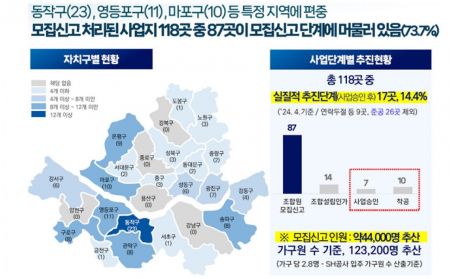
Regional housing cooperatives can provide newly built apartments at affordable costs if the projects proceed normally, but successful cases are extremely rare. Instead, many members have faced difficulties and financial burdens. This is because there have been many cases of recruiting members or mismanaging project funds despite unclear project progress.
The city has conducted comprehensive surveys of regional housing cooperatives, published collections of damage cases, and requested legal amendments from the Ministry of Land, Infrastructure and Transport (such as granting district mayors the authority to dissolve cooperatives). However, as projects prolong, members’ financial burdens and damages increase, so these measures were prepared ahead of legal amendments.
Seoul City will first actively support regional housing cooperative projects that are lawful and progressing smoothly, helping them to swiftly proceed with redevelopment procedures. Approximately 20 such projects are identified in Seoul, moving forward without conflicts.
Conversely, projects struggling with land acquisition and past their sunset deadlines will be encouraged to voluntarily dissolve according to relevant laws. Projects that have been stagnant for a long time and are subject to forced dissolution by district mayors will also be identified. For these projects, a joint expert liquidation support team and coordinators will be dispatched. The liquidation support team will provide advice to prevent unfavorable liquidation plans for members, and coordinators will assist in finding project methods suited to local conditions.
Especially for projects past their sunset deadlines, support will be provided to hold general meetings to decide on project termination. A 'Dissolution General Meeting Guideline' will be distributed to help members make informed decisions based on their understanding of project procedures.
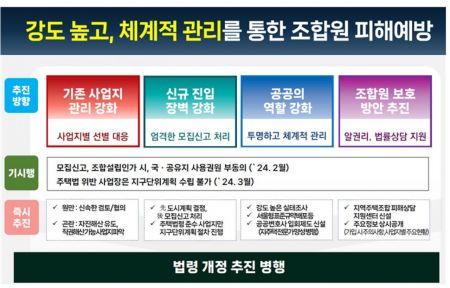
Entry requirements for new regional housing cooperative projects will also be strengthened. Urban planning will be conducted first to prevent recruiting members with false or exaggerated plans, changing the process so recruitment can only occur after planning. Previously, members were recruited before district unit plans were established.
Additionally, when national or public land is involved, land use rights will be considered secured only if explicit consent has been received. In unavoidable cases where the cooperative or promoters have substantially secured private land use rights but cannot meet legal requirements, exceptions will be handled through meetings with property management departments. Furthermore, district unit plans will only be decided for projects that fulfill information disclosure and other obligations.
Public lawyers will be required to attend general meetings where major agendas such as fund borrowing, contractor selection, and cooperative dissolution are decided. Standardized project-related forms, including the Seoul-type standard bylaws, will be shared. Cooperatives that fail to address issues pointed out in surveys conducted since 2021 will have administrative procedures such as permits suspended.
Seoul City will establish a Regional Housing Cooperative Damage Consultation Support Center in the second half of this year to provide legal consultations.
Han Byung-yong, Director of Seoul City’s Housing Policy Office, said, "To prevent regional housing cooperative project entities from relying on fees collected from members, we will raise land ownership requirements at the time of cooperative establishment approval and propose banning collateral loans on part of the acquired land to improve the system. We will also intensively manage ongoing projects to minimize member damages and prevent housing oversupply."
© The Asia Business Daily(www.asiae.co.kr). All rights reserved.


















