Financial Supervisory Service Releases 'Best Execution Obligation' Guidelines
Taker Orders Favor ATS
Maker Orders Favor Korea Exchange
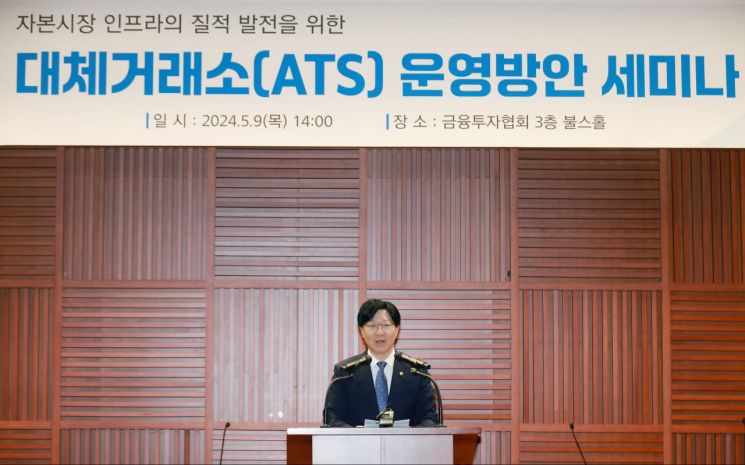
With the launch of the Alternative Trading System (ATS) scheduled for the first half of next year, the principle of 'best execution obligation' has been disclosed. Orders that execute existing volume (Taker) should choose the exchange with lower costs, while orders that create new volume (Maker) should select the exchange with a higher likelihood of execution. If there are no instructions from investors, orders executing existing volume are likely to be routed to the ATS with lower fees, and orders creating new volume are expected to be placed on the Korea Exchange. Considering this, the ATS is reported to set transaction fees 20% lower for Taker orders and 40% lower for Maker orders.
On the 19th, the Financial Supervisory Service (FSS) announced the 'Best Execution Obligation Guidelines for Securities Firms' containing these details. The detailed standards for best execution apply to 'listed securities' in the securities market and 'listed depositary receipts' related to securities.
Once the ATS is introduced, the principle of 'best execution obligation' must be applied to determine whether securities firms place orders at the most favorable conditions. However, if there are investor instructions, those take precedence over the detailed best execution standards.
Securities firms must establish a system to execute orders based on the 'consolidated order book' of multiple execution markets according to the best execution standards. Also, the order execution standards instructed by investors to securities firms are valid for a maximum of three months. Therefore, before expiration, investors must be notified at least three times that the instruction will expire. If there are no separate instructions from investors, orders will be placed according to the best execution standards.
The general principle of best execution, which has attracted market attention, is applied differently depending on whether the order is Taker or Maker. Taker orders have a high likelihood of execution, so orders should be placed on the exchange with lower costs. Conversely, if there are few or no trading orders in the order book, the exchange with a higher likelihood of trade execution should be selected.
An FSS official explained, "The best execution principle means that securities firms should reasonably allocate orders according to the order book. Since Taker orders are certain to be executed, considering costs, ATS may be more advantageous, but for Maker orders, the Korea Exchange, which has higher trading volume, may be more favorable."
© The Asia Business Daily(www.asiae.co.kr). All rights reserved.
![Clutching a Stolen Dior Bag, Saying "I Hate Being Poor but Real"... The Grotesque Con of a "Human Knockoff" [Slate]](https://cwcontent.asiae.co.kr/asiaresize/183/2026021902243444107_1771435474.jpg)
















