Extremely Difficult Pull-Up Scores Rarely Achieved Normally
This Year's Exam Is 'Abnormal'... Undergoing Authorities' Thorough Investigation
The results of India's medical school entrance exam, 'NEET-UG,' have sparked nationwide outrage. This exam is notorious for its extreme difficulty, making it very hard to achieve high scores under normal circumstances. However, this year, thousands of 'abnormal' high scorers emerged, triggering allegations of cheating.
On the 18th (local time), the British BBC reported that examinees across India took to the streets in protest. The anger of the examinees was ignited by the recently held medical school exam, 'NEET-UG.'
All students aspiring to enter medical schools in India must take this exam, which is infamous for its tremendous difficulty. Every year, millions of students take the test, but only a very small number pass. Even the best students find it difficult to barely meet the passing score. However, this year, thousands of students received abnormal high scores, and as a result, the previously high scorers were pushed down in the relative evaluation and could not enter medical schools.
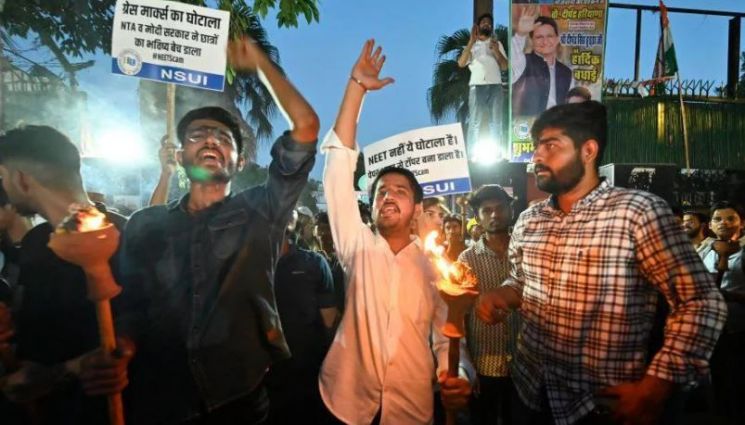
The exam results were announced on the 4th. However, after examinees raised suspicions of cheating, the exam organizers are now subject to multiple thorough investigations by authorities. Some examinees have even submitted petitions to the courts demanding a retest.
Ultimately, the Indian Minister of Education acknowledged on the 16th that "some cheating" was revealed in certain exams. In connection with this, the Indian Supreme Court reportedly sent a notice stating that "even if someone's fault is at the level of 0.001%, it must be thoroughly investigated."
The intense anger of Indian examinees stems from India's uniquely strict entrance exam system. Today, admission to prestigious universities in India is considered an essential factor for success. In particular, medical and engineering schools are known to be the most popular. This is because doctors and engineers are the most respected professions in India.
In this year's NEET exam, the highest-level university quota was reportedly only about 110,000 seats. A staggering 2.4 million examinees competed for these spots. Of the total quota, 55,000 to 60,000 seats are offered by national and public universities, while the rest are provided by private universities.
Competition for public universities with lower tuition fees is said to be especially fierce. The five-year tuition fee at Indian public universities ranges from 500,000 to 1,000,000 rupees (approximately 8 to 16 million KRW), but private universities charge as much as ten times that amount. It is known that typical Indian households find it difficult to afford private university tuition fees.
© The Asia Business Daily(www.asiae.co.kr). All rights reserved.
![Clutching a Stolen Dior Bag, Saying "I Hate Being Poor but Real"... The Grotesque Con of a "Human Knockoff" [Slate]](https://cwcontent.asiae.co.kr/asiaresize/183/2026021902243444107_1771435474.jpg)
















