Daekyohyeop '2024 University Presidents Survey' Results
Metropolitan Cities and Small Universities Focus on 'Freshman Recruitment'
'Curriculum Reform' Selected as University Innovation Task
77% of Universities Say "No AI Policy Established on Campus"
Amid the ongoing financial crisis faced by universities due to the declining school-age population, university presidents nationwide have shown the greatest interest in government financial support projects. Universities in metropolitan cities, provincial-level universities, and small-scale universities are confirmed to be focusing on recruiting and filling new students.

According to the "2024 University Presidents Survey Results" announced by the Korea Council for University Education on the 19th, the highest priority area of interest among university presidents was "financial support projects," accounting for 71.8% (94 respondents). This is similar to the results of the same survey last year.
This appears to be due to the worsening university finances and the problem of unfilled new student quotas caused by the recent decline in the school-age population. Since 2014, the number of enrolled students in four-year general universities has been decreasing, and the new student enrollment rate is also declining.
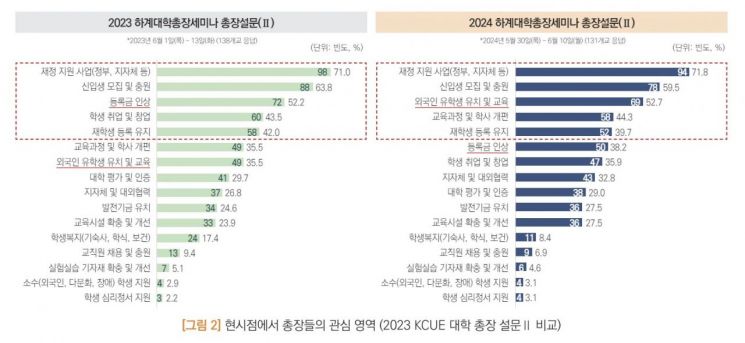
The next areas of interest were "new student recruitment and enrollment (78 respondents, 59.5%)," "attracting and educating international students (69 respondents, 52.7%)," "curriculum and academic reform (58 respondents, 44.3%)," "retaining enrolled students (52 respondents, 39.7%)," and "tuition fee increases (50 respondents, 38.2%)."
Compared to the previous year, interest in attracting and educating international students rose sharply (35.5% → 52.7%), while interest in tuition fee increases declined (52.2% → 38.2%).
New student recruitment and enrollment were prioritized by universities in metropolitan cities, provincial-level universities, and small-scale universities, but did not rank among the top priorities for universities in the Seoul metropolitan area and large-scale universities. Attracting and educating international students was not among the top priorities for national/public and small-scale universities.
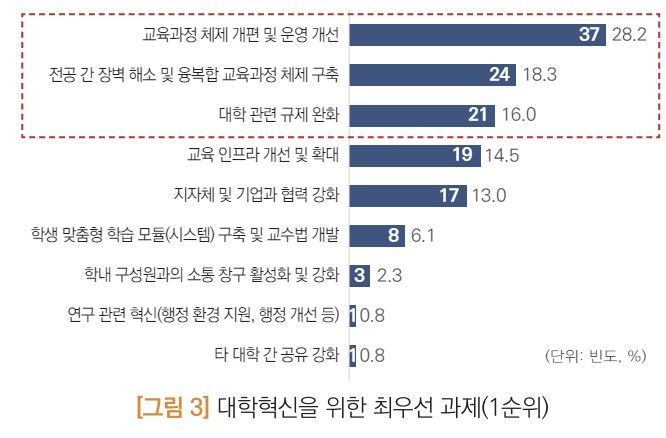
The top priority for university innovation was "curriculum system reform and operational improvement" (28.2%). This was followed by "breaking down barriers between majors and establishing interdisciplinary curriculum systems" (18.3%) and "relaxation of university-related regulations" (16.0%).
By university type, national/public universities prioritized strengthening cooperation with local governments and businesses; metropolitan area universities prioritized both relaxation of university-related regulations and strengthening cooperation with local governments and businesses. Large-scale universities identified breaking down barriers between majors and establishing interdisciplinary curriculum systems, as well as improving and expanding educational infrastructure, as their top priorities.
Regarding the impact of generative AI on the future university society, 83.2% (109 respondents) viewed it positively. The most positive aspect cited was "advancement of educational services and personalized learning." Innovative changes in teaching and learning methods and improved abilities to access, expand, and utilize knowledge and information were also noted as positive factors.
On the other hand, only a small minority, 7.6% (10 respondents), responded that generative AI would have a negative impact.
However, most universities (101 respondents, 77.1%) answered that specific school policies regarding generative AI have not yet been established. Only 22.9% (30 respondents) reported applying related policies. Regarding AI utilization methods, "offering courses related to generative AI" (58 respondents, 44.3%) was the most frequently selected, followed by "chatbots" (54 respondents, 41.2%) and "research and data analysis" (49 respondents, 37.4%).
The Korea Council for University Education emphasized, "Universities are keenly aware of the need for change and innovation," and added, "For university innovation, it is essential to improve university regulations and expand and stabilize government funding for higher education."
The Korea Council for University Education announced the analysis results of this survey in conjunction with this year's Summer University Presidents Seminar. The survey was conducted from May 30 to June 10 targeting presidents of 190 member universities, with responses from presidents of 131 universities.
From June 19 to 20, the Korea Council for University Education will hold the Summer University Presidents Seminar at the Grand Hyatt Incheon Hotel in Jung-gu, Incheon, with presidents from 135 universities nationwide attending. The seminar's theme is "Tasks for the Co-growth of Universities and Local Communities."
© The Asia Business Daily(www.asiae.co.kr). All rights reserved.
![Clutching a Stolen Dior Bag, Saying "I Hate Being Poor but Real"... The Grotesque Con of a "Human Knockoff" [Slate]](https://cwcontent.asiae.co.kr/asiaresize/183/2026021902243444107_1771435474.jpg)


















