The Hyundai Motor Chung Mong-Koo Foundation organized a lecture to communicate the significance of climate tech research and engage with future generations.
On the 19th, the foundation announced that it held the 'Climate Tech Open Lecture' on the 18th at the OnDream Society located in Myeongdong, Seoul.
The foundation held this public lecture to convey the necessity and meaning of climate tech research to future generations and to maintain ongoing communication. Additionally, last year, it launched a social innovation project to nurture entrepreneurial researchers in the climate tech field and support challenges such as startups and commercialization to respond to global climate change.
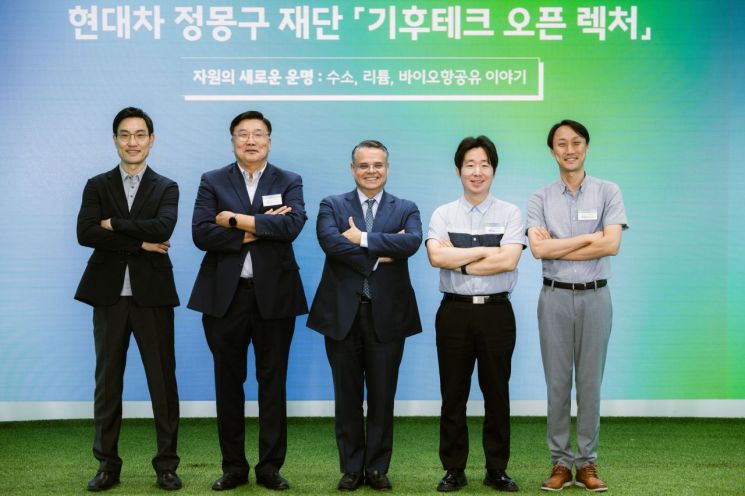 (Photo from left) Choi Jae-ho, Secretary General of Hyundai Motor Chung Mong-koo Foundation; Jeong Heon, Principal Researcher at Korea Institute of Energy Research; Henry Gonzalez, Deputy Secretary General of the Green Climate Fund (GCF); Jeong Da-woon, Senior Researcher at Korea Institute of Industrial Technology; Park Cheol-ho, Principal Researcher at Korea Institute of Energy Research. Photo by Hyundai Motor Chung Mong-koo Foundation
The first session of the lecture featured Henry Gonzalez, Deputy Secretary-General of the Green Climate Fund, who delivered the keynote speech on the topic of 'Sustainability of Climate and Technology.' Deputy Secretary-General Gonzalez cited the case of financing the e-mobility transition in Latin America to create climate-resilient urban spaces. He stated, "Technological innovation is key to addressing global climate issues, and support and investment in climate tech can open new markets and opportunities, significantly expanding the scale of climate response in regions worldwide."
During the discussion session, three research teams from the Green Society and science communicator Lee Dok-sil engaged in a lively debate on hydrogen, lithium, and bio-aviation fuel, which are key resources necessary to achieve carbon neutrality. In the hydrogen sector, Cheol-ho Park, Principal Researcher at the Korea Institute of Energy Research, introduced his research titled 'Development of Next-Generation Hollow Fiber Membranes for Hydrogen Purification through Sub-micrometer Selective Layer In-line Nano Coating Process.' He emphasized that achieving carbon neutrality requires high-purity gas-phase substances such as hydrogen and carbon dioxide, and that developing processes and materials that consume the least energy is highly meaningful.
In the lithium sector, Da-woon Jung, Senior Researcher at the Korea Institute of Industrial Technology, presented his research on 'Development of Carbon-Neutral Next-Generation Lithium Concentration Technology Using DLE Method.' He mentioned that supplying lithium resources, which have been environmentally destructive and concentrated in supply chains, in a new way is significant for enabling self-reliance in the electric vehicle industry.
In the bio-aviation fuel sector, Heon Jung, Principal Researcher at the Korea Institute of Energy Research, introduced his research on 'Carbon-Neutral Bio-Aviation Fuel Production Using Biomass.' He explained that sustainable aviation fuel can contribute up to 65% to carbon neutrality in the aviation sector and can reduce carbon emissions by up to 80% compared to petroleum-based aviation fuel, thus greatly aiding in achieving carbon neutrality.
© The Asia Business Daily(www.asiae.co.kr). All rights reserved.