Hong Jun-pyo "Original Organization Not Subject to Constitutional Court Review"
Persistent Powerlessness Toward 'Special Committee Politics'
On the 18th, the People Power Party filed a constitutional dispute petition with the Constitutional Court regarding Speaker Woo Won-sik and the Democratic Party's unilateral election of the National Assembly standing committee chairpersons and the forced assignment of standing committee members. Meanwhile, voices of opposition have emerged both inside and outside the party. This is due to fatigue from the prolonged negotiation over the formation of the National Assembly and a sense of powerlessness in taking parliamentary matters to the judiciary.
Joo Jin-woo, the legal advisory chairman of the People Power Party, along with about 10 others, submitted a petition for a constitutional dispute trial to the Constitutional Court in Jongno-gu, Seoul, in the afternoon. The petition was filed on behalf of 108 People Power Party lawmakers to confirm the invalidity of the forced assignment of standing committee members and the election of standing committee chairpersons.
The People Power Party claimed that the election of 11 standing committee chairpersons, including the Steering Committee Chair, and the forced assignment of ruling party members to those committees, as well as the exclusion of the remaining 11 standing committees, decided at the second plenary session of the National Assembly on the 10th, were "unconstitutional and dictatorial acts."
The People Power Party also opposed the forced assignment of standing committee members by then Speaker Park Byeong-seok of the Democratic Party in 2020, when the 21st National Assembly was inaugurated, and filed a constitutional dispute petition with the Constitutional Court.
This petition to the Constitutional Court differs from the one filed four years ago by then floor leader Joo Ho-young alone; this time, all ruling party lawmakers at the start of the 22nd term are petitioners, requesting a judgment on whether the Speaker violated political neutrality, according to the People Power Party.
However, criticism has arisen that asking the judiciary to resolve an internal parliamentary issue such as the formation of the National Assembly is itself problematic. Hong Joon-pyo, mayor of Daegu, pointed out on Facebook that "the formation of the National Assembly is a matter of parliamentary autonomy and is not subject to the Constitutional Court's constitutional dispute jurisdiction," adding, "Dragging all issues to the judiciary indicates a lack of political capability."
Mayor Hong also warned, "Politics that frequently resort to lawsuits in courts or the Constitutional Court leads to the judicial subjugation of politics and may eventually cause the National Assembly to become ineffective," urging, "Politics is fundamentally about dialogue and compromise. Even if difficult, resolve issues through dialogue and compromise."
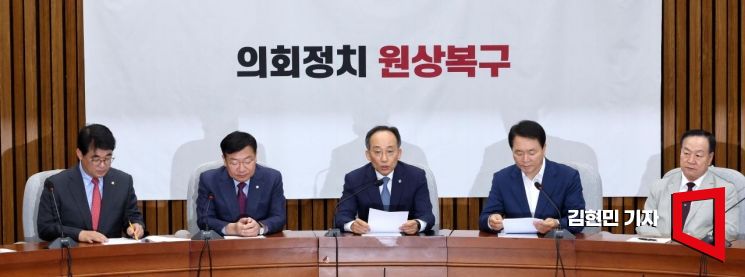 Chu Kyung-ho, floor leader of the People Power Party, is speaking at the party's strategy meeting held at the National Assembly on the 18th. Photo by Hyunmin Kim kimhyun81@
There are also criticisms that even if the case is filed with the Constitutional Court, it will take considerable time to reach a judgment, reducing its effectiveness. The constitutional dispute petition filed in 2020 was dismissed in September 2023, three years later.
The ruling party is proposing bills through special committee meetings and field visits and communicating with the government, but there are clear limitations when standing committees are not operating normally, leading some lawmakers to still express a sense of powerlessness. A ruling party official said, "Even amid confrontation between the ruling and opposition parties, activities to try to do something for people's livelihoods must continue," adding, "For legislation to follow, the negotiation over the formation of the National Assembly must be settled."
© The Asia Business Daily(www.asiae.co.kr). All rights reserved.
![Clutching a Stolen Dior Bag, Saying "I Hate Being Poor but Real"... The Grotesque Con of a "Human Knockoff" [Slate]](https://cwcontent.asiae.co.kr/asiaresize/183/2026021902243444107_1771435474.jpg)
















