On the Day of Putin's Visit to North Korea, Korea-Japan-China Cooperation Forum in Seoul
Chinese Foreign Minister Wang Yi: "Cooperation Among the Three Countries is Key to Global Peace"
Diplomatic authorities from South Korea, Japan, and China unanimously emphasized that the three countries must unite more than ever amid the changing global landscape. Ahead of Vladimir Putin's visit to North Korea, the three nations reaffirmed their commitment to cooperation in Seoul.
On the 18th, Cho Tae-yeol, Minister of Foreign Affairs, delivered a written congratulatory message at the "2024 Korea-Japan-China Trilateral Cooperation International Forum" hosted by the Trilateral Cooperation Secretariat (TCS) at the Four Seasons Hotel in Seoul, stating, "Even amid today's grave regional situation and global complex crises, cooperation among the three neighboring countries that have shared thousands of years of history, representing one-fifth of the world's population and one-quarter of global GDP, is more necessary than ever."
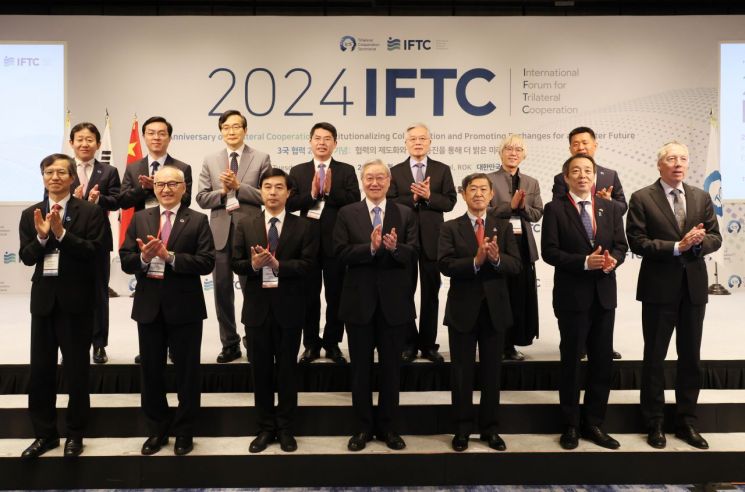 At the opening ceremony of the Korea-Japan-China trilateral cooperation international forum held on the 8th at the Four Seasons Hotel in Jongno-gu, Seoul, attendees including former Minister of Foreign Affairs and Trade Kim Sung-hwan and Koichi Mizushima, Ambassador of Japan to Korea, are taking a commemorative photo.
 [Photo by Yonhap News]
Kang In-sun, the Second Vice Minister of Foreign Affairs, said at the forum, "Everyone knows and agrees on the importance of trilateral cooperation, but the path ahead may not be smooth," adding, "The greater the difficulties, the more important the cooperation among South Korea, Japan, and China, neighbors with thousands of years of shared history and global powers." He particularly noted that the trilateral cooperation marked a "new leap forward" following last month's trilateral summit held in Seoul, emphasizing, "The Korean government will strive to develop this positive momentum to further solidify the future of trilateral cooperation."
Wang Yi, Director of the Central Foreign Affairs Office of the Communist Party of China and Foreign Minister, said in a written congratulatory message, "This year marks the 25th anniversary of trilateral cooperation," evaluating that "over the past 25 years, trilateral cooperation has developed into one of the most influential multilateral cooperation mechanisms in Asia, playing a key role in benefiting the peoples of the three countries and promoting regional and global peace and prosperity."
Sing Hai-ming, Chinese Ambassador to South Korea, also stated on-site, "Trilateral cooperation to promote regional and global peace and development is more important than ever," adding, "If we join forces, the path of China-Korea-Japan cooperation will become broader, the pace more stable, and the achievements more abundant."
Yoko Kamikawa, Japanese Minister of Foreign Affairs, said in a written congratulatory message, "As the world is facing a historical turning point, the potential for the three countries to cooperate further is great." Koichi Mizushima, Japanese Ambassador to South Korea, pledged to prepare well for the next summit as the chair country.
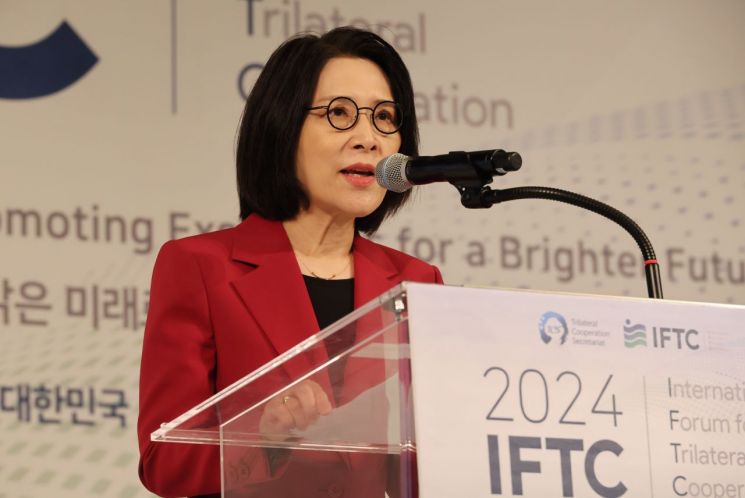 On the 18th, Kang In-seon, the 2nd Vice Minister of Foreign Affairs, delivered a congratulatory speech at the opening ceremony of the Korea-Japan-China Trilateral Cooperation International Forum held at the Four Seasons Hotel in Jongno-gu, Seoul.
 [Photo by Yonhap News]
At the forum, various proposals were made to strengthen trilateral cooperation.
Cho Yang-hyun, Director of the Japan Research Center at the Korea National Diplomatic Academy, pointed out that although the three leaders had agreed to regularize meetings several times, some were suspended due to bilateral historical and territorial disputes and US-China competition. He emphasized the need to establish a tradition of continuous multilateral cooperation among South Korea, Japan, and China, similar to ASEAN (Association of Southeast Asian Nations), which holds regular summits. He particularly stressed that the Chinese president, rather than the premier, should attend.
Director Cho said, "It is true that US-China competition affects trilateral cooperation," adding, "It is important for future trilateral cooperation to ensure that the competitive elements of the US-China system do not negatively impact trilateral cooperation."
Ning Fukui, former Chinese Ambassador to South Korea, also emphasized, "Trilateral cooperation should not be influenced by geopolitical politics," stating, "Avoiding Cold War thinking and pursuing regional peace and stability is the shared responsibility of the three countries."
Kunihiko Miyake, Cabinet Office Counselor of Japan, mentioned that expanding the scope of trilateral cooperation activities is worth considering. He proposed, "While maintaining the basic framework of trilateral cooperation, we should expand the participating countries and the scope of activities." Referring to the plan agreed upon at last month's trilateral summit to cooperate with Mongolia on reducing East Asian yellow dust, he said this approach "could be a breakthrough."
© The Asia Business Daily(www.asiae.co.kr). All rights reserved.
![Clutching a Stolen Dior Bag, Saying "I Hate Being Poor but Real"... The Grotesque Con of a "Human Knockoff" [Slate]](https://cwcontent.asiae.co.kr/asiaresize/183/2026021902243444107_1771435474.jpg)

















