KRA Exports Live Horse Racing Broadcasts to 24 Countries in Asia, Europe, and North America Since 2013
Achieves Cumulative Sales of 650 Billion Won
Korean horse racing is emerging as K-content enjoyed by people worldwide. The Korea Racing Authority (KRA), which has been exporting live Korean horse racing broadcasts to Asia, North America, Europe, and Oceania, has expanded its exports this year to South America and Africa, enabling K-horse racing to be enjoyed live across all continents.
On the 19th, the KRA announced that since starting live Korean horse racing broadcast exports in 2013, it has achieved 24 regular export countries and cumulative sales of 650 billion KRW over 12 years.
The KRA’s overseas live broadcast export business, which began with a pilot broadcast to Singapore in December 2013, involves exporting live Korean horse racing videos, commentary, and racing information abroad. Each country sells betting tickets through their domestic betting operators, and the KRA receives a certain commission from the betting sales.
Live broadcast exports have grown as K-content promoting Korean horse racing and leading the global expansion of Korea’s horse industry. Especially amid the risk of collapse of the horse industry due to the suspension of Korean horse racing caused by the COVID-19 pandemic, the KRA pursued a more aggressive strategy by securing export channels. As a result, regular exports expanded to 8 countries in 2021 and 6 countries in 2022.
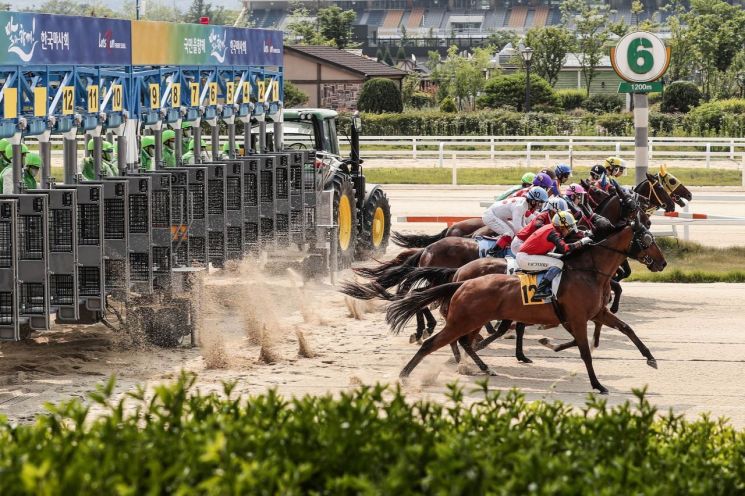
This year, the KRA expanded English horse racing information services and global promotion of Korean horse racing, exporting live Korean horse racing broadcasts to the continents of South America (Brazil) and Africa (Republic of South Africa). The export of K-horse racing live broadcasts enjoyed across all continents in 24 countries achieved sales of approximately 27.2 billion KRW in the first quarter of this year, a 13% increase compared to the previous year. This is the highest sales performance ever through the largest number of export countries.
The KRA is aiming for a new leap forward in its live broadcast export business. Macau and Singapore, traditionally regarded as strong Asian horse racing countries, decided to close their racecourses in April and October of this year, respectively, due to financial difficulties. The KRA’s strategy is to fill the void left by Macau and Singapore with K-horse racing.
A KRA official said, "The 24 importing countries cited stability as a strength of K-horse racing. Because a public corporation oversees horse racing operations, fairness is guaranteed, and races are held year-round in various climates, allowing continuous content provision." Indeed, Cornel McSoley, a live broadcast import official from the UK, the birthplace of horse racing, evaluated, "Korea has been providing high-quality live racing content stably for a long time. It is attractive because it offers British horse racing fans high-level races and analytical materials."
The KRA is solidifying its global position aiming to become a leading horse racing nation. After persistent efforts including infrastructure improvements such as racecourses and training facilities for racehorses to meet international standards, strengthening the capabilities of horse racing professionals like trainers and jockeys, and upgrading computer systems for betting ticket sales, Korea was recognized as a Part 2 (PARTⅡ) country in 2016, which corresponds to a secondary tier.
Jung Ki-hwan, Chairman of the KRA, emphasized, "The Korean horse racing live broadcast export business is expected to achieve greater growth in overseas markets based on stability and reliability," adding, "The KRA will do its best to enter the ranks of advanced horse racing countries and become a global top 5 leading company in the horse industry."
© The Asia Business Daily(www.asiae.co.kr). All rights reserved.
![Clutching a Stolen Dior Bag, Saying "I Hate Being Poor but Real"... The Grotesque Con of a "Human Knockoff" [Slate]](https://cwcontent.asiae.co.kr/asiaresize/183/2026021902243444107_1771435474.jpg)
















