40% of Office Workers Have Side Job Experience
High Earners Also Join the N-Job Trend
Using Side Jobs for Job Change and Employment Preparation
#Choi (31), a marketer in his third year, opened an Instagram account last month as a side job. Choi uploads short-form content featuring his own household tips, such as reviews of kitchenware, to the account. His goal is to reach 10,000 followers. He learned from an acquaintance who started Instagram side jobs earlier that many advertising offers come in once the follower count hits 10,000.
#Office worker Kim Ju-young (32) is dedicating her time after work to writing a manuscript to publish an e-book about her successful diet secrets. Having lost 12kg, Kim decided to create a PDF file detailing the exercise and diet control know-how she used and sell it on freelance market platforms. She plans to use the experience of publishing an e-book as part of her portfolio when changing jobs.
Recently, as prices rise but wage growth stagnates, the so-called 'N-jobbers'?people securing various sources of income beyond their labor income?are increasing. While side jobs were once an unavoidable choice to overcome financial difficulties, they now seem to be established as a form of self-development aimed at achieving economic freedom.
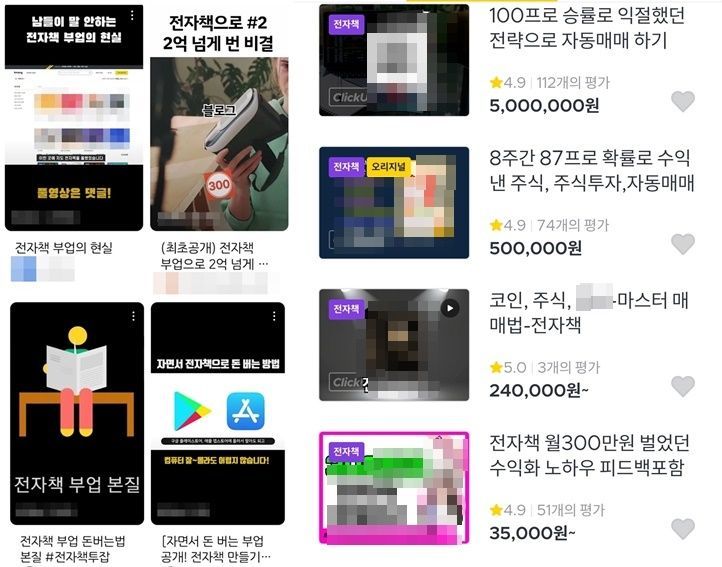 On the 18th, a video about how to generate income through e-book publishing was posted on YouTube (photo left). On the freelancer market platform Kmong (photo right), e-books published by individuals are being distributed. [Image source=YouTube, Kmong screenshot]
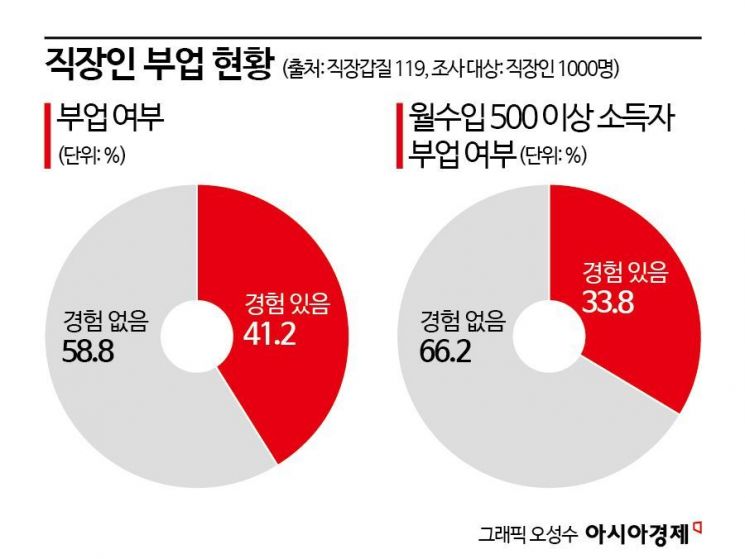
In fact, 4 out of 10 office workers have experience generating income through side jobs. According to a survey conducted by the labor civic group 'Workplace Power Harassment 119' from the 31st of last month to the 10th of this month targeting 1,000 office workers, 41.2% of respondents said they had experience doing other work alongside their main job for additional income. Among high earners (145 people) making over 5 million KRW per month, 33.8% reported having side job experience.
It is analyzed that high earners, whose monthly income exceeds the median income for single-person households (about 2.22 million KRW), engage in side jobs largely for personal skill enhancement and self-development reasons.
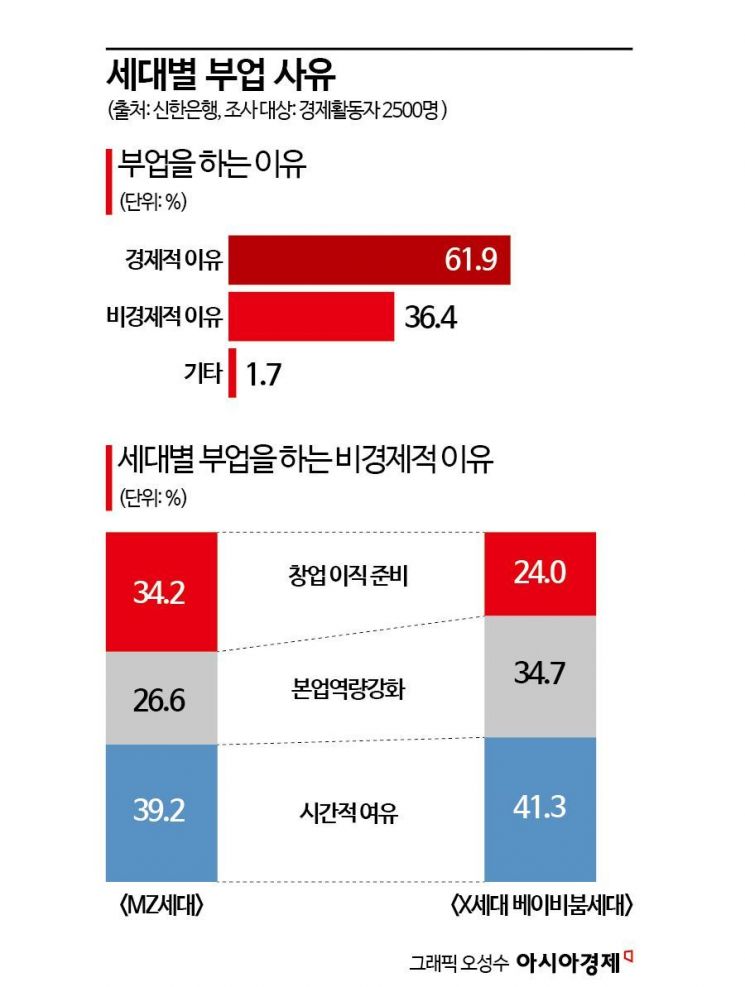
The trend of side jobs evolving into means beyond securing living expenses is also reflected in statistics. According to the 'Ordinary People Financial Life Report' released by Shinhan Bank in April, among 2,500 economically active people, 61.9% said they do side jobs for non-economic reasons.
Among them, the MZ generation (Millennials + Generation Z) tends to choose side jobs more for self-development compared to Generation X (born 1965?1980) and Baby Boomers (born 1946?1964). For example, 34.2% of MZ respondents said they do side jobs for entrepreneurship or job change preparation, while only 24% of Generation X and Baby Boomers said the same. Conversely, Generation X and Baby Boomers had a higher percentage (41.3%) citing time availability as their reason for side jobs.
As side jobs transform into a form of self-development, the types of side jobs are diversifying. While side jobs in the past were limited to supplementary means to overcome financial hardship, such as substitute driving and service part-time jobs, recently, high value-added occupations that can be leveraged in one’s main job, such as Instagram and YouTube creators, are gaining popularity.
Publishing e-books is a representative example. A 'self-publishing' craze is sweeping among office workers recently. They write their own business or investment know-how in PDF documents and distribute them on freelance market platforms like 'Kmong.' Currently, on Kmong, e-books written and published by individuals, ranging from 'How to earn 700 million KRW annually with Chat GPT' to 'How to succeed as a full-time investor,' are traded starting from 10,000 KRW to several million KRW. On YouTube, side job review videos claiming to have earned hundreds of thousands of KRW monthly through e-books are also popular.
Operating personal blogs and Instagram accounts are also among popular side job categories. In the case of blogs, the method gaining attention is posting articles related to one’s interests to increase visitor numbers and generate advertising revenue.
Experts explain that the MZ generation engages in side jobs not only for livelihood but also for experience. Professor Choi Young-jun of Yonsei University’s Department of Public Administration said, "Many young people are becoming N-jobbers not only for simple livelihood purposes but also to pursue a free lifestyle and grow their careers. One reason young people take on side jobs is that it is increasingly difficult to meet their expected income with just one job."
© The Asia Business Daily(www.asiae.co.kr). All rights reserved.



















