Bank of Korea Report... 156 When OECD Average Set at 100
Clothing and Footwear at 161... Public Utility Fees Low at 64
"Prices Must Be Lowered Through Supply Chain Improvement and Import Source Diversification"

The cost level of food, clothing, and housing in South Korea was found to be more than 1.5 times higher than the average of the Organization for Economic Cooperation and Development (OECD). Since the prices of food, clothing, and housing have risen more than in the past, it is analyzed that diversifying supply channels and improving distribution structures are urgent.
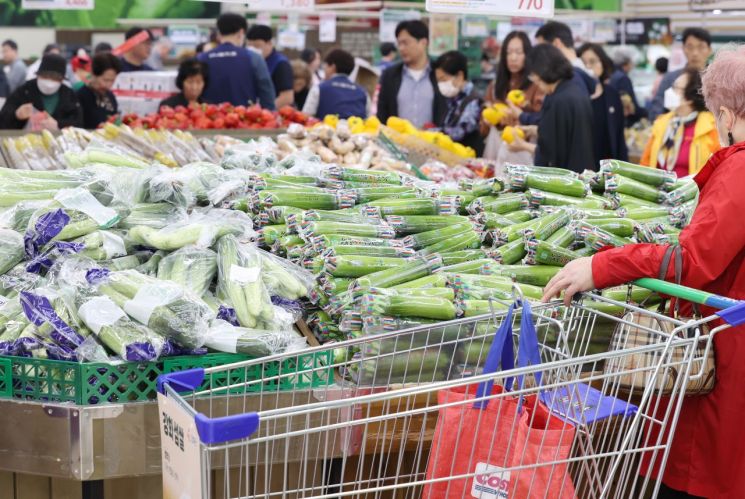 The cost of food, clothing, and housing in our country has been found to be more than 1.5 times higher than the OECD (Organisation for Economic Co-operation and Development) average. [Image source=Yonhap News]
According to the report "Characteristics and Implications of South Korea's Price Levels" released by the Bank of Korea on the 18th, the costs of food, clothing, and housing in South Korea were significantly higher than the OECD average. For clothing and footwear, if the OECD average is set at 100, it reached 161, and food prices reached 156. Housing costs were 123.
On the other hand, electricity, gas, and water charges were 64, showing that public utility fees were significantly lower than the OECD average. Overall, while the costs of food, clothing, and housing were high, public utility fees were low, so the overall price level was at the average level of OECD countries with similar income levels.
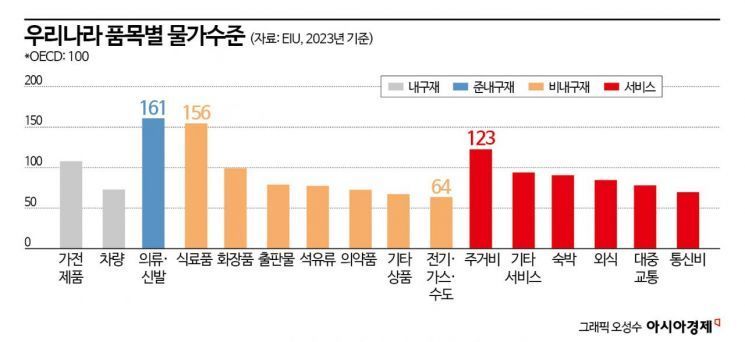
The price gap between major items and the OECD average has widened compared to the past. Comparing domestic price levels by item with the OECD average, food prices increased from 1.2 times in 1990 to 1.6 times in 2023, while public utility fees decreased from 0.9 times to 0.7 times during the same period.
The Bank of Korea cited low productivity, narrow supply channels, and irrational distribution structures as causes of sustained high costs in specific items. In the case of high agricultural product prices, the causes include a shortage of farmland, small-scale farming leading to low productivity and high production costs, considerable distribution costs, and limited supply through imports of some fruits and vegetables compared to major countries.
High clothing prices are due to strong domestic consumer brand preferences, concentration on high-cost distribution channels, and high inventory levels, which also exert cost pressures. In particular, the domestic consumers' preference for brand products has led some foreign clothing companies to adopt strategies of pricing their products higher domestically than overseas, which is pointed out as a cause of higher prices.
On the other hand, public utility fees remain low because the government suppresses fee increases through policy measures.
Im Woong-ji, deputy head of the Price Trends Team at the Bank of Korea's Research Department, explained, "To solve the high inflation problem, it is necessary to seek solutions from a structural perspective rather than short-term responses such as fiscal input," adding, "In the future, fiscal capacity will decrease due to aging, while living cost burdens are likely to increase due to climate change, so fiscal input has its limits."
Deputy Head Im emphasized, "To stabilize excessively high prices of essential consumer goods, diversifying supply channels and improving distribution structures are crucial, and for public services, it is necessary to secure the sustainability of supply."
He particularly argued that to mitigate the high levels and volatility of agricultural product prices such as fruits, it is necessary to enhance agricultural productivity, expand stockpiling capacity, secure import sources, and increase the diversity of consumer varieties to improve elasticity on both supply and demand sides. Additionally, it is analyzed that improving the high-cost distribution structure through streamlining agricultural product distribution and diversifying clothing distribution channels is necessary.
© The Asia Business Daily(www.asiae.co.kr). All rights reserved.
![Clutching a Stolen Dior Bag, Saying "I Hate Being Poor but Real"... The Grotesque Con of a "Human Knockoff" [Slate]](https://cwcontent.asiae.co.kr/asiaresize/183/2026021902243444107_1771435474.jpg)


















