China appears to be extending an olive branch by including Australia and New Zealand in the list of countries allowed visa-free entry to China. This is interpreted as a message of conciliation and cooperation to these countries, which have been part of the U.S.-led coalition pressuring China.
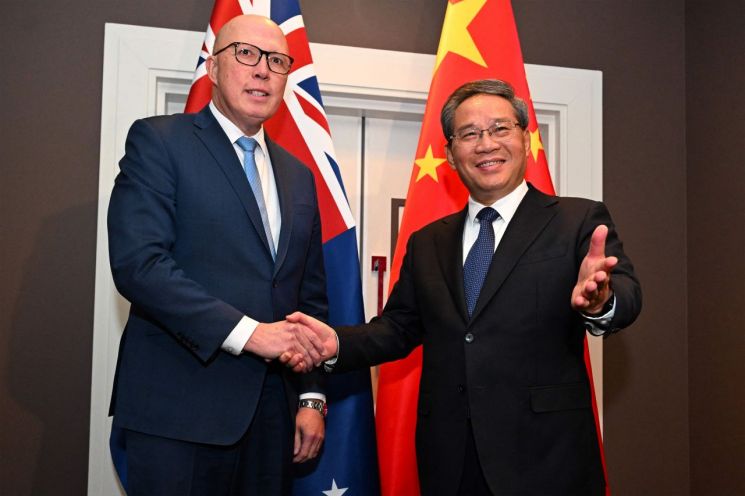
According to China Central Television (CCTV) on the 17th, the Chinese government announced that it would include Australia in the scope of "unilateral visa exemption" immediately after Premier Li Qiang met with Australian Prime Minister Anthony Albanese. While Australia requires visas for Chinese nationals entering the country, China will allow Australians to enter visa-free. Earlier, on the 13th, New Zealand was also included in the unilateral visa exemption measures.
Typically, China has coordinated visa policies with other countries based on reciprocity, but since December last year, it has been expanding unilateral visa exemption measures. Since December, China has implemented unilateral visa exemptions for six countries: Germany, France, Italy, the Netherlands, Spain, and Malaysia. Holders of ordinary passports from these countries can stay in China visa-free for up to 15 days for business, tourism, or visiting relatives. At the time, China explained the background of this measure as "part of efforts to expand opening-up to the outside world."
Australia and New Zealand participate in the U.S.-led intelligence alliance "Five Eyes" (United States, United Kingdom, Canada, Australia, New Zealand), and Australia is also a member of the security alliance "AUKUS" (United States, United Kingdom, Australia) aimed at countering China.
The Chinese state-run media Global Times (GT) expressed its intention to strengthen cooperation with Australia, emphasizing that this could bring tangible benefits to the peoples of both countries. GT stated, "The relationship between China and Australia has not been smooth over the past two years, but dialogue has provided opportunities to manage differences," adding, "There are countries in the world, like Australia, that have neither historical grievances with China nor substantial geopolitical conflicts, and their economic structures are highly complementary to China's, forming interdependent relationships in terms of international trade."
It continued, "Australia is weighing geopolitical instability against its own development interests and is returning to a relatively correct path," urging, "Other countries should also be vigilant."
According to Australian government statistics, China is Australia's largest trading partner, accounting for 26% of Australia's goods and services trade in 2022?2023. The Chinese Customs General Administration reported that trade between the two countries increased by 4.1% year-on-year to $229.2 billion (approximately 313 trillion won) last year.
© The Asia Business Daily(www.asiae.co.kr). All rights reserved.

















