European Union (EU) leaders plan to endorse the reappointment of Ursula von der Leyen, President of the European Commission, on the 17th (local time).
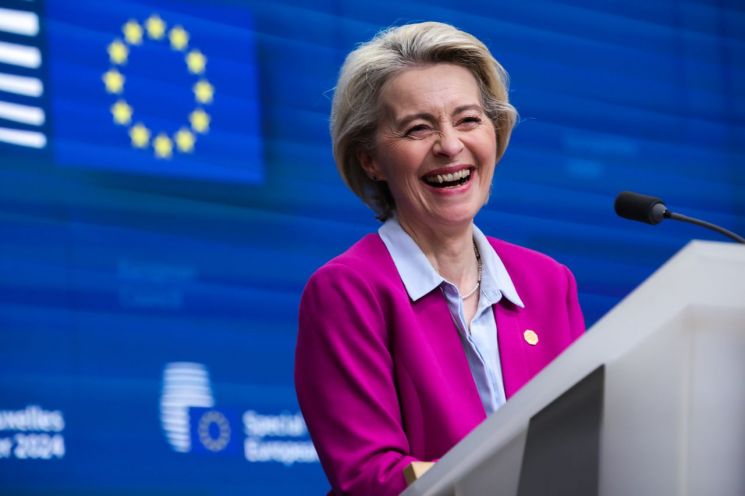
According to major foreign media, the leaders of the 27 EU member states will hold a private dinner in Brussels, Belgium, on the day and are expected to send political support for von der Leyen's reappointment.
The leaders of France, Germany, and Italy, the three most influential countries within the EU, are also reported to have implicitly expressed their acceptance of von der Leyen's reappointment.
The EU's decision to back von der Leyen is interpreted as a response to the significant instability in the current domestic and international environment facing Europe. Von der Leyen has emphasized the necessity of her reappointment, citing the war in Ukraine and the increased uncertainty in US-EU relations if former President Donald Trump wins the US presidential election in November.
The authority to appoint the EU leadership, including the President of the European Commission, lies with the European Council composed of the 27 EU member states' leaders. However, the Lisbon Treaty, which serves as the EU's constitutional basis, stipulates that "the results of the European Parliament elections shall be taken into account when nominating the Commission President."
To reflect the treaty's intent, the EU introduced the Spitzenkandidat (lead candidate) system in 2014, prioritizing the lead candidate of the political group (negotiating group) that won first place in the European Parliament elections as the next Commission President candidate.
After the dinner, EU leaders plan to hold a final agreement on the appointment of the President at the official summit scheduled for the 27th-28th. Subsequently, the appointment proposal will be put to a vote in the European Parliament on the 15th of next month. A majority vote in the Parliament is required for approval. Despite the rise of the far-right in the European Parliament elections held from the 6th to the 9th, mainstream centrist political groups, including the EPP, maintained a majority, so if the reappointment is endorsed, the voting process is expected to proceed relatively smoothly.
Von der Leyen, who began her term in 2019, is the first female head of the EU executive since the establishment of the European Economic Community (EEC), the EU's predecessor, in 1957.
© The Asia Business Daily(www.asiae.co.kr). All rights reserved.
![Clutching a Stolen Dior Bag, Saying "I Hate Being Poor but Real"... The Grotesque Con of a "Human Knockoff" [Slate]](https://cwcontent.asiae.co.kr/asiaresize/183/2026021902243444107_1771435474.jpg)
















