Korea's Net External Financial Assets Ratio to GDP at 44.8%, Ranked 8th Worldwide
Norway, Netherlands, Germany, Belgium, Japan Surpass Korea
Contributes to Domestic Financial Market Stability, Must Actively Pursue Financial Globalization
The proportion of net external financial assets in South Korea's gross domestic product (GDP) was found to be at the 8th highest level in the world. The continued long-term surplus of net external financial assets is analyzed to contribute to the stability of the domestic financial market by reducing the possibility of a foreign exchange crisis. Given that the financial market is more stable than in the past, there are calls for the government to actively promote the internationalization of the domestic financial system.
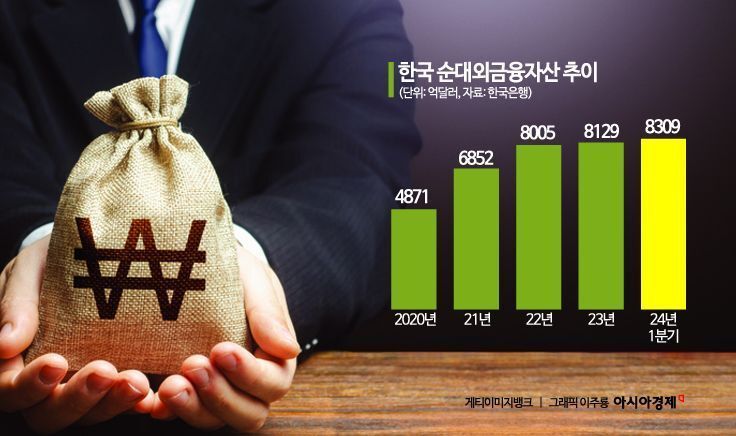
Net External Financial Assets Account for 44.8% of Korea's GDP, Ranking 8th Globally
According to an analysis of International Monetary Fund (IMF) statistical data by the Korea Institute for International Economic Policy on the 17th, Korea's net external financial assets as a percentage of GDP stood at 44.8% in 2022, ranking 8th among 46 major countries.
Net external financial assets are calculated by subtracting external financial liabilities from external financial assets. This means that South Korea has more money to receive from abroad than it owes. Korea became a net external financial asset surplus country for the first time in 2014. According to the Bank of Korea, as of the end of last year, South Korea's net external financial assets amounted to $810.2 billion, maintaining a surplus for 10 consecutive years. The surplus size also increased about tenfold from $80.8 billion in 2014.
The increase in the surplus of net external financial assets is attributed to the continued current account surplus, expansion of overseas direct investment by companies and individuals, and increased loans from domestic banks to Korean overseas subsidiaries.
As of 2022, Norway ranked first with net external financial assets amounting to 200% of GDP, followed by the Netherlands, Germany, Belgium, Japan, Denmark, and Saudi Arabia, all with higher proportions than Korea. Among the 46 major countries surveyed, only 15 were net external financial asset surplus countries, while the rest were deficit countries. Notably, Greece had a net external financial asset ratio of -150% of GDP, Ireland -120%, and Portugal -90%.

Net External Financial Asset Surplus Lowers Foreign Exchange Crisis Risk
The institute's analysis showed that countries that shifted from a deficit to a surplus in net external financial assets tended to maintain a steady surplus once the shift occurred. This suggests that Korea's transition to a net external financial asset surplus is a structural change rather than a temporary one, according to the institute.
In net external financial asset surplus countries, when foreign capital withdraws, unlike deficit countries, domestic capital abroad returns home, mitigating volatility in capital inflows and outflows. This is interpreted as a market-friendly safety mechanism that can reduce the risk of a foreign exchange crisis in Korea.
Jung Young-sik, head of the International Macroeconomics and Finance Division at the Korea Institute for International Economic Policy, said, "Intervention in the foreign exchange market solely through foreign exchange reserves has relatively high opportunity costs and may face practical constraints due to pressure from countries like the United States," adding, "The stabilization function of the foreign exchange market through a net external financial asset surplus is a meaningful structural change."
The net external financial asset surplus has also played a positive role in strengthening the international competitiveness of Korea's financial services. Jung explained, "During periods of net external financial asset surplus, the home country's financial stability improves, increasing the likelihood of policy authorities easing financial regulations and financial companies expanding overseas operations."
The institute pointed out that as Korea's net external financial assets have shifted to a surplus structure and the economy has become more stable, there is a need to more actively promote financial internationalization. This includes easing regulations on overseas expansion and business activities of financial companies that were introduced during periods of net external financial asset deficits.
Additionally, it suggested reconsidering the internationalization of the Korean won, which has seen no progress since 2010, and strengthening policies to promote Korea as an international financial hub.
Jung stated, "Due to factors such as the decrease in the National Pension Fund caused by low birth rates and aging, and the possibility of a current account deficit, the period of net external financial asset surplus may be limited to the next 10 to 15 years," adding, "It is necessary to establish systems and environments that can provide more flexibility for financial internationalization while the opportunity exists."
© The Asia Business Daily(www.asiae.co.kr). All rights reserved.
![Clutching a Stolen Dior Bag, Saying "I Hate Being Poor but Real"... The Grotesque Con of a "Human Knockoff" [Slate]](https://cwcontent.asiae.co.kr/asiaresize/183/2026021902243444107_1771435474.jpg)

















