20 US and European Companies to Hire Tens of Thousands This Year
Defense Spending Rises Amid Ukraine War... Overlapping Labor Shortages
As global geopolitical tensions escalate and orders surge, the defense industry is undertaking the largest-scale hiring of employees since the Cold War.
On the 16th (local time), major foreign media surveyed the hiring plans of 20 leading defense and aerospace companies in the US and Europe, revealing that tens of thousands of employees will be hired this year.
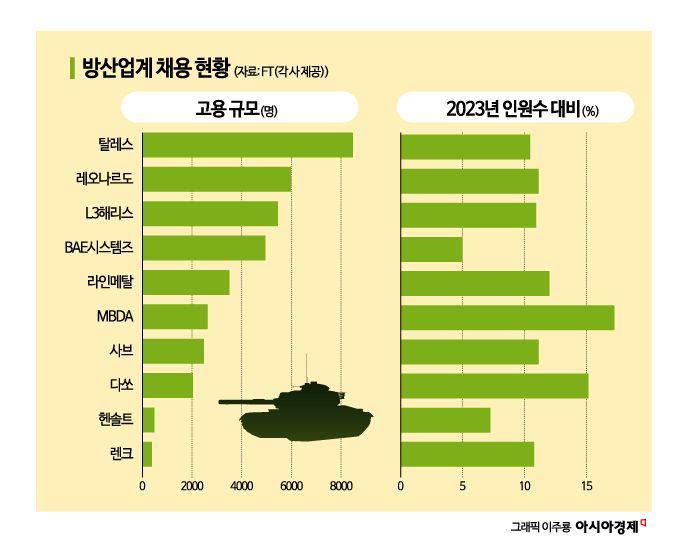
The largest defense contractors Lockheed Martin, Northrop Grumman, and General Dynamics currently have 6,000 job openings. Among the surveyed companies, 10 plan to hire an amount equivalent to 10% of their total workforce.
Regarding this hiring boom, Yann P., Secretary General of the European Aerospace and Defence Industries Association (ASD), analyzed, "This is the most intense period in the defense sector since the end of the Cold War, with a significant increase in orders over a short period."
Governments worldwide have significantly increased defense spending amid rising geopolitical tensions following Russia's invasion of Ukraine. The surge in orders, ongoing labor shortages since the COVID-19 pandemic, and competition in digital technologies have collectively driven increased hiring across the defense industry.
The range of positions and roles being hired is broad, spanning from trainees to executives. There is high demand for engineers, software developers, cybersecurity analysts, welders, and machinists.
Looking at individual companies, Italy's leading defense firm Leonardo plans to hire 6,000 employees by the end of this year. Between 2025 and 2028, it intends to recruit 8,000 to 10,000 new hires, focusing on industrial and software engineers. Antonio Liotti, Leonardo's Chief Human Resources Officer, stated, "We are hiring much more intensively than during the Iraq or Afghanistan wars."
Germany's largest defense company Rheinmetall and Norway's Nammo are also aggressively recruiting. This is due to a significant increase in ammunition production to replenish government stockpiles. On the 14th, Rheinmetall decided to hire hundreds of employees from automotive parts manufacturer Continental. Nammo's workforce increased from 2,700 in 2021 to 3,100 in 2023. A Nammo representative said, "We have never seen such a situation before," adding, "Doubling the company's size by the end of 2030 seems reasonable."
French company Thales has hired 9,000 employees over the past three years, which accounts for about 11% of its current workforce of 81,000. Western governments have supplied Ukraine with Thales' Starstreak missiles, which were held in reserve stockpiles.
BAE Systems has expanded hiring for long-term programs such as global combat aviation programs and the UK's Type 26 frigate for the Royal Navy. Tania Gandamiharja, BAE Systems' HR Director, said, "We have doubled new hires over the past five years and plan to recruit about 2,700 trainees and graduates this year. We are also hiring thousands of experts."
European missile company MBDA, which produced the Storm Shadow and SCALP missiles used in the Ukraine war, plans to hire more than 2,600 employees this year, representing about 17% of its current workforce of 15,000.
The government is also stepping up amid the defense industry's hiring boom. The UK has launched a nuclear technology task force to meet the increased labor demand in civilian nuclear and military programs and plans to train tens of thousands of workers.
The Nuclear Skills Delivery Group (NSDG) expects that over 30,000 additional workers will be needed in the nuclear defense sector by 2030.
In addition to the surge in orders, some positions require additional security clearances, which is another reason defense companies are actively recruiting. An RTX representative stated, "We are struggling to hire engineers and experienced employees who hold security clearances."
In this situation, some companies are turning to overseas talent. Susan Wiegand, CEO of German defense company Rheinmetall, said, "We cannot find enough employees by looking only within Germany," adding, "Qualified overseas talent is also needed."
© The Asia Business Daily(www.asiae.co.kr). All rights reserved.
![Clutching a Stolen Dior Bag, Saying "I Hate Being Poor but Real"... The Grotesque Con of a "Human Knockoff" [Slate]](https://cwcontent.asiae.co.kr/asiaresize/183/2026021902243444107_1771435474.jpg)
















