Hankyung Association "Domestic Overseas E-commerce Deficit Expands"
As the global e-commerce market grows centered around Chinese companies, the rise of Chinese e-commerce platforms is also prominent in the domestic distribution market. Advice has been given that distribution industry policies focused on regulation need to be improved as the deficit in domestic overseas e-commerce expands.
On the 17th, the Korea Economic Association revealed this through the 'Analysis of the Global E-commerce Market Status in the Last 5 Years (2018?2023)'.
The global e-commerce market size doubled in five years, increasing from $2.9 trillion in 2018 to $5.8 trillion last year. During this period, the annual average growth rate of the e-commerce market was 14.6%, surpassing the overall retail growth rate of 4.4%.
In particular, the annual average sales growth rate of the three major Chinese e-commerce companies?JD.com, Alibaba, and Pinduoduo (parent company of Temu)?stood out at 41.0% over the past five years. This explains why JD.com (2nd), Alibaba (3rd), and Pinduoduo (4th) all ranked within the top five in last year’s global e-commerce company sales rankings.
This change also affected the domestic e-commerce market. South Korea’s purchase amount through Chinese e-commerce platforms last year increased by 121.2% compared to the previous year, reaching 3.3 trillion KRW, surpassing the United States (1.9 trillion KRW). It was the first time last year that the purchase amount from China exceeded that from the U.S.
Among these, South Korea’s overseas e-commerce has recorded a deficit since 2021, with purchase amounts exceeding sales amounts. Last year, the deficit reached 5.1 trillion KRW.
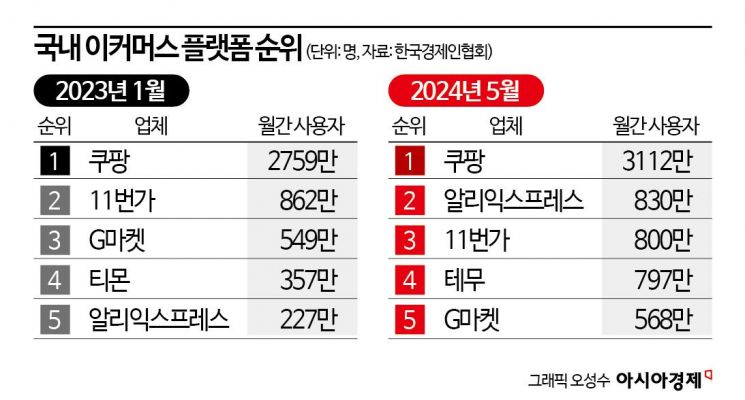
Looking at the domestic e-commerce platform rankings based on monthly user numbers, Chinese platforms have overtaken domestic platforms such as 11st and Gmarket. In January last year, AliExpress (5th) was the only Chinese platform in the top five, but last month, both AliExpress (2nd) and Temu (4th) were listed.
The Korea Economic Association argued that to improve the domestic market under these circumstances, measures such as ▲improving distribution policies focused on regulation ▲strengthening consumer protection ▲supporting domestic small and medium distribution and manufacturing companies should be prepared. They suggested improving the Distribution Industry Development Act, which is regulation-centered and restricts distribution company activities causing reverse discrimination controversies, and checking the fulfillment status of consumer protection obligations by foreign online platforms to minimize consumer damage.
© The Asia Business Daily(www.asiae.co.kr). All rights reserved.
![Clutching a Stolen Dior Bag, Saying "I Hate Being Poor but Real"... The Grotesque Con of a "Human Knockoff" [Slate]](https://cwcontent.asiae.co.kr/asiaresize/183/2026021902243444107_1771435474.jpg)
















