Sung Tae-yoon, Director of Policy Office, Announces Tax Reform Direction
Inheritance Tax Rate to Be Lowered to OECD Average Level
Future Shift to Estate Acquisition Tax and Capital Gains Tax
Comprehensive Real Estate Tax Applied Only to Ultra-High-Value Single and Multiple Homes
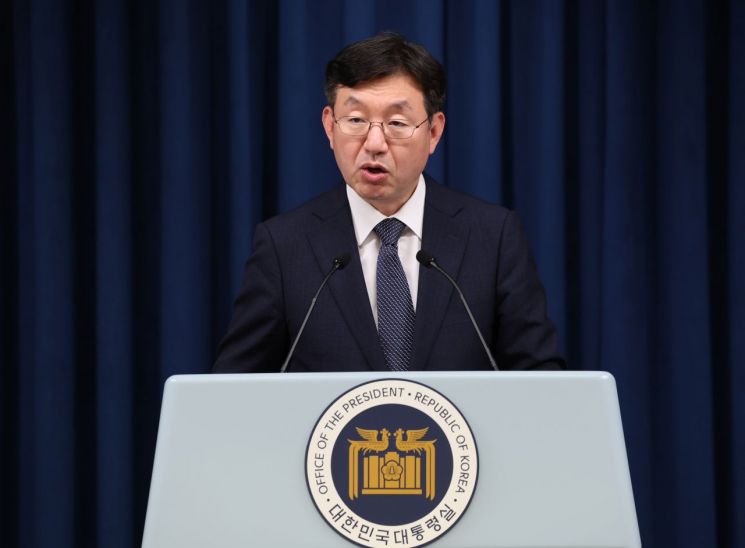
The Presidential Office announced on the 16th that it plans to reform the tax system by significantly easing the comprehensive real estate holding tax (종부세, Jongbu-se) to a level that is virtually abolished and by lowering the inheritance tax rate to the level of the Organisation for Economic Co-operation and Development (OECD).
Seong Tae-yoon, the Presidential Office Policy Chief, appeared on KBS's 'Sunday Diagnosis' on the same day and explained, "Tax-related reform work is absolutely necessary."
Abolishing Jongbu-se is Desirable... Partially Absorbed into Property Tax
Regarding the Jongbu-se reform, Chief Seong pointed out, "The effect on stabilizing housing prices is minimal, and there is a considerable element of tax burden being passed on to tenants," adding, "Because of these factors, I believe abolition or a complete overhaul is necessary."
He continued, "There is a tendency to be hostile toward multi-homeowners, but they are supplying jeonse and monthly rental housing," and said, "If the tax burden on low-priced multi-homeowners becomes excessively high, it could shrink the supply of jeonse and monthly rental housing."
He further explained, "Jongbu-se is used as a resource for local governments, but property tax serves that function, so managing it integrally under property tax is a way to solve the issue of double taxation," and added, "I think it is desirable to abolish the system and, if necessary, partially absorb it into property tax."
However, Chief Seong noted concerns about worsening local finances if Jongbu-se is completely abolished and said the focus is currently on easing it.
He emphasized, "It is desirable to have ultra-high-priced single homeowners and those whose total housing value is very high pay taxes, while abolishing Jongbu-se for those with typical homes and multi-homeowners whose total housing value is not very high."

Lowering Inheritance Tax Rates... Later Transition to Estate Acquisition Tax
Chief Seong also explained that "it is time to reform" the inheritance tax.
He pointed out, "In the past, because income tax and various other taxes were not collected smoothly, taxes were levied at the time of death," adding, "Now, people pay a lot of taxes, so imposing additional (inheritance) taxes on wealth accumulated by paying taxes is a problem of double taxation."
Currently, South Korea's top inheritance tax rate is 50%, and with the major shareholder surcharge system applied, it rises to 60%, which is very high globally. Chief Seong explained that it should be lowered to the OECD average level. He said, "It is necessary to reduce it initially to around a maximum of 30%."
Chief Seong emphasized that after lowering the inheritance tax rate to the OECD average level, it should be gradually transitioned to an estate acquisition tax and capital gains tax system.
The estate acquisition tax considers each heir's inherited property as an individual taxable unit, so the tax burden is lower compared to inheritance tax, which applies a progressive tax rate on the entire estate.
Chief Seong said, "Currently, inheritance tax penalizes having many children," and added, "It is necessary to change this form to an estate acquisition tax system."
Capital gains tax is a system that defers taxes if children inheriting a business continue to manage it without selling. Chief Seong explained, "If taxes are imposed when passing a business to children, the management rights of the business become uncertain," and "many countries are transitioning to a capital gains tax system."
In particular, Chief Seong said the current inheritance tax exemption of 500 million KRW is too low and should be increased.
He said, "The exemption standard was set too long ago," and added, "It should be structured so that inheriting an apartment in Seoul does not impose an excessive inheritance tax burden." Along with this, Chief Seong mentioned plans to raise the exemption limit for spouses.
Chief Seong emphasized, "Focusing on Jongbu-se and inheritance tax is because these taxes typically have a large distortion effect on economic activities but do not generate significant tax revenue," and said, "Without reforming these areas, it is difficult to have overall economic vitality."
Regarding the low birthrate planning department announced by President Yoon Seok-yeol, Chief Seong said, "We are considering the tentative name 'Population Strategy Planning Department,'" and explained, "This department will serve as a comprehensive planning and strategy body, similar to the former Economic Planning Board, responsible for overall population and low birthrate response strategies, establishing comprehensive plans, participating in budget allocation, and conducting policy research and evaluation."
© The Asia Business Daily(www.asiae.co.kr). All rights reserved.


















