NCC Spread $279 per Ton in June
Highest Margin in 1 Year and 4 Months
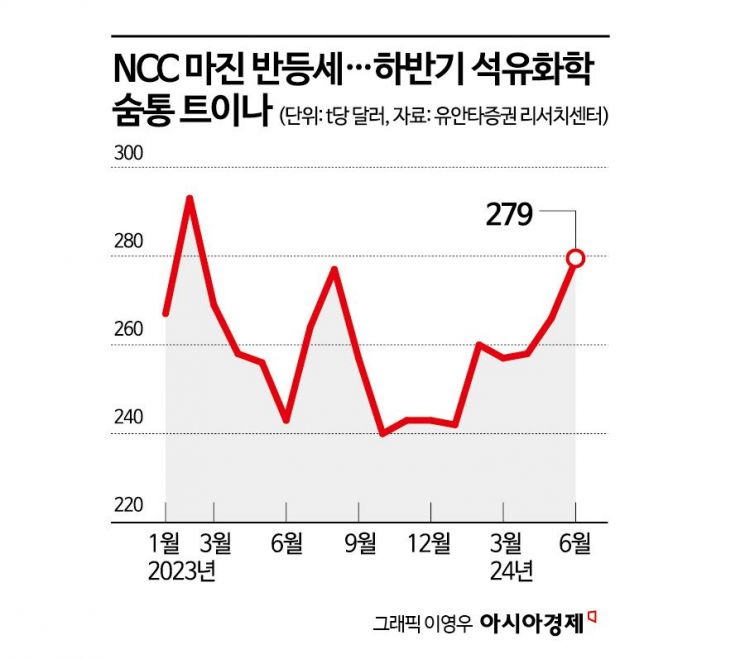
The 'NCC (Naphtha Cracking Center) spread,' a key profitability indicator for petrochemical companies, has shown signs of rebound in the second quarter. There is growing optimism that the deteriorating performance of petrochemical firms will improve in the latter half of this year.
According to the petrochemical industry and Yuanta Securities on the 14th, the NCC spread (margin) rose from $258 per ton in April to $266 in May, and reached $279 per ton (based on the first week) this month. Notably, this month's margin was the highest in one year and four months since February last year. The NCC spread refers to the margin obtained by subtracting the naphtha raw material price from the prices of basic petrochemical products such as ethylene, propylene, benzene, and butadiene produced through domestic NCC facilities. Although there are differences by company, the break-even point for NCC companies is generally considered to be around $250 per ton.
The NCC spread steadily declined after recording $293 per ton in February last year, falling to the $240 per ton range in the second half of the same year. This created a structure where production led to losses. Major petrochemical companies such as LG Chem, Lotte Chemical, and Hanwha Solutions began recording operating losses from that time. Rising international oil prices due to Middle East risks and reduced exports to China caused by China's petrochemical self-sufficiency since 2014 further exacerbated the poor performance. The share of China in domestic petrochemical product exports also dropped from 51.5% in 2021 to 38.1% in 2022.
Recent improvements in the NCC spread are attributed to the effects of China's economic stimulus measures. The Chinese government announced the 'Igu Hwan Shin (以舊換新)' policy, which simultaneously expands consumption and investment, leading to increased demand for petrochemical raw materials as product purchases rise. Igu Hwan Shin is a policy that provides incentives for replacing old vehicles, home appliances, and furniture with new ones.
According to export data from the Korea International Trade Association for January to April this year, exports of 11 major petrochemical products to China increased by 7.2% compared to the previous year. Hwang Gyu-won, a researcher at Yuanta Securities, noted, "Typically, during the humid monsoon season (June to September), global demand decreases due to potential changes in chemical product properties caused by moisture, so the improvement in the spread in June is unusual." He added, "It appears that China's Igu Hwan Shin policy, which has increased demand for automobiles and home appliances, is also impacting the petrochemical industry's business conditions."
The outlook for the second half of this year is also gaining weight for potential improvement. The European petrochemical industry is expected to shut down NCC facilities with an annual capacity of 1 million tons, reducing supply. Additionally, as countries are pushing for or considering interest rate cuts, the business environment is expected to improve. Wi Jeong-won, a researcher at Daishin Securities, analyzed, "Since the second half of last year, inventory reduction of petrochemical products in China has continued," and "The NCC operating rate in China has also recovered to over 85% since March, indicating that demand recovery for petrochemical products is steadily improving."
However, expecting a significant improvement at this point is premature. A petrochemical industry official said, "China's production scale is so large that we are hoping China does not increase its exports more than what we export."
© The Asia Business Daily(www.asiae.co.kr). All rights reserved.
![Clutching a Stolen Dior Bag, Saying "I Hate Being Poor but Real"... The Grotesque Con of a "Human Knockoff" [Slate]](https://cwcontent.asiae.co.kr/asiaresize/183/2026021902243444107_1771435474.jpg)
















