Joint Press Conference After MOU Signing Ceremony
"Strengthening Cooperation in Transportation and Energy Facility Infrastructure"
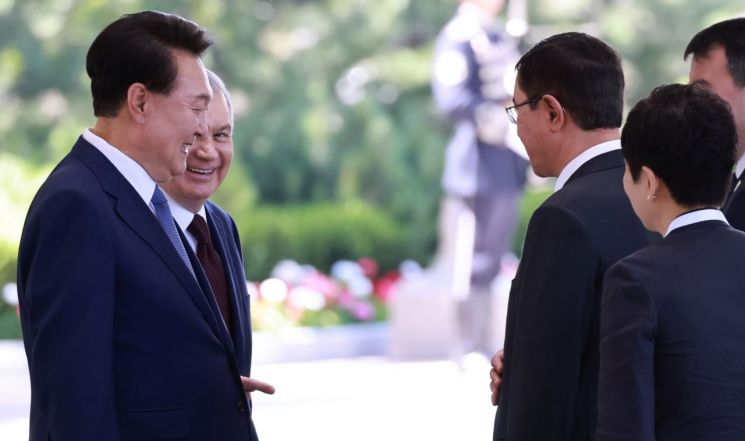 President Yoon Suk-yeol is receiving introductions of the Uzbek delegation members from Shavkat Mirziyoyev, President of Uzbekistan, during the official welcoming ceremony held at the Presidential Palace in Tashkent, Uzbekistan, on the morning of the 14th (local time).
 [Image source=Yonhap News]
On the 14th (local time), President Yoon Suk-yeol held a summit meeting with President Shavkat Mirziyoyev in Tashkent, the capital of Uzbekistan, and agreed to deepen the "special strategic partnership" between the two countries.
In particular, Uzbekistan, which possesses key minerals such as tungsten and molybdenum used in semiconductor and secondary battery materials, will establish a partnership for cooperation in the supply chain of critical minerals and collaborate to strengthen a stable economic security network.
President Yoon held the Korea-Uzbekistan summit and a memorandum of understanding (MOU) signing ceremony on the same day, followed by a joint press conference. Both leaders stated, "A foundation has been laid to strengthen mutually beneficial and future-oriented cooperation between Korea and Uzbekistan." During this summit, the two leaders signed an MOU to solidify the critical minerals supply chain and enhance cooperation in infrastructure sectors such as transportation and energy facilities.
This year marks the 5th anniversary of the establishment of the Korea-Uzbekistan special strategic partnership, and with the first state visit to Uzbekistan in five years since 2019, the special strategic partnership between the two countries is expected to be further solidified. Uzbekistan is the only country in Central Asia that has established a special strategic partnership with Korea. The countries that have such a partnership with Korea include Uzbekistan, India, Indonesia, and the United Arab Emirates (UAE), totaling four countries.
In particular, through the signing of the "2025-2027 Cooperation Plan between Foreign Ministries" and the "Agreement to Activate the Korea-Uzbekistan Trade and Economic Joint Committee," both sides agreed to focus on strengthening the institutional foundation to systematically and substantively develop the special strategic partnership between the two countries.
Support for Korean Companies Winning National Energy and Infrastructure Projects
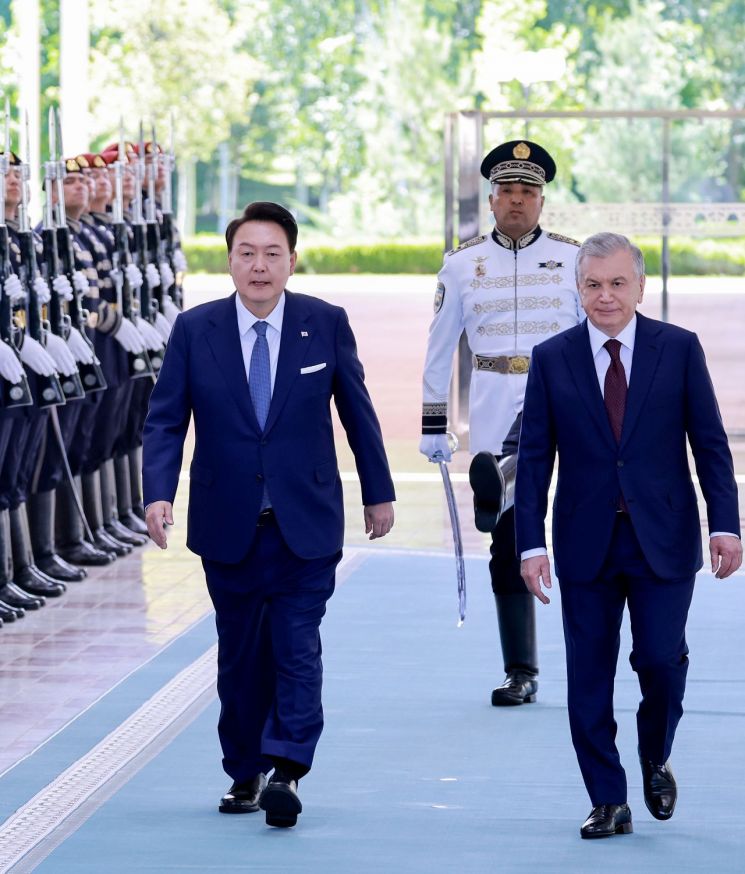 President Yoon Suk-yeol inspects the honor guard with Uzbek President Shavkat Mirziyoyev at the official welcoming ceremony held at the Presidential Palace in Tashkent, Uzbekistan, on the morning of the 14th (local time).
 [Photo by Yonhap News]
Support for Korean companies to win orders and expand their presence will also be established in sectors such as high-speed rail, infrastructure, health and medical care, science and technology, education and human resource development, and environment.
An official from the Presidential Office stated, "The two leaders confirmed their intention to strengthen cooperation in all fields, including political affairs, economy, society, defense, development cooperation, culture, education, and human exchanges, by spending two full days of official, economic, and cultural schedules together on the 14th and 15th, thereby building ties and trust."
Furthermore, this summit is expected to expand the foundation for Korean companies to win orders in Uzbekistan's national energy and infrastructure projects. A supply contract for Korean high-speed rail worth 270 billion won and an Economic Development Cooperation Fund (EDCF) loan agreement were signed, and cooperation was requested regarding large-scale infrastructure projects (approximately 5.35 billion USD), such as the "Tashkent-Andijan Highway," which is scheduled for bidding in the second half of the year.
In the energy and infrastructure sectors, the "Uzbekistan District Heating Modernization Cooperation Agreement" was signed to secure the export base for Korea's district heating systems.
Signing of the 'Critical Minerals Supply Chain Cooperation Partnership Agreement'
The partnership for critical minerals supply chain cooperation with resource-rich Uzbekistan will also be strengthened. Uzbekistan, which holds large quantities of critical minerals such as tungsten and molybdenum used in semiconductors and secondary batteries, will enhance the partnership for cooperation in the critical minerals supply chain. A comprehensive cooperation system will be established covering the entire cycle from exploration, development, refining, smelting, to utilization, including technical cooperation and human exchanges.
In particular, through the signing of the "Critical Minerals Supply Chain Cooperation Partnership Agreement" between the two countries, it was agreed that Korean companies will be given priority opportunities to participate in development and production when economic feasibility is confirmed. The production facilities for high-purity rare metal products within the jointly operated "Rare Metals Center" will be expanded to establish a commercialization base for securing rare metal resources in the future.
Conditions for expanding Korean companies' exports will also be created. With the conclusion of negotiations on Uzbekistan's tariff concessions for goods, a key procedure for Uzbekistan's accession to the World Trade Organization (WTO), the stability of Korean companies' business activities in the region will be guaranteed.
Through the contract to increase the sub-lending limit with Uzbekistan Industrial and Construction Bank (UZPSB) (from 30 million USD to 50 million USD), the foundation to support Korean companies' export activities in automobiles, auto parts, machinery, and equipment to Uzbekistan is expected to be strengthened.
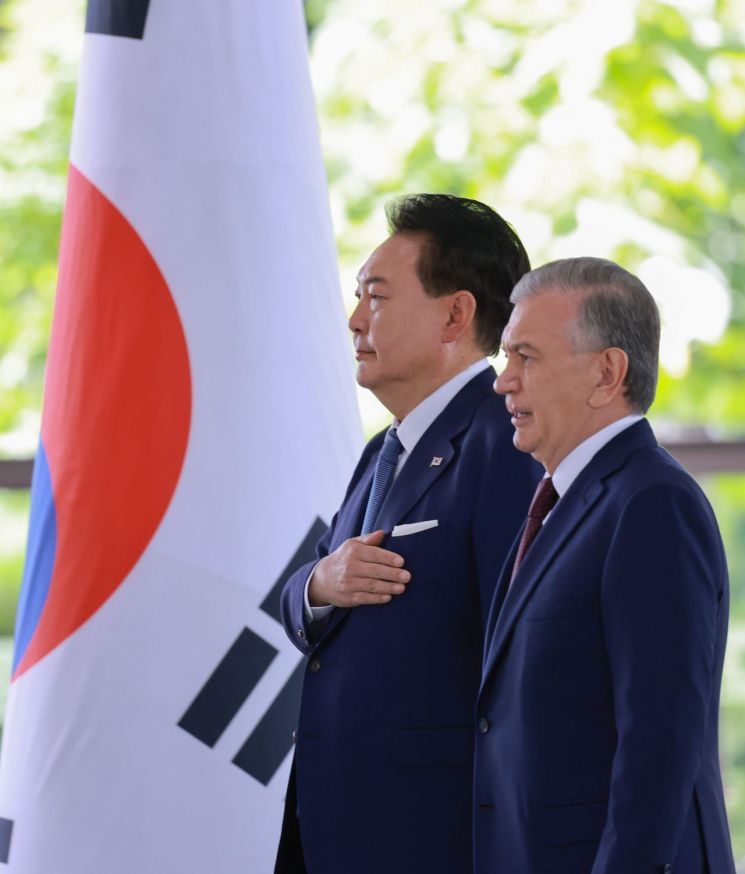 On the morning of the 14th (local time), President Yoon Suk-yeol stood on the reviewing stand with Uzbek President Shavkat Mirziyoyev during the official welcoming ceremony held at the Presidential Palace in Tashkent, Uzbekistan, placing his hand over his heart during the playing of the national anthem.
 [Image source=Yonhap News]
Additionally, by increasing the loan support limit for Uzbekistan, the largest EDCF cooperation country in Central Asia, Korea plans to diversify economic cooperation with Uzbekistan and establish a foothold for Korean companies' entry into Uzbekistan.
With the signing of the second phase EDCF loan agreement for the pharmaceutical cluster project, efforts to strengthen Uzbekistan's pharmaceutical research capabilities and establish a self-sufficient drug supply base will be supported, advancing cooperation in the pharmaceutical sector between the two countries. The second phase of the pharmaceutical cluster project is a follow-up to the 2021 project for constructing the Tashkent Pharmaceutical University and support facilities, aiming to additionally build infrastructure related to new drug development research and clinical trials.
Moreover, through the signing of the "Korea-Uzbekistan Industrial Workforce Development Program MOU" by the Korea International Cooperation Agency (KOICA), a win-win economic cooperation foundation will be established by fostering young industrial technical personnel in Uzbekistan and providing skilled labor to the domestic industry.
Furthermore, leveraging Korea's strengths in personnel, parliamentary, and administrative information sectors, efforts will be made to contribute to the innovation of Uzbekistan's administrative services through capacity building in public administration, technical cooperation, and digitalization support. Korea will share its efficient civil servant personnel system and human resource development strategies and support the strengthening of human resource management capabilities in Uzbekistan's public institutions and state-owned enterprises.
A major achievement of this visit was the establishment of a cooperation foundation related to the implementation of the "Korea-Central Asia K-Silk Road Cooperation Initiative" announced during the visit and the first Korea-Central Asia summit meeting. The Presidential Office stated, "From Uzbekistan, a leading country in non-proliferation in Central Asia, support was confirmed for the complete denuclearization of North Korea, compliance with UN Security Council resolutions, and the 'Bold Initiative' for a denuclearized, peaceful, and prosperous Korean Peninsula, as well as support for a 'free and peaceful reunified Korean Peninsula.'"
© The Asia Business Daily(www.asiae.co.kr). All rights reserved.



















