Brazil Fires Before Dry Season
China Struggles with Heatwave
Korea Issues Heatwave Advisory
Abnormal Climate Worldwide
Drought, El Ni?o Effects
Abnormal weather patterns are wreaking havoc around the world. In South Korea, a heatwave advisory was issued a week earlier than last year, while China is suffering from "scorching heat." Brazil is experiencing a weather anomaly with wildfires engulfing the tropical rainforest.
According to Brazilian local media G1, wildfires in the Pantanal region of Brazil, which started ahead of the main dry season, have been ongoing for more than two weeks. The Pantanal is the world's largest freshwater wetland, covering an area of approximately 220,000㎢, similar in size to the Korean Peninsula.
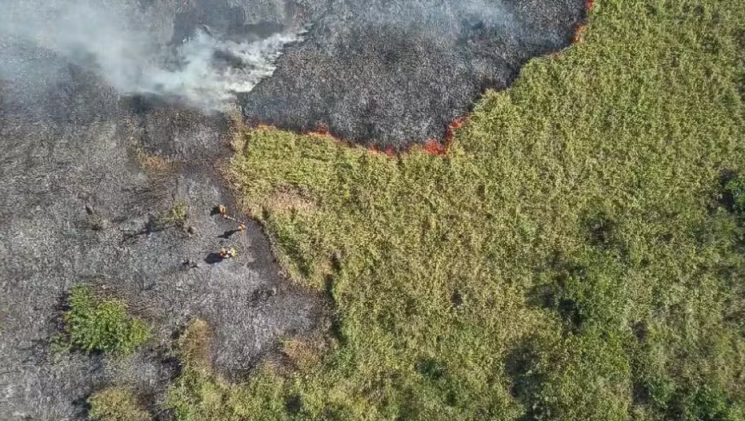 Firefighters are extinguishing a fire on June 7 in Matogrosso do Sul Pantanal, Corumba. Photo by Brazilian local media G1
Recently, the Brazilian National Institute for Space Research (INPE) reported that from January to the 9th of this month, there were 1,315 fires in the Pantanal, a tenfold increase compared to 127 fires during the same period last year. This is the second-highest number in the past 15 years, following 2,135 fires in 2020. At that time, about one-third of the Pantanal wetlands were destroyed by the fires.
As the flames remain uncontrolled, the affected area is gradually expanding. According to the satellite monitoring program of the Federal University of Rio de Janeiro, more than 3,400㎢ of the Pantanal was lost between January 1 and June 9.
The dry season in the Pantanal typically begins in July and peaks in August and September. However, this year, due to low rainfall, the wildfire season started earlier than usual. Although the exact cause of the fires has not been determined, natural ignition caused by drought and weather anomalies such as El Ni?o is suspected.

China is also suffering from heatwaves in various regions. Surface temperatures in central and southern Hebei Province, Shandong Province, Henan Province, southern Shanxi Province, and northern Anhui Province soared to around 60 degrees Celsius, with some areas exceeding 70 degrees. On the 13th, the China Meteorological Administration advised via Weibo (China's version of X) that "surface temperatures may remain similar or rise further over the next few days," and warned citizens not to take children or pets outside, as they are shorter and more affected by surface temperatures.
South Korea is also showing signs of an "unprecedented heatwave." Heatwave advisories were issued on the 11th in Daegu and Ulsan, a week earlier than last year. Subsequently, the advisories were expanded to regions including Gwangju and Jeonnam. A heatwave advisory is issued when "the daily maximum apparent temperature is expected to remain above 33°C for two or more consecutive days," or "when a rapid rise in apparent temperature or prolonged heatwave is expected to cause significant damage."
World Meteorological Organization: "Higher Likelihood of Heatwaves This Year"
According to a report published by the World Meteorological Organization (WMO) in June, global temperatures are expected to steadily rise over the next five years, exceeding 1.1°C above the 1850?1900 baseline. There is an 86% chance that at least one year during this period will be hotter than 2023, which was the hottest year on record so far.
The probability that the average temperature from 2024 to 2028 will be more than 1.5°C above pre-industrial levels is 47%, a significant increase from the 32% reported last year. Specifically, the temperature increase is projected to be between 1.2°C and 1.6°C in 2024, 1.2°C and 1.7°C in 2025, 1.2°C and 1.8°C in 2026, 1.3°C and 1.9°C in 2027, and 1.3°C and 1.9°C in 2028.
© The Asia Business Daily(www.asiae.co.kr). All rights reserved.

![Clutching a Stolen Dior Bag, Saying "I Hate Being Poor but Real"... The Grotesque Con of a "Human Knockoff" [Slate]](https://cwcontent.asiae.co.kr/asiaresize/183/2026021902243444107_1771435474.jpg)
















