Deployment of 7 New Container Ships
Early Execution of 20.2 Billion KRW Freight Support for SMEs
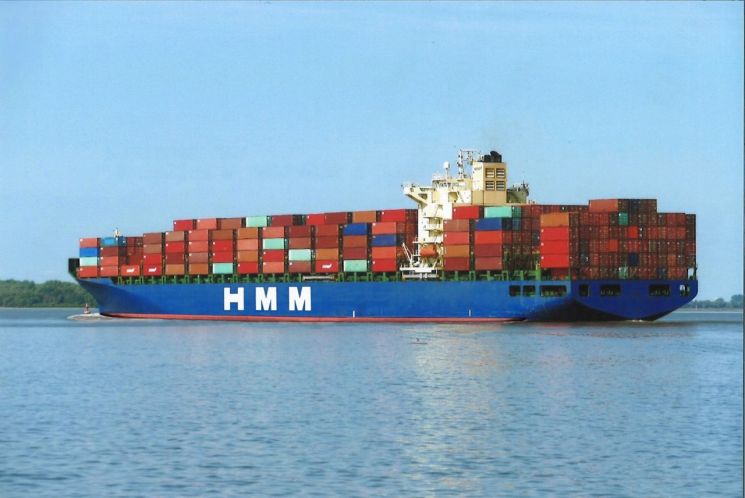
As maritime logistics costs have surged recently, increasing the burden on export companies, the government has decided to deploy seven large new container ships in the second half of the year. Support for logistics costs for export companies will also be strengthened.
On the 14th, the government announced that it discussed the "Impact of Rising Maritime Freight Rates on Export and Import Logistics and Response Measures" at the 42nd Economic Relations Vice Ministers' Meeting. After reviewing the impact on export and import logistics, the government found that direct effects such as export shipment delays have been limited so far, but the burden on export companies has increased due to transportation delays caused by the detour around the Cape of Good Hope and rising maritime freight rates.
To prepare for container space shortages, the government plans to urgently deploy three temporary vessels (total capacity of 9,000 TEU; 1 TEU equals one 20-foot container) through the national shipping company HMM in June and July to high-demand regions including the U.S. West and East Coasts and the Middle East. Additionally, seven large new container ships (total capacity of 70,000 TEU) will be deployed on major routes in the second half of the year, and dedicated container space of 1,685 TEU per voyage will be supplied exclusively for small and medium-sized enterprises (SMEs) and mid-sized companies.
To reduce the freight burden on export companies, the government will expedite the disbursement of 20.2 billion KRW in export vouchers in the second half of the year and will consider additional freight support measures based on future freight rate trends. Furthermore, to prepare for delayed payment settlements, the government will expand the scope and timing of support such as preferential export credit guarantee limits (1.5 times) and rapid insurance claim payments. An additional shared container yard with a capacity of 700 TEU, offering rates cheaper than the market, will be established near the new port area of Busan Port.
The government will continue to operate an export-import logistics emergency response team led by the Vice Minister of Oceans and Fisheries and an export emergency response team led by the Director-General of Trade and Investment at the Ministry of Trade, Industry and Energy. A government official stated, "Since the recent upward trend in freight rates is likely to continue for some time, we will swiftly and thoroughly implement this plan, including dedicated container space support for national shipping companies, through inter-agency cooperation. We will do our utmost to respond promptly to logistics risks and maintain the strong export momentum."
Private sector support efforts are also ongoing. Since March, the Korea International Trade Association has been providing weekly dedicated container space of 1,000 TEU for SMEs on Europe and Americas routes in cooperation with HMM. An HMM official said, "We are deploying temporary vessels and allocating part of the cargo space on existing routes for small and medium-sized companies, and we plan to expand this if necessary."
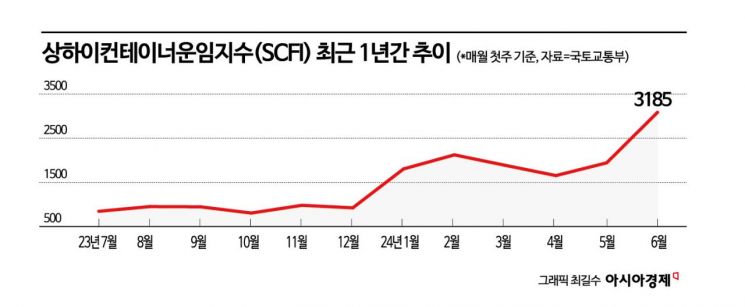
The joint public-private efforts come as the upward trend in maritime freight rates shows little sign of stopping. The Shanghai Containerized Freight Index (SCFI) recorded 3,184.87 as of the 7th, up 140.1 points from the previous week. It has risen for nine consecutive weeks since mid-March, increasing by more than 80% over two months. Surpassing the 3,000 mark on the 3rd was the first time in about 1 year and 10 months since August 2022.
This is due to the ongoing "Red Sea crisis" caused by attacks on vessels by Yemen's Houthi rebels, which have blocked the Red Sea route since the end of last year. Ships have had to detour around the Cape of Good Hope in South Africa instead of using the Suez Canal, increasing travel distance and time, and container space availability has become tight. As ships fail to arrive on time, containers pile up at ports, causing congestion and driving maritime freight rates even higher.
China's Labor Day and improved consumer demand in the U.S. also fueled the freight rate increase. Additionally, China's "volume push" added to the burden. With the U.S. announcing a "tariff bomb" on Chinese products starting in August, China preemptively flooded the market with shipments. Global freight market analysis firm Geneta stated, "Currently, export volumes from China are higher than in the past," and analyzed, "Recently, China has been pushing out shipments preemptively due to concerns over additional U.S. tariff hikes."
© The Asia Business Daily(www.asiae.co.kr). All rights reserved.
![Clutching a Stolen Dior Bag, Saying "I Hate Being Poor but Real"... The Grotesque Con of a "Human Knockoff" [Slate]](https://cwcontent.asiae.co.kr/asiaresize/183/2026021902243444107_1771435474.jpg)

















