Fair Trade Commission imposes 140 billion KRW fine on Coupang and refers case to prosecution
People's Solidarity for Participatory Democracy warns of additional issues with PB sales
Most fast delivery online malls sell PB products
The Fair Trade Commission (FTC) has imposed a fine of 140 billion KRW on Coupang over allegations of preferential treatment of its private brand (PB) products and has referred the case to the prosecution, raising alert in the distribution industry. This is the first time the government has taken disciplinary action related to the product display practices of distribution companies. Civic groups have also announced plans to file additional complaints against other distribution companies, leaving other major distributors selling PB products uneasy. The FTC's decision is expected to inevitably cause a major upheaval in the PB market.
FTC: "No plans to expand investigation to other companies"
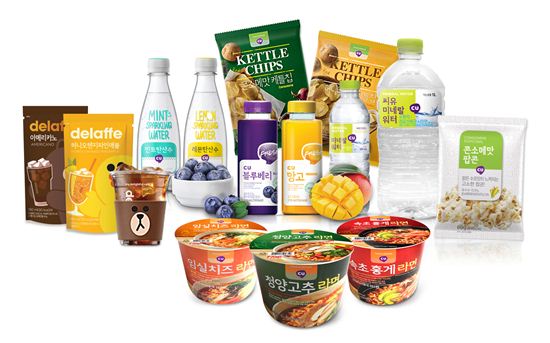 CU PB Product Collection Cut
On the 13th, the FTC concluded a two-year investigation and issued corrective orders and a fine of 140 billion KRW to Coupang and CPBLB (Coupang's dedicated PB subsidiary). Additionally, both Coupang and CPBLB were each referred to the prosecution for violations of the Fair Trade Act.
The FTC revealed that Coupang artificially manipulated the search ranking algorithm for products. It also found that Coupang employees wrote purchase reviews and assigned star ratings, which unfairly boosted only their own products to the top of search rankings, thereby misleading consumers.
However, the FTC stated that there will be no restrictions on the display of in-store PB products. It also disclosed that such employee review activities were not detected in other e-commerce companies, effectively indicating no plans to expand the investigation.
Most distributors sell PB products... possibility of sanctions remains
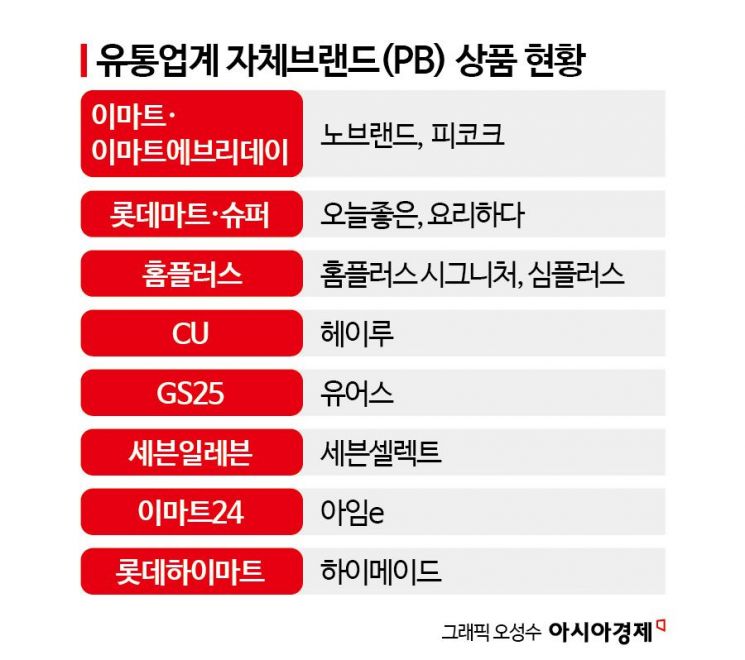
Nonetheless, distribution companies remain on edge. Most distributors, like Coupang, create PB products and sell them alongside other companies' products.
Currently, large supermarkets sell products such as Lotte Mart's Super Oneul Joeun and Yorihada, E-Mart and E-Mart Everyday's No Brand and Peacock, and Homeplus's Homeplus Signature and Simple Plus. Convenience stores sell Heyroo at CU, Yours at GS25, Seven Select at 7-Eleven, and I'm e at E-Mart 24, while Lotte Hi-Mart operates Hi-Made. All these products are sold not only offline but also through online malls or their own applications (apps).
People's Solidarity for Participatory Democracy (PSPD) has also announced plans for additional complaints. At a press briefing held on the 4th at a cafe in Sejong City, PSPD stated, "Since the FTC's judgment found violations, if there are platforms that appear to favor their own products, we believe issues should be raised based on the same standards." The sanctions against Coupang began after PSPD reported algorithm issues to the FTC.
Although not included in this complaint, PSPD pointed out that the very launch of Coupang's PB products could be problematic. PSPD said, "While not in this case, we are concerned about platforms acting as both player and referee by launching PB products."
The distribution industry is worried that FTC sanctions could follow if civic groups file complaints. A distribution industry official said, "The way each online mall exposes products or displays search rankings is based on each company's proprietary know-how. If Coupang is problematic, other places might face different issues."
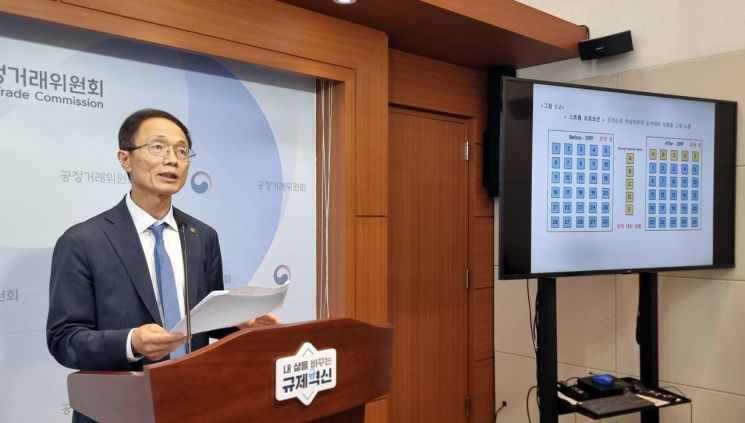 On the morning of the 13th, Cho Hong-seon, Vice Chairman of the Korea Fair Trade Commission, announced at the Fair Trade Commission press room in the Government Sejong Complex that a corrective order and a fine of 140 billion KRW were imposed on Coupang and its subsidiary CPLB, which exclusively supplies Coupang's private brand (PB) products, for hierarchical customer inducement practices. He also stated that both entities will be reported to the prosecution. Photo by Yonhap News
E-commerce industry expands direct purchasing for fast delivery... will it be hindered?
The FTC also raised issues regarding direct purchase products alongside PB products, sparking controversy. Direct purchase products are those that Coupang buys directly from suppliers and sells, while PB products are planned and sold by Coupang but production is subcontracted to manufacturers. The FTC criticized Coupang for using employee reviews to promote "own products (direct purchase products + PB products)" to higher search rankings.
Coupang operates an open market that mediates transactions for third-party sellers alongside selling its own products. The FTC pointed out that Coupang holds a dual role as both the platform setting and operating search ranking criteria and as a seller of its own products. This dual status can lead to conflicts of interest between selling its own products and mediating sales of third-party sellers.
The problem is that most e-commerce companies and major distributors' online malls also sell "own products" and adopt the same method as Coupang, which operates an open market. Although the proportion of open market sales varies by company, those offering early morning or same-day delivery are increasing direct purchase products to ensure predictable delivery. To this end, they are competitively building large-scale logistics centers.
As of 2022, Coupang's sales ratio of "own products" reached 70%. Based on this, Coupang operates its flagship brand "Rocket Delivery." Typically, direct purchase products involve the platform bearing inventory risks. Therefore, many believe that sales promotion strategies are the exclusive prerogative of distribution companies. Coupang responded in a statement, saying, "The FTC's decision, which claims that Coupang's Rocket Delivery, chosen by many consumers for its low prices and convenient delivery, is deceptive, is an anachronistic and anti-innovation measure that ignores the rights of smart consumers in the digital era."
"Will the PB market shrink?"... Distribution industry on alert
Concerns have also been raised that the PB market may shrink in the future. The Korea Chamber of Commerce and Industry announced in February an analysis of "sales of distribution companies' private brand (PB) products," revealing that the domestic PB product market size grew by 11.8% over the past year (Q4 2022 to Q3 2023). This growth rate is about six times higher than the overall consumer goods market growth of 1.9% during the same period.
However, the domestic PB market still has a long way to go. According to the global market research firm Statista, the share of PB sales in the Korean distribution market in Q1 this year was 3%, ranking 43rd out of 50 surveyed countries. This is significantly lower than major advanced countries such as Switzerland (52%), the UK (46%), Germany (37%), and the US (17%). If distribution companies reduce PB product promotions and preferential exposure, consumption could decrease accordingly. In this case, small and medium-sized enterprises, which account for 80-90% of PB product production, may face a decline in sales.
An industry official said, "PB products gained popularity among consumers due to their cost-effectiveness, but limiting exposure could provoke consumer backlash amid high inflation. There are also concerns that the sales channels for small and medium-sized enterprises could shrink."
© The Asia Business Daily(www.asiae.co.kr). All rights reserved.
![Clutching a Stolen Dior Bag, Saying "I Hate Being Poor but Real"... The Grotesque Con of a "Human Knockoff" [Slate]](https://cwcontent.asiae.co.kr/asiaresize/183/2026021902243444107_1771435474.jpg)

















