Mandatory Application of IFRS 18 from 3 Years Later
Temporary and Non-recurring Items Included in Operating Profit Basis
Consideration of Parallel Display to Separately Show Current Operating Profit
The financial authorities are promoting a Korean-style interim plan that requires separate disclosure of operating profit and loss under the current method to ensure a smooth transition to the 'International Financial Reporting Standard (IFRS) 18,' which will be implemented from January 1, 2027. This is because the calculation of operating profit and loss under the new accounting standard will include non-recurring items such as one-time expenses, which is expected to cause significant confusion among companies and investors.
The Financial Services Commission and the Financial Supervisory Service announced that they held the first meeting of the IFRS 18 Implementation Support Task Force on the morning of the 13th at the Chamber of Commerce and Industry. Relevant organizations such as the Korean Accounting Standards Board, Korea Exchange, Korea Listed Companies Association, KOSDAQ Association, Korean Institute of Certified Public Accountants, and Capital Market Research Institute attended the meeting.
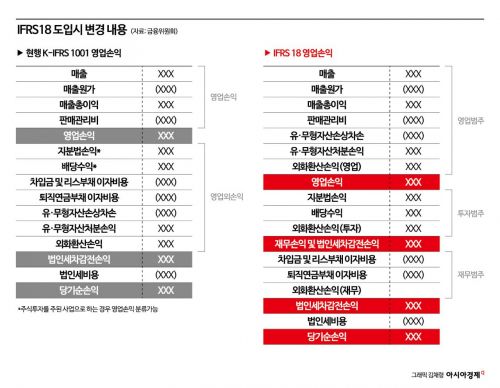
With the introduction of IFRS 18, the presentation method of operating profit and loss in financial statements in South Korea will change significantly. Under the current standards, operating profit and loss is measured by deducting cost of sales and selling and administrative expenses from sales. However, under the new accounting standard, operating profit and loss will be classified as a residual category that excludes investment and financing activities. This is because IFRS 18 is based on the residual category approach. IFRS 18 introduces category-specific 'subtotals' such as operating profit and loss within the income statement and measures operating profit and loss as residual profit and loss, not belonging to investment or financing categories. It presents operating activity-related items as a single subtotal regardless of materiality, frequency, or persistence, thereby including various special items that occur temporarily or non-recurring. Previously, IFRS did not specifically regulate the presentation or measurement methods of subtotals such as operating profit and loss in the income statement, so South Korea has mandated additional disclosure of operating profit and loss.
According to IFRS 18, subtotals are newly established and defined by source of profit and loss within the income statement, such as operating, investing, financing, corporate tax, and discontinued operations categories. Additionally, if a company wishes to disclose non-accounting performance measures not separately defined in IFRS 18, it can do so in the notes.
Accordingly, the authorities plan to prepare an 'interim plan' reflecting the current method within the basic principles and scope of IFRS 18 to reduce confusion among companies and investors caused by the accounting standard change. They plan to review measures to separately present a subtotal that maintains South Korea's current operating profit and loss measurement method within the IFRS 18 operating profit and loss calculation process.
Furthermore, to minimize confusion among information users, the authorities will collect opinions and review a reasonable name for the 'subtotal.' They will also significantly strengthen guidance and promotion related to this matter to minimize practical confusion or difficulties. Seminars, forums, and practical meetings will be held, and a dedicated Q&A team will be formed. An IFRS 18 dedicated website and hotline will also be established.
In the future, an impact analysis of the income statement restructuring under IFRS 18 will be conducted. Through simulations, the effects on companies and industries (such as construction, shipbuilding, and finance) will be analyzed. For example, equity-method gains and losses of holding companies whose main business is investment in subsidiaries may currently be classified as operating profit and loss, but under IFRS 18, they will be classified as investment gains and losses.
The authorities will also review whether regulatory systems using operating profit and loss as regulatory indicators need to change or maintain these indicators. For instance, under the KOSDAQ listing regulations, a company is designated as an investment caution stock after five consecutive years of operating losses, and under the External Audit Act, auditors can be appointed ex officio after three consecutive years of operating losses.
The Financial Services Commission stated, "We will prepare K-IFRS No. 1118, reflecting a modified adoption plan suitable for our circumstances through opinion gathering via the task force, etc. This will be revised in 2025 and fully implemented from 2027."
They added, "Since difficulties are expected for companies in the early stages of implementation, we plan to operate the system with a focus on guidance for a certain period, considering non-action on accounting errors during application unless intentional."
© The Asia Business Daily(www.asiae.co.kr). All rights reserved.
![Clutching a Stolen Dior Bag, Saying "I Hate Being Poor but Real"... The Grotesque Con of a "Human Knockoff" [Slate]](https://cwcontent.asiae.co.kr/asiaresize/183/2026021902243444107_1771435474.jpg)
















