16,000 Scheduled Retirees by 2030
22% of All Employees... About 2,000 Retire Each Year
This Year's Labor Negotiations Also Focus on 'Retirement Age Extension'
Union: "Let's Extend Retirement Age to Align with National Pension Receipt"
Management: "Corporate Retirement Extension Not Possible Without Social Agreement"
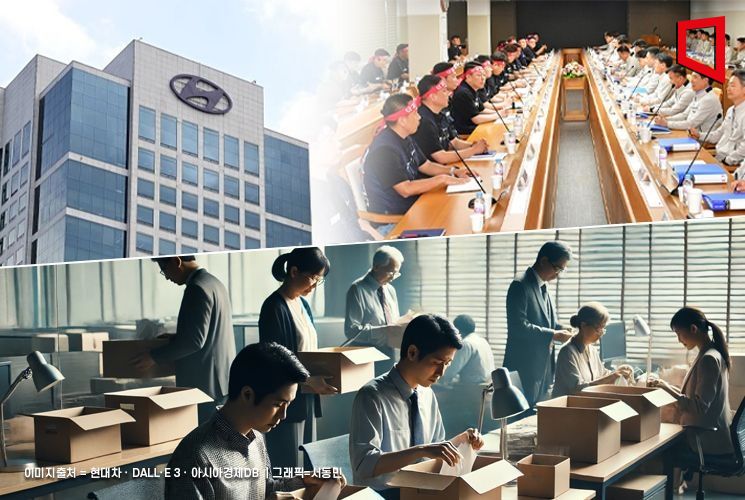
It has been revealed that 20% of all Hyundai Motor Company employees are expected to retire by 2030. Within the next seven years, one-third of the union members face the risk of disappearing. The issue of 'retirement age extension,' which comes up every year at labor-management wage negotiations and collective bargaining tables, is being regarded with particular seriousness this year.
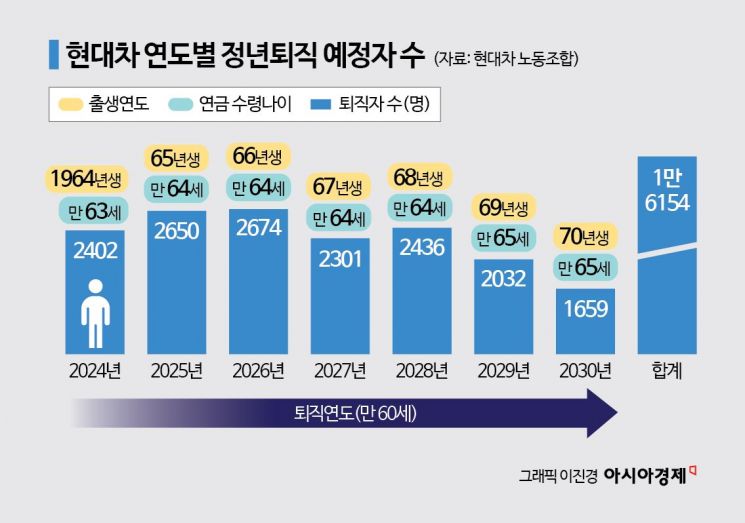
According to the Hyundai Motor Union on the 13th, the total number of employees scheduled to retire by 2030 is 16,154. This accounts for 22% of the total workforce of 73,502 employees as of the end of 2023. More than 2,000 employees leave the company annually. The number of retirees over the next seven years is nearly 30% higher compared to the previous seven years (2017?2023, about 12,000 people). Among the total union members of approximately 45,000, those expected to retire by 2030 make up 35%, exceeding one-third.
Hyundai Motor’s retirement age is 60 years old, which is the same as the legal retirement age in South Korea. The union is demanding an extension of the retirement age up to 64, the year before the start of National Pension benefits.
During the 7th wage negotiation between Hyundai Motor labor and management held on the 11th, fierce debates arose over the 'retirement age extension' included in a separate demand. Moon Yong-moon, the union chairman, stated, "With the company's proactive decision, social issues such as employment insecurity can be resolved," adding, "Discussions on extending the retirement age linked to the National Pension system are part of the process of shaping public opinion."
On the other hand, Lee Dong-seok, the company representative, said, "Considering the social atmosphere including youth unemployment issues, it is not easy for the company to make a proactive decision," and emphasized, "This is an issue that must be addressed by observing social and political changes moving forward."
The union mentioned the National Pension because there can be up to a five-year income gap between retirement and the start of pension receipt. The starting age for National Pension benefits will be delayed to 64 in 2028 and 65 in 2033. The union argues that the retirement age should be extended as much as possible until pension benefits begin.
Conversely, the company is concerned that this issue could escalate into generational conflicts over jobs, especially when combined with youth unemployment problems. There is also criticism that the benefits of extending the retirement age would only go to workers in large companies with good employment conditions, potentially deepening the dual structure of the labor market.
From the union’s perspective, they have no choice but to stake their survival on extending the retirement age to maintain their organization. According to Hyundai Motor’s Sustainability Report, as of 2022, employees aged 50 and above accounted for 43.7% of the total workforce, nearly half. Meanwhile, the union membership rate relative to the total number of employees has steadily declined from 71% in 2019 to 63% in 2022.
Experts diagnose that social consensus is urgently needed, citing the example of Japan. Japan, which entered a super-aged society earlier than South Korea, has the same legal retirement age of 60 but has effectively established a '65-year retirement system' by imposing an obligation on employers to continue employing workers who wish to work until age 65.
Furthermore, Japan codified in 2020 the employer’s obligation to "make efforts to secure employment opportunities until workers reach 70 years old," introducing a phased extension of the retirement age. Toyota’s decision in May this year to raise the upper age limit for its senior reemployment system from 65 to 70 is also based on such social and policy consensus.
Jeon Jin-ho, a researcher at the National Assembly Legislative Research Office, pointed out, "Japan first made the 'effort provision' mandatory and only after reaching a sufficient level of social consensus based on labor-management agreements did it proceed to the final stage of legal obligation," adding, "If social consensus does not precede improvements to the retirement age extension system, it could trigger further social conflicts."
© The Asia Business Daily(www.asiae.co.kr). All rights reserved.


















