Up to 35% Tariffs... Notified to Manufacturers on This Day
Opposition from Germany and Others... "Concerns Over Trade Retaliation"
The European Union (EU) is reportedly pushing to impose tariffs of up to 35% on Chinese-made electric vehicles, according to major foreign media on the 12th (local time).
According to sources familiar with the matter, the EU Commission plans to notify electric vehicle manufacturers on the same day that it will temporarily apply additional tariffs of up to 25% on Chinese-made electric cars starting next month. Currently, the EU imposes a 10% tariff on Chinese electric vehicles. Imposing an additional tariff of up to 25% is expected to generate more than 2 billion euros (approximately 2.9594 trillion KRW) in annual revenue.
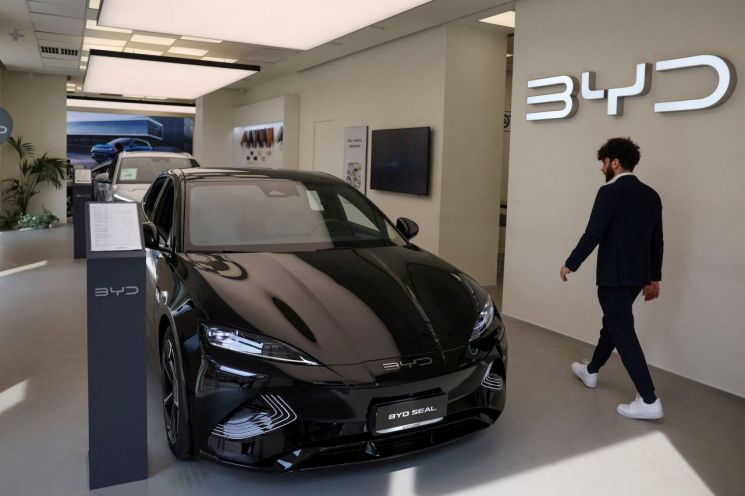
The additional tariffs on Chinese electric vehicles in Europe will affect not only Chinese manufacturers such as BYD and Shanghai Automotive Industry Corporation (SAIC) but also companies like Tesla, which have factories in China. The tariffs may vary depending on the manufacturer and the level of subsidies.
The EU claims that Chinese electric vehicle manufacturers receive massive government subsidies, weakening the competitiveness of European manufacturers. Accordingly, since October last year, the EU has been conducting anti-subsidy investigations on Chinese electric vehicles.
According to the U.S. private research institute Rhodium Group, China exported electric vehicles worth 10 billion euros (approximately 14.8 trillion KRW) to the EU in 2023. The market share doubled to 8%. The Rhodium Group predicted that if the EU’s tariff rate remains below 50%, it will be difficult to curb imports of Chinese electric vehicles and protect EU manufacturing.
Germany’s economic think tank Kiel Institute stated that imposing an additional 20% tariff on Chinese electric vehicles would reduce imports to one-quarter. In 2023, 500,000 vehicles were imported, which would decrease to 125,000 vehicles. This amounts to approximately 4 billion USD (about 5.51 trillion KRW).
China is expected to retaliate immediately with trade countermeasures, so the backlash from imposing tariffs is likely to be severe. China has warned that it will take retaliatory measures if the EU imposes additional tariffs.
According to foreign media, Germany, Sweden, and Hungary oppose this measure due to concerns about Chinese retaliation. German Chancellor Olaf Scholz recently stated, "Isolation and tariff barriers ultimately only make everything more expensive and make everyone poorer." Foreign media also expect Central European countries such as the Czech Republic and Slovakia to join the opposition. Food and luxury goods exporting countries like Italy are also concerned about trade retaliation against their domestic products. EU automobile manufacturers are also against the tariff hike, fearing that China might respond in kind or even block access to the Chinese market.
However, despite such opposition, the EU Commission is pushing forward with the tariff imposition. Sources expect the EU to raise tariffs to about 35%, which is still below the U.S. tariff rate of 100% on Chinese electric vehicles. According to sources, the EU Commission’s responsible department has secured evidence that Chinese automobile manufacturers and suppliers have received subsidy loans, tax reductions, and cheap land support.
EU member states are expected to vote on imposing tariffs on Chinese electric vehicles before November 2. At least 11 countries’ support is required to overturn this decision. The final tariffs are typically imposed for five years.
© The Asia Business Daily(www.asiae.co.kr). All rights reserved.
![Clutching a Stolen Dior Bag, Saying "I Hate Being Poor but Real"... The Grotesque Con of a "Human Knockoff" [Slate]](https://cwcontent.asiae.co.kr/asiaresize/183/2026021902243444107_1771435474.jpg)











