Standing Committee Held with Only Opposition Amid Ruling Party's Absence
Political Strife Over Broadcasting Act Amendment Overshadows AI Basic Act and Mobile Communication Law Repeal
Concerns Over Delays in Science and Technology Advancement
The 22nd National Assembly's Science, Technology, Information and Broadcasting Communications Committee (STIBC) has been formed, but concerns are growing within the Ministry of Science and ICT. There is increasing worry that key issues in the fields of science and information communications, such as the AI Basic Act and the abolition of the Device Distribution Act?which failed to pass even in the 21st National Assembly?may once again be pushed aside due to political conflicts.
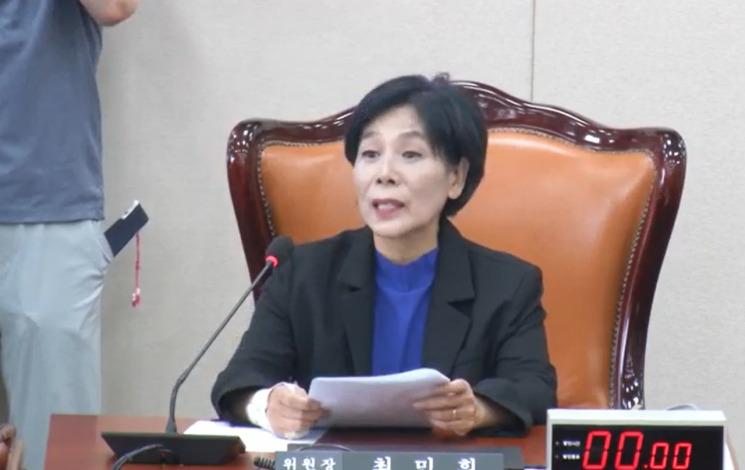 Chairperson Choi Min-hee of the National Assembly Science, Technology, Information and Broadcasting and Communications Committee is making a speech on the 11th.
On the 11th, the day after the Democratic Party unilaterally elected 11 standing committee chairs, the STIBC held its first meeting chaired by Chairperson Choi Min-hee. All lawmakers from the ruling People Power Party were absent. Although the committee is expected to conduct work reports from its affiliated agencies such as the Ministry of Science and ICT, the Korea Communications Commission, and the Nuclear Safety and Security Commission, disruptions are inevitable for the time being.
The STIBC is more likely than any other standing committee to experience intense conflict between the ruling and opposition parties. The Democratic Party is pushing for amendments to the three broadcasting laws and has assigned many heavyweight lawmakers to the committee to this end. Among lawmakers with a background in science, only Hwang Jeong-ah, formerly of the Korea Astronomy and Space Science Institute, stands out.
Officials at the Ministry of Science and ICT are deeply concerned. As broadcasting, a subject of political contention, takes priority in the STIBC, legislative activities in urgently needed science and technology fields such as semiconductors, AI, space, and quantum are at risk of being deprioritized. Although not under the STIBC’s jurisdiction, even the abolition of the R&D preliminary feasibility study, promised by President Yoon Seok-yeol and announced at the government level, is analyzed to face difficulties passing through the National Assembly.
In the 21st National Assembly, the STIBC failed to pass major bills such as the abolition of the Device Distribution Act, the AI Basic Act, the Corporate Research Institute Act, and the Regional Science and Technology Innovation Act. Issues that had significant impact on the public and lacked particular partisan disputes ultimately disappeared.
A senior official from the Ministry of Science and ICT expressed concern, saying, "If the deadlock between the ruling and opposition parties continues for a long time, discussions on science and technology policy legislation may be pushed to a lower priority."
Before the launch of the 22nd National Assembly, Minister of Science and ICT Lee Jong-ho requested support at the '22nd National Assembly Science and Technology Sector Newly Elected Lawmakers Invitation Meeting' hosted by the Federation of Science and Technology Societies, asking that science and technology-related bills be passed and appropriate budgets be reflected. However, only three of the elected lawmakers who heard this request chose the STIBC. Even lawmakers from the science and technology sector have avoided the STIBC, which has become a target of political conflict.
© The Asia Business Daily(www.asiae.co.kr). All rights reserved.
![Clutching a Stolen Dior Bag, Saying "I Hate Being Poor but Real"... The Grotesque Con of a "Human Knockoff" [Slate]](https://cwcontent.asiae.co.kr/asiaresize/183/2026021902243444107_1771435474.jpg)
















