Opening of Myeonmok Line to connect 7 lines, expected to become the transportation hub of Jungnang-gu's northeastern area
Improved transportation conditions anticipated to revitalize local businesses and enhance corporate accessibility to Sinnae Knowledge Industry Center... Mayor Ryu Kyung-gi states, "'Gangbuk Great Renovation' along with the 'Myeonmok Line Opening' will be a turning point for Jungnang's development"
Recently, a great gift was delivered to Jungnang-gu.
This is because the preliminary feasibility study for the Myeonmok Line urban railway has passed. As a result, banners were hung throughout the streets of Jungnang-gu, and residents warmly welcomed the news.
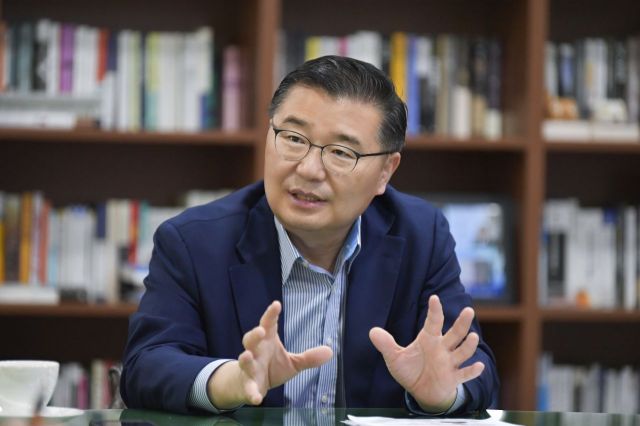
Ryu Gyeong-gi, the mayor of Jungnang-gu, also said, “Once the Myeonmok Line urban railway opens, seven lines including subway lines 1, 6, and 7, the Gyeongui-Jungang Line, the Gyeongchun Line, and GTX B/C lines will be connected, making Jungnang-gu stand tall as the transportation hub of the northeastern area.”
Mayor Ryu expressed expectations that with the passage of the Myeonmok Line preliminary feasibility study (hereafter ‘pre-feasibility study’), Jungnang-gu will become the transportation center of the northeastern area and that this will be a turning point for Jungnang’s development along with the ‘Gangbuk Area Grand Renovation.’
The Myeonmok Line urban railway, which passed the pre-feasibility study on the 5th, is a subway (light rail) line starting from Sinnae Station in Jungnang-gu, passing through Mangu-dong and Myeonmok-dong, and connecting to Cheongnyangni Station in Dongdaemun-gu. The total length is 9.147 km with 12 stations. The project cost alone amounts to 1.0814 trillion KRW.
Seoul Mayor Oh Se-hoon also supported the project, stating, “Since the Myeonmok Line is a core facility of the ‘Gangbuk Area Grand Renovation - Gangbuk Prosperity Era,’ we will actively support the completion of the urban railway axis and the revitalization of regional development.”
The district has made relentless efforts over the past 20 years to promote the Myeonmok Line urban railway. This is because it was judged that convenience in transportation environments promotes urban economic growth and plays an important role in balanced regional development.
In particular, the area around the Myeonmok Line is facing large-scale development such as housing development projects including the designation of Moa Town, the promotion of the Sinnae 4 District housing development project, the confirmed relocation of the SH Corporation headquarters, and complex development targets due to the Gangbuk Grand Renovation (Sinnae Vehicle Depot, Sangbong Terminal, Sangbong and Mangu Station areas).
Accordingly, it was emphasized that proactive measures are needed to prepare for the rapidly increasing transportation demand, which was recognized in this pre-feasibility study.
The district stated that with the passage of the Myeonmok Line pre-feasibility study, the long-standing wishes of local residents will be resolved, and various effects such as convenience in public transportation from the northeastern area to the city center and balanced development are expected.
With the opening of the Myeonmok Line, connectivity among seven major lines including subway lines 1, 6, and 7, the Gyeongui-Jungang Line, the Gyeongchun Line, and GTX-B/C lines will greatly improve. The use of public transportation services that ensure punctuality and safety will make it easier for residents to move within and outside the district, eliminating the railway transportation blind spots in Jungnang-gu upon project completion.
Residents are especially expecting that transportation inconveniences will be greatly improved, accessibility to downtown Seoul will be significantly enhanced, and the area will develop into a transportation hub of the northeastern region.
Also, due to road traffic saturation caused by large-scale urban development in nearby areas such as Byeollae, Galmae, and Dasan, the Myeonmok Line is expected to serve as an alternative transportation means for residents of Sinnae, Mangu, and Myeonmok-dong who have experienced traffic inconveniences, with the railway enabling mass transportation and punctual operation. In particular, improvements in traffic congestion during peak commuting hours are also anticipated.
Moreover, with the establishment of a subway station near ‘Jungnang-gu Office,’ which previously had poor access due to the absence of a subway station, accessibility will improve not only for employees working there but also for residents, enabling more convenient administrative services.
Kim, an employee of Jungnang-gu Office, said, “Many district offices in Seoul, such as those in Dongdaemun-gu, Seongdong-gu, and Gwangjin-gu, have nearby subway stations, making access convenient. In contrast, Jungnang-gu Office has no subway station, causing significant inconvenience.” He added, “Once the Myeonmok Line opens, access to the district office will become much easier for both employees and residents.”
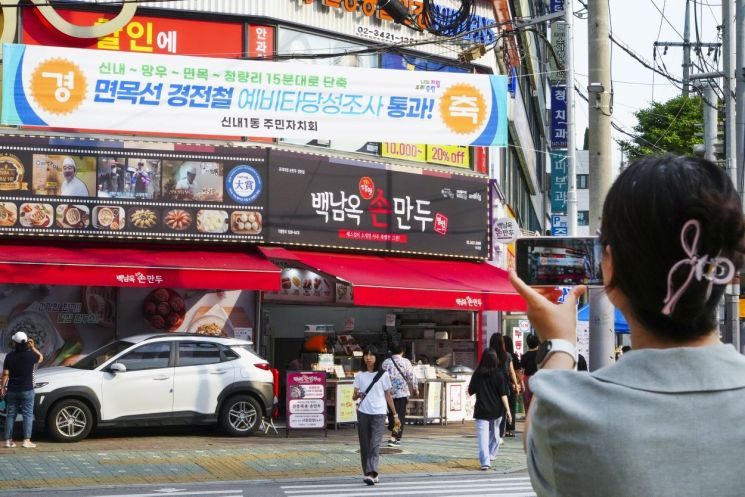
Furthermore, new station areas will be formed along the Myeonmok Line, accelerating regional economic revitalization and development as a transportation hub in the northeastern area.
In particular, with improved accessibility between other regions and Jungnang-gu, revitalization of local commercial districts such as Urim Market and Dongwon Market near the Myeonmok Line is also expected.
Synergistic effects are also anticipated in the creation of a high-tech industrial complex and corporate attraction around Sinnae Station. The Sinnae-dong area is expanding as a new economic center, with two knowledge industry centers located around Sinnae IC, the planned construction of the Jungnang Startup Support Center in Sinnae-dong (targeted for groundbreaking in 2025), and the planned completion of a fashion business advancement and advanced R&D center in Yangwon District by 2026.
The district expects that with smoother transportation and improved corporate accessibility due to the opening of the Myeonmok Line, more companies will be attracted and job creation will increase, leading to regional development.
Along with this, the SH Corporation headquarters relocation project, which reached a final agreement in September 2023, is also expected to gain momentum.
Since the Myeonmok Line requires step-by-step progress including basic planning, design, and construction until its opening, Jungnang-gu stated that it will actively propose to related organizations such as the Ministry of Land, Infrastructure and Transport and Seoul City to expedite the project.
Mayor Ryu Gyeong-gi said, “Once the Myeonmok Line opens, transportation conditions will improve, providing convenient and faster mobility, increasing local floating population, revitalizing the local economy, and creating jobs, thereby injecting vitality into the ever-changing and developing Jungnang-gu.” He added, “By resolving transportation issues ahead of development, we will accelerate regional development plans and projects centered on the Myeonmok Line.”
© The Asia Business Daily(www.asiae.co.kr). All rights reserved.
![Clutching a Stolen Dior Bag, Saying "I Hate Being Poor but Real"... The Grotesque Con of a "Human Knockoff" [Slate]](https://cwcontent.asiae.co.kr/asiaresize/183/2026021902243444107_1771435474.jpg)

















