The business sector and labor sector are engaged in a tug-of-war over whether platform workers should be included as subjects for next year's minimum wage application. While the business sector argues that the Minimum Wage Commission should not deliberate on this matter, the labor sector counters that platform workers should also be included and protected.
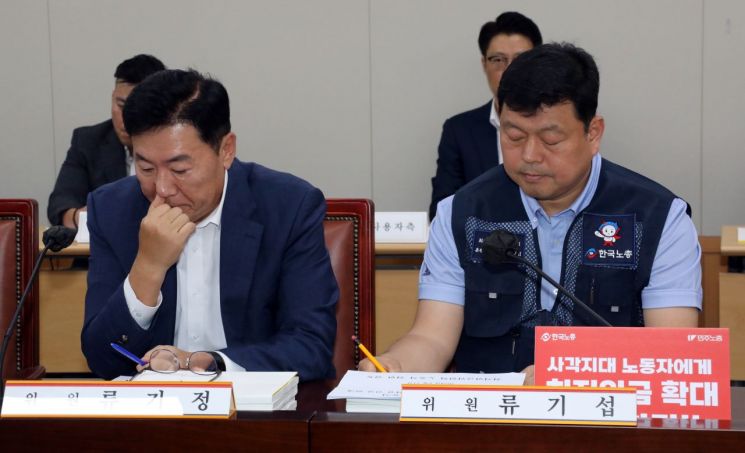 On the afternoon of the 11th, the third plenary meeting of the Minimum Wage Commission, which will deliberate on next year's minimum wage, was held at the Minimum Wage Commission in the Government Sejong Complex. Ryu Ki-jung, Executive Director of the Korea Employers Federation and a user committee operating member (left), and Ryu Ki-seop, Secretary General of the Korean Confederation of Trade Unions and a labor committee operating member, are seated side by side.
 [Photo by Yonhap News]
On the 11th, the Minimum Wage Commission held its 3rd plenary meeting at the Government Complex Sejong to discuss the level and scope of application of next year's minimum wage. During the discussion, the commission did not address the differentiated application of minimum wage by industry or the wage level, but the business and labor sides clashed over the expansion of the scope of application.
The labor sector cited Article 5, Paragraph 3 of the Minimum Wage Act, arguing that subcontracted workers, i.e., platform workers, should be subject to the minimum wage. Article 5, Paragraph 3 of the law states that if wages are generally determined by subcontracting or other similar forms and it is not appropriate to set an hourly minimum wage, a separate minimum wage amount may be set according to the Presidential Decree. Ryu Gi-seop, a worker representative and Secretary-General of the Federation of Korean Trade Unions (FKTU), said in his opening remarks, "In recent years, the proportion of platform and special employment workers has reached a level that cannot be ignored due to the expansion of the labor market base," adding, "Millions of workers are not receiving minimum protection because they are not recognized as workers under the Labor Standards Act." Lee Mi-seon, Vice Chairperson of the Korean Confederation of Trade Unions (KCTU), also submitted court precedents recognizing the worker status of insurance planners, freight drivers, and delivery riders as materials to the Minimum Wage Commission.
On the other hand, the business sector argued that this is beyond the authority of the Minimum Wage Commission. Ryu Ki-jung, Executive Director of the Korea Employers Federation (KEF), stated, "At this point, it is beyond the authority granted by law for the Minimum Wage Commission to decide this," adding, "According to Article 5, Paragraph 3 of the law, the prerequisite for separately determining the minimum wage for a specific subcontracting form is the recognition of its necessity. The entity that recognizes this is the government." The logic is that only after the government first acknowledges the necessity of minimum wages for platform workers can the Minimum Wage Commission discuss minimum wage issues related to platform workers.
The discussion ended without a conclusion as the business sector decided to request additional review from the government. Future discussions are expected to proceed after further legal review. However, even if the Minimum Wage Commission concludes that it can discuss the minimum wage for platform workers, it is anticipated that the business and labor sectors will clash over whether it will actually be addressed in this year's deliberations.
© The Asia Business Daily(www.asiae.co.kr). All rights reserved.

















