Claudia Sheinbaum, elected as Mexico's first female president in history, announced plans to pursue constitutional amendments including the direct election of judges. Concerns over the constitutional amendments among investors have led to a continued decline in the value of the Mexican peso.
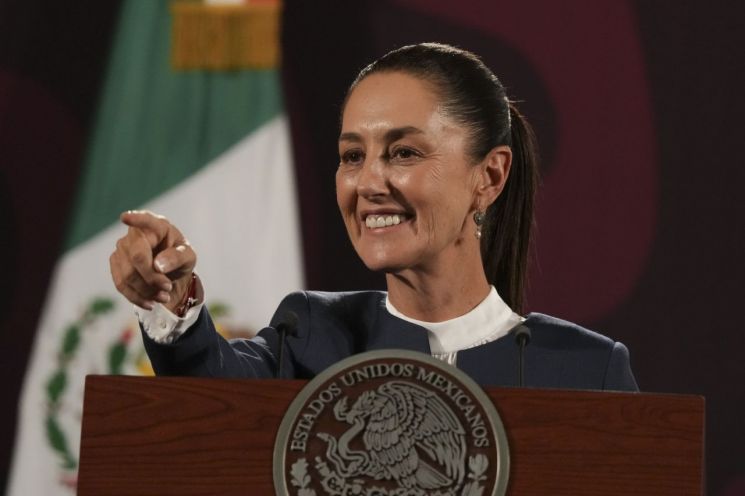
According to Bloomberg and other sources, Sheinbaum held her first press conference since her election on the afternoon of the 10th (local time) at the Mexican Presidential Palace, stating, "The proposal to reform the judicial system will be the first to be discussed in the new Congress," and added, "There must be broad discussions starting several months before the new Congress begins (in September)."
Prior to the press conference, Sheinbaum had lunch with her "political mentor," President Andr?s Manuel L?pez Obrador, confirming that these reforms are intended to continue the policy direction of the current administration.
The direct election of judges, which had faced strong opposition mainly from the judiciary and opposition parties, is a representative example. The constitutional amendment including the direct election of judges has been regarded as a long-standing goal of the L?pez Obrador administration. Sheinbaum also confirmed that reforms such as civil servant pension reform and a ban on re-election for public officials will be pursued primarily. She added that the controversial regulatory agency consolidation reform, which has raised significant concerns among investors, may be discussed at a later time.
Major foreign media have pointed out that discussions on minimum wage increases, bans on genetically modified corn, and independent sector regulatory agencies are also on the table in relation to these constitutional amendments, some of which may potentially violate the USMCA, the trilateral trade agreement with the United States and Canada. Carlos Serrano, chief economist at BBVA Mexico, expressed concern, saying, "Uncertainty and volatility are inevitable as long as it is unclear how judicial reform will be implemented."
The financial market is already showing signs of increased uncertainty. This is due to concerns that constitutional amendments and various policies, which had been blocked by opposition parties, may be pushed through in the next Congress. Despite Senate Majority Leader Ricardo Monreal stating this morning that market considerations will be taken into account during constitutional amendment discussions, investor concerns have not eased. Earlier, President L?pez Obrador, Sheinbaum’s political mentor, remarked last week regarding the uncertainties pointed out by investors that "justice is more important than the market."
Moreover, in this election, the ruling party in Mexico, the National Regeneration Movement (MORENA), along with the Green Party and the Labor Party left-wing coalition, secured the constitutional amendment threshold in the lower house. Although the Senate has not reached the constitutional amendment threshold, it is possible to pursue amendments if centrist votes are attracted. The media reported that "investor concerns have intensified over the possibility that reforms weakening the checks and balances of Congress could be passed."
The Mexican peso, which had shown strength over the past few years, has been on a downward trend for more than a week following the presidential election. Immediately after Sheinbaum’s remarks regarding constitutional amendments were made public, the peso lost nearly 2% against the dollar. In the Asian foreign exchange market, the peso traded around 18.58 pesos per dollar. Considering that it was 17.01 pesos per dollar on the 30th of last month, just before the election, the currency has depreciated by more than 8%.
Gabriela Schiller, an economist at Banco de M?xico, said, "The market was expecting Sheinbaum to distance herself from President L?pez Obrador," and predicted, "With the pursuit of various reforms including constitutional amendments, the peso exchange rate could surge to 20 pesos per dollar (currency depreciation)." Miguel Iturriaga, a strategist at BBVA Mexico, also diagnosed, "If such rhetoric continues in the short term, the peso will remain unstable," adding, "We can see risk premiums rising not only for the peso but also in other regions."
However, Sheinbaum drew a line, stating that these reforms will not affect market volatility, including the value of the peso. She announced plans to appoint her cabinet next week. On the 11th, she is scheduled to meet with a delegation from U.S. President Joe Biden’s administration. Sheinbaum will be inaugurated on October 1.
© The Asia Business Daily(www.asiae.co.kr). All rights reserved.
![Clutching a Stolen Dior Bag, Saying "I Hate Being Poor but Real"... The Grotesque Con of a "Human Knockoff" [Slate]](https://cwcontent.asiae.co.kr/asiaresize/183/2026021902243444107_1771435474.jpg)
















