Hankyung Association Issues Report Highlighting Problems
Business Community Focuses on Possible 'Criminal Liability for Breach of Fiduciary Duty'
Legal Sector Says "'Proportional Benefit of Shareholders' Concept Is Ambiguous"
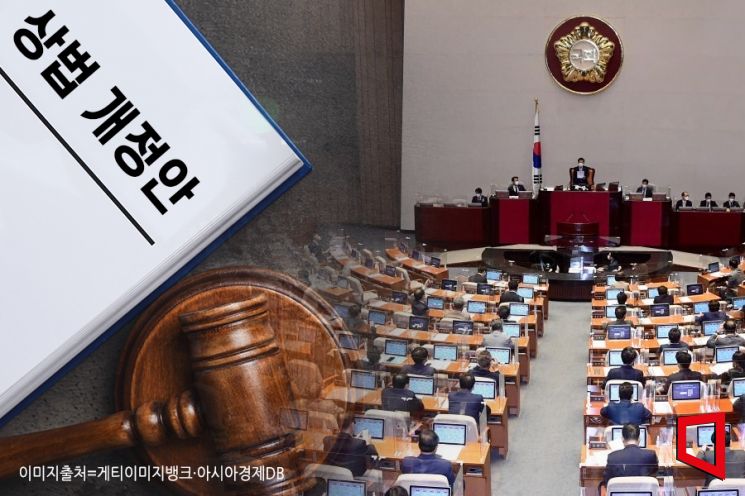
As the amendment to the Commercial Act, which stipulates the duty of directors to faithfully consider the proportional interests of shareholders, begins the legislative process in the National Assembly, concerns continue to mount in the business community.
According to the business community on the 11th, the Korea Economic Association disclosed a research report commissioned from Professor Kwon Jae-yeol of Kyung Hee University Law School the day before, pointing out the problems of the amendment. In the report, Professor Kwon stated, "The amendment to the Commercial Act will cause confusion in the legal system and corporate management." Under the provisions of our Civil Act and Commercial Act, directors are considered agents who have entered into a mandate contract with the company, and their duty of loyalty should be owed only to the company. He further emphasized that it is practically impossible for directors to reconcile the diverse demands of shareholders into one. He also predicted that cases of directors being sued for damages on the grounds of breach of duty of loyalty by shareholders would become rampant. If directors try to cater to each shareholder's preferences, the power of each shareholder will increase, undermining the 'capital majority rule' where shareholders with a higher investment ratio hold management rights. He also pointed out that in major countries such as the United States (Model Business Corporation Act), the United Kingdom, Japan, Germany, and Canada, company laws limit the duty of loyalty of directors to the company, and there are no legislative examples stipulating a duty of loyalty to shareholders' interests.
There are many concerns in the business and legal communities that this could be grounds for 'criminal punishment.' If it is judged that a director has not properly fulfilled their duty of loyalty, shareholders can file a criminal complaint against the director for breach of trust. Subsequently, the prosecution can investigate the complaint and bring the case to trial. In such cases, not only the director but also the company to which the director belongs could face 'judicial risks.'
There is debate over the 'proportional interests of shareholders' that directors must faithfully consider. The concept is still vague and not commonly accepted, which is pointed out as a problem. This concept first emerged in the SM Entertainment stock manipulation case. In February last year, SM held a board meeting to approve the allocation and issuance of new shares and convertible bonds, and on the same day, signed a contract with Kakao to purchase new shares and convertible bonds worth 217.2 billion won, causing significant losses to shareholders. The Seoul Eastern District Court ruled in a provisional injunction lawsuit related to this case that "the decision of the SM board of directors infringed on the proportional interests of shareholders." Experts regard this as the first precedent using the term 'proportional interests of shareholders.'
Attention is also focused on whether bills restricting corporate management activities will be consecutively proposed in the 22nd National Assembly, starting with this amendment to the Commercial Act. In the political sphere, there is speculation about the possible reintroduction of the 'Yellow Envelope Act.' Following the recent first-ever strike by the National Samsung Electronics Labor Union since the company's founding, demands for expanding union rights and guaranteeing collective bargaining rights have increased, leading to expectations that the opposition party will move to reintroduce this bill, which was discarded in the previous National Assembly. The Yellow Envelope Act aims to limit companies from claiming damages caused by labor disputes of company labor unions. Companies are concerned that this could grant unions impunity for illegal actions and lead to rampant strikes and assemblies.
© The Asia Business Daily(www.asiae.co.kr). All rights reserved.

















